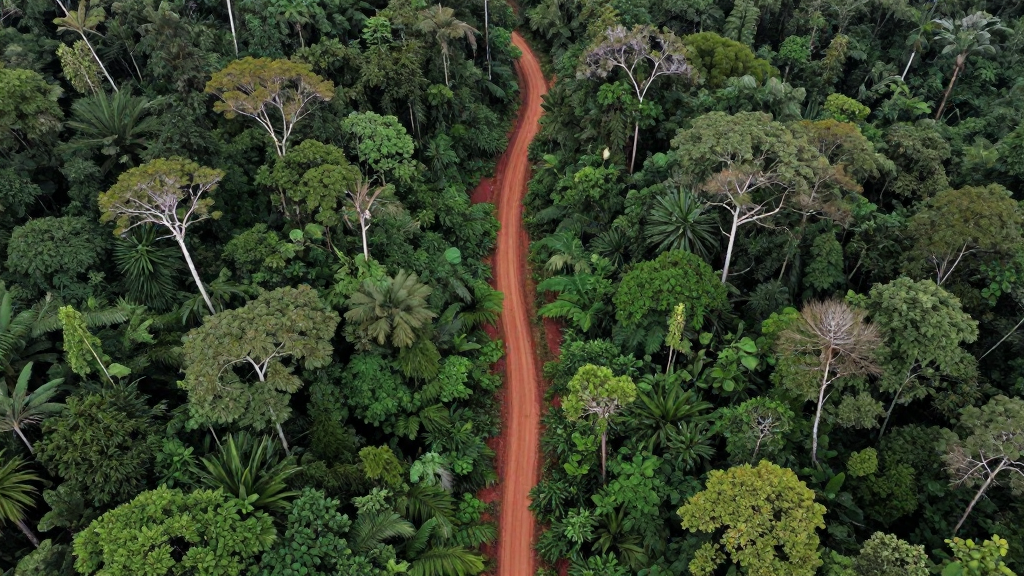
Brazil’s Supreme Court delivered a sweeping ruling Tuesday that halts a controversial $75 million highway project through one of the Amazon’s most pristine stretches of rainforest, a decision that environmental advocates are calling the most significant judicial intervention to protect the Amazon in a generation.
A Road That Could Alter the Planet
The ruling freezes work on the BR-319 highway, a crumbling 870-kilometer artery connecting Manaus, the Amazon’s sprawling jungle capital, to the southern grid of Brazil. The project had drawn fierce opposition from scientists who say paving the route will open a vast territory to land-grabbers and cattle ranchers, accelerating deforestation in a forest that absorbs roughly five percent of global annual carbon emissions.
Philip Fearnside, a senior scientist at Brazil’s National Institute for Research in Amazonia who has studied the region for four decades, said the highway represents a potential tipping point for the entire ecosystem. “When the roads are open, people just move in,” Fearnside said. “In the Amazon, people go into these areas and invade the land or claim it, even if they are not actually there, and resell it, and it gets deforested.”
The Scientific Warnings Fall on Deaf Ears
The government of President Luiz Inácio Lula da Silva has defended the project as essential for connecting isolated communities and spurring economic development in the Amazon’s neglected northern states. Officials argue the project includes environmental safeguards, including a 50-kilometer monitoring zone on either side of the highway and checkpoint stations to deter illegal clearing.
Fearnside dismissed those protections as inadequate. “Fifty kilometers on each side is just minuscule compared to the area that is being opened up,” he said. “You are opening up a huge area of Amazon forest deforestation, and that has global impacts. Global climate is very near a tipping point where warming gets out of human control, and a key part of that is exactly this area.”
The highway passes through what scientists call the “arc of deforestation,” a zone where land-clearing has accelerated sharply over the past decade. Brazil’s own space research agency, INPE, has recorded an alarming surge in forest loss within 50 kilometers of the existing roadbed, even before paving begins.
Forty Years of Broken Promises
Successive Brazilian governments have pledged to protect the Amazon while simultaneously greenlighting infrastructure projects that fragment the forest. The BR-319 has a notorious history: land-grabbers stripped thousands of acres of adjacent forest during a brief window of construction activity in the 1970s, and satellite imagery shows those scars persist today.
The Supreme Court agreed to hear four separate petitions challenging the project’s environmental licensing, after advocacy groups submitted satellite analysis showing the highway corridor harbors more than 2,000 species of birds, mammals and reptiles, many found nowhere else on Earth.
“These are big operators that claim big areas of government land, and then they often get titles to it,” Fearnside explained. “They use legal pathways to do this, then resell it to cattle ranchers, and it gets deforested. That is a vicious circle because the more people get rewarded for invading these areas, the more and more people come and invade more areas.”
Whether the ruling survives appeal or the justices allow limited construction to resume remains uncertain. The court’s next hearing is scheduled for mid-July.
The case has drawn international attention beyond the environmental community. The United Nations Environment Programme filed an amicus brief warning that approving the highway could undermine Brazil’s commitments under the Paris Agreement and trigger a formal review by the Green Climate Fund, potentially freezing billions of dollars in climate financing earmarked for Amazon conservation. European Union diplomats have separately warned that continued deforestation could jeopardize the EU-Mercosur trade deal, already hanging by a thread over environmental provisions.
For the roughly 50,000 residents of communities along the BR-319 route, the Supreme Court ruling offers temporary relief but no certainty. Many have lived without reliable road access for years, relying on expensive river transport or expensive airlifts for basic goods and medical emergencies. Local leaders have appealed to the court to allow construction of a basic all-weather road while protecting the surrounding forest — a compromise the government says it is willing to explore if the court gives it room to negotiate.