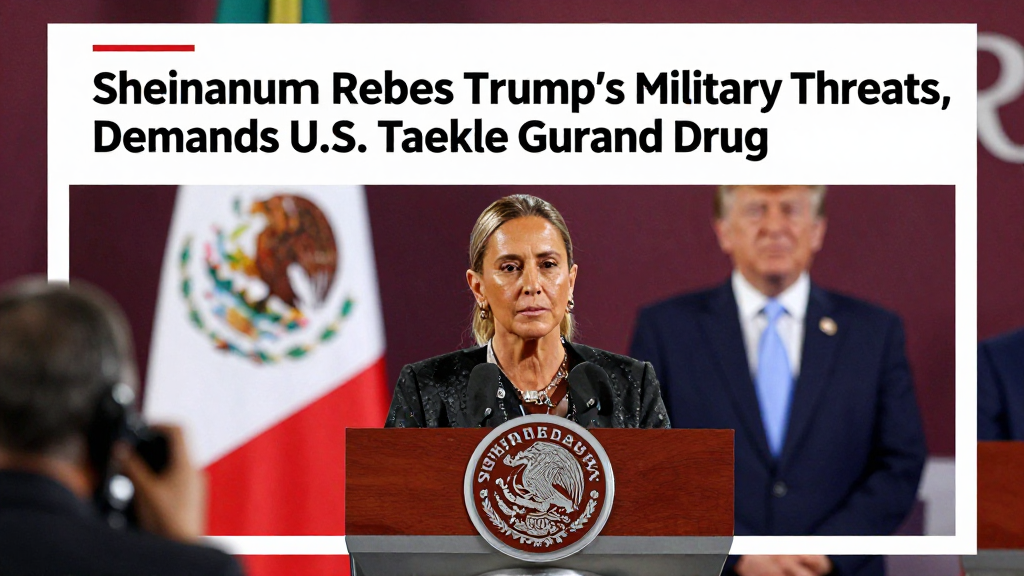
MEXICO CITY — Mexican President Claudia Sheinbaum delivered a forceful rebuttal on Monday to President Trump’s escalating threats to use U.S. military force against drug cartels operating on Mexican soil, telling Washington to address domestic drug demand and stop illegal arms trafficking before pointing fingers abroad.
Speaking at her daily morning press conference at Palacio Nacional, Sheinbaum cited U.S. Department of Justice data showing that 75 percent of weapons used by criminal groups in Mexico are smuggled from the United States, arguing that choking off the supply of American guns would deal a far greater blow to cartels than any military operation.
Sheinbaum’s Sharp Rebuke
“If the flow of illegal weapons from the United States into Mexico were stopped, these groups would not have access to this type of high-powered weaponry to carry out their criminal activities,” Sheinbaum said, her voice cutting through what her office called a deliberate display of calm resolve.
The Mexican leader has maintained a strategy of keeping a “cool head” throughout weeks of escalating rhetoric from Washington, refusing to be drawn into tit-for-tat exchanges while privately working diplomatic channels. But Monday’s statement marked one of her sharpest direct rebuttals yet.
“We will not accept any action that violates our national sovereignty,” she told reporters. “Dialogue and cooperation are the only viable paths.”
The Counter Cartel Coalition
Trump announced the formation of a new Americas Counter Cartel Coalition at a weekend summit at his golf club outside Miami, gathering right-leaning leaders including Argentina’s Javier Milei and El Salvador’s Nayib Bukele. Notably absent from the guest list were the left-leaning presidents of Brazil, Colombia, and Mexico — the three most populous nations in Latin America.
At the summit, Trump took direct aim at Sheinbaum, praising her voice before adopting a mocking falsetto to mimic her refusal of military assistance. “No. No. No. Please president,” he said to laughter from the assembled delegates. “We must recognize that the epicenter of cartel violence is Mexico,” Trump added, warning his administration would “do whatever is necessary to defend our national security.”
The White House has pointed to the recent killing of Jalisco New Generation Cartel leader Nemesio “El Mencho” Oseguera Cervantes — confirmed dead in a Mexican special forces raid in late February — as evidence that its pressure campaign is producing results. Mexico’s federal government confirmed the operation in early March.
Mexico’s Own Crackdown
Responding in part to sustained U.S. pressure, Mexico has intensified its own counter-cartel operations over the past year, arresting hundreds of trafficking suspects, destroying clandestine drug labs, and extraditing alleged cartel operatives to American courts. Sheinbaum’s government insists it has acted decisively within its own legal framework, without foreign boots on the ground.
The diplomatic standoff comes as the two economies remain deeply intertwined. Mexico runs a significant trade surplus with the United States, and sectors from automotive manufacturing to agriculture depend on cross-border supply chains that neither side has appetite to disrupt for long. Analysts say both governments have strong incentives to find an off-ramp from the current confrontational posture.
But the immediate trajectory points toward continued friction. The White House has signaled additional sanctions against cartel-linked financial networks, while Mexico City has lodged formal complaints through diplomatic channels and called for an emergency session of the Organization of American States. Neither side has ruled out further escalation.
For millions of Mexicans caught between cartel violence and the sovereignty debate, the real question is not who wins the diplomatic battle — it is whether ordinary citizens will pay the price of a geopolitical showdown neither government seems willing to back away from.
The killing of El Mencho in late February sent shockwaves through criminal networks across the hemisphere, triggering retaliatory arson attacks in the town of Etzatlán where he was cornered. At least nine people were killed in the aftermath, underscoring how deeply the cartels have embedded themselves in Mexican civic life.