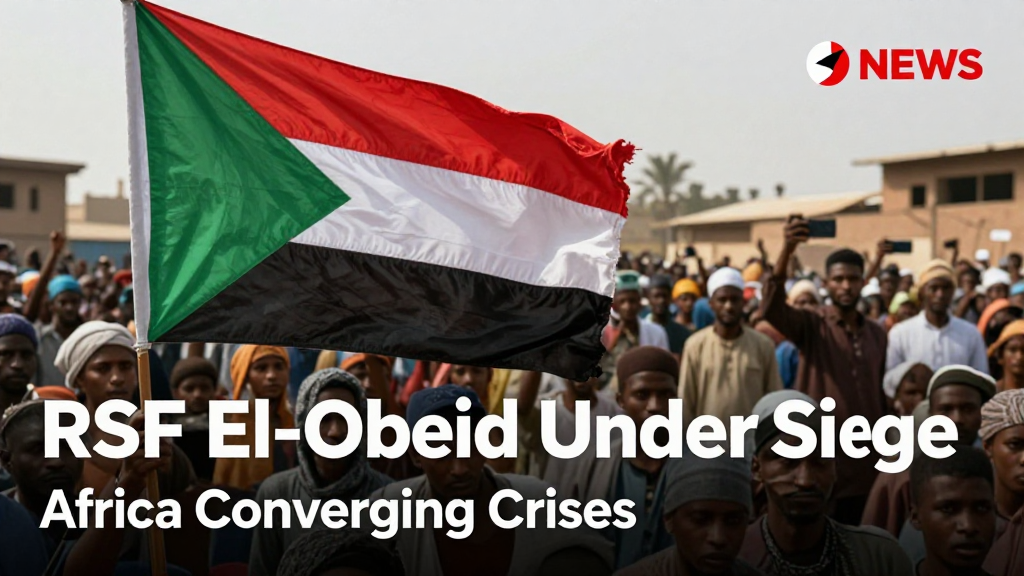
EL OBEID, Sudan — The strategic city of El Obeid was under near-encirclement on Wednesday as Sudan paramilitary forces pressed their advance toward the key north-central hub, triggering urgent warnings from the United Nations that thousands of civilians face catastrophic risk if fighting reaches full intensity. The city of roughly 600,000 people sits at the crossroads of the road networks linking Khartoum to Darfur and Kordofan, making its fate pivotal to the broader trajectory of a war now in its third year.
North Africa: El Obeid Under Siege as RSF Closes In
The Rapid Support Forces have been massing outside El Obeid, capital of North Kordofan state, for weeks in one of the most sustained assaults since the civil war erupted in April 2023. Drone strikes have intensified in recent days, hitting civilian infrastructure and disrupting the primary aid corridor into the city, according to the UN Secretary-General’s Personal Envoy for Sudan, Pekka Haavisto.
“We are alarmed of the ongoing hostilities around the city, including frequent drone strikes,” Haavisto told reporters at UN Headquarters. “These are already affecting the civilians and affecting humanitarian aid to the city. Any further escalation would place thousands of people at risk.”
The warning echoes alarms previously raised over El Fasher, the capital of North Darfur, where RSF attacks triggered accusations of ethnic cleansing documented by Amnesty International. Human rights groups warn El Obeid risks becoming a repeat of that catastrophe, with entire neighborhoods already without electricity and hospitals reporting critical shortages of surgical supplies.
West Africa: Burkina Faso Severs France Ties as Regional Tensions Mount
West Africa is confronting overlapping security and diplomatic shocks. Burkina Faso formally severed diplomatic relations with France, expelling the ambassador and closing the French cultural institute and military bases as it deepens its strategic partnership with Russia. The move follows years of growing anti-French sentiment across the Sahel, where coup-led governments have systematically expelled French forces and welcomed Russian military contractors.
Nigeria faces compounding crises: a new wave of school kidnappings that drew international condemnation, flooding that has killed at least 30 people across the north, and communal violence in Plateau State that left a village pastor and his family burned alive. The country declared a national security emergency even as its military struggles to contain multiple simultaneous fronts. Ghana, meanwhile, is managing its own political turbulence as opposition parties mass for a constitutional showdown over disputed electoral reforms.
Central Africa: Ebola Declared Continental Emergency as Rwanda Standoff Worsens
The Democratic Republic of Congo is battling a spiraling Ebola outbreak that has killed more than 370 people across four provinces. The Africa CDC declared it a continental health emergency, activating emergency protocols and deploying rapid-response teams. Healthcare workers in Haut-Uele province report entire villages sealed off by both disease and violence, making treatment and contact tracing nearly impossible.
The legal standoff between the DRC and Rwanda at the International Court of Justice has intensified. Kinshasa filed a landmark case accusing Kigali of orchestrating the M23 rebellion through direct military and logistical support. Rwanda denies the accusations but has escalated military operations inside DRC territory, with M23 fighters pushing toward the eastern city of Goma for the first time in months, alarming regional powers and the UN mission stationed there.
East Africa: Kenya Police Fire on Protesters as Uganda Shuts Media
Kenya’s Gen Z protest movement, which has demanded systemic governance reform for more than two years, held its largest anniversary demonstration yet, drawing tens of thousands to Nairobi streets. Police deployed water cannon and live ammunition, killing at least three people and injuring dozens more. The Kenya National Commission on Human Rights documented systematic beatings of protesters in custody, while the UN High Commissioner for Human Rights called for an independent investigation.
In Uganda, the military occupying the Nation Media Group headquarters issued explicit threats against journalists, warning that any staff remaining on the premises would face arrest on sight. Reporters Without Borders confirmed the military action has silenced the country’s most-read independent news outlet. Uganda has detained at least 14 journalists this year, according to CPJ, in what observers describe as the most aggressive media crackdown since the Museveni government’s early years.
Southern Africa: South Africa Anti-Migrant Fury as Region Braces for Exodus
South Africa is facing its worst anti-foreign sentiment crisis in years. June 30 anti-migrant demonstrations erupted across Johannesburg, Cape Town, and Pretoria, with mobs targeting shops and residences owned by nationals from Malawi, Mozambique, and Zimbabwe. At least eight people were killed and more than 200 arrested. The Southern African Development Community issued a rare joint statement condemning the violence and warning of mass displacement across the sub-region.
The South African government deployed 2,500 soldiers to major cities, the largest domestic troop deployment since the 2010 World Cup. Malawi and Mozambique began airlifting their citizens out of South Africa, and Zimbabwe announced emergency consular operations in Johannesburg. Analysts warn the violence could destabilize the region’s already fragile migration architecture and strain diplomatic ties for years to come.
The converging crises have placed the African Union under mounting pressure. With its peace fund depleted by simultaneous deployments to Somalia, the Sahel, and the DRC, the continental body has struggled to issue more than rhetorical statements. The El Obeid assault, if it succeeds, would give the RSF effective control of the road network connecting Khartoum to Darfur and Kordofan, a strategic prize that could reshape the balance of power across Sudan and beyond.