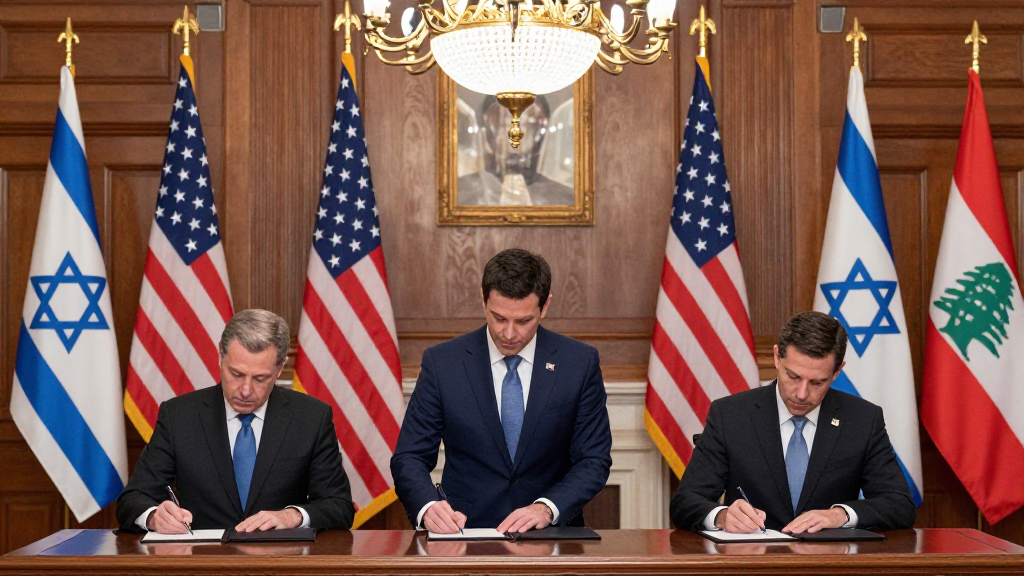
Israel and Lebanon signed a United States-brokered framework agreement on Friday, June 26, establishing a phased roadmap toward ending years of hostilities along their shared border, though implementation faces immediate opposition from Hezbollah and deep skepticism from analysts who question whether the deal can survive first contact with the realities on the ground.
Signed in Washington, D.C. by Israeli Ambassador to the United States Yechiel Leiter and Lebanese Ambassador to the United States Nada Hamadeh Moawad, with Secretary of State Marco Rubio presiding, the agreement lays out a two-track process under which Israel would begin withdrawing from positions it currently holds inside Lebanon, and the Lebanese Armed Forces would gradually assume security responsibility in those areas. The framework stops short of a full peace treaty and explicitly acknowledges that the disarmament of Hezbollah remains the central unresolved question.
“Today we’ve taken the first step in what will be a difficult journey, without a doubt, but an important and an essential and a necessary one,” Rubio said at the ceremony. His remarks underscored the administration’s effort to manage expectations, presenting the agreement as a beginning rather than an endpoint.
Hezbollah Vows to Block Disarmament
Hezbollah, the Iranian-backed militant and political movement that has controlled southern Lebanon for decades, condemned the framework within hours of its signing. The group, which opened a parallel front against Israel following the Hamas-led October 7 attacks, insisted it would not surrender its weapons and would treat any Lebanese army units that moved to replace it as adversaries.
The framework agreement requires Hezbollah’s armed units to be disarmed as a precondition for a full Israeli withdrawal. Senior Lebanese officials have acknowledged privately that compelling the group to give up its weapons would require either a political consensus that does not currently exist or a use of force that the Lebanese Armed Forces is neither equipped nor willing to undertake.
Yechiel Leiter, Israel’s ambassador, struck a defiant tone during the signing ceremony. “Iran is out, Hezbollah is out, and the road to peace between Israel and Lebanon is in,” he said. “Final destination: peace between our two countries, real peace, where both countries will live in security, where Israel’s and Lebanon’s sovereignty will be respected, honored and protected.”
Regional Context and the Iran Dimension
The framework agreement emerged against the backdrop of a separate U.S.-Iranian negotiation that resulted in a 60-day ceasefire roadmap announced the same week. That deal, which left Israel outside its scope, created friction between Jerusalem and Washington, according to officials briefed on the talks. Israel has described terms that leave it exposed, particularly regarding the northern border where Hezbollah’s rocket arsenal remains largely intact.
Critics within the Israeli defense establishment have argued that the framework repeats a structural flaw present in UN Security Council Resolution 1701, which ended the 2006 Lebanon War: demanding Hezbollah’s disarmament without assigning enforcement authority capable of delivering it. A senior Israeli official told the Axios news outlet that Israel would “maintain its security zone within the borders of the Yellow Line in Lebanon until the day when Hezbollah and the other terrorist organizations in Lebanon are disarmed and there is no longer a threat from the territory of Lebanon.”
The agreement’s 14-point framework does not specify what happens if Hezbollah refuses to comply, nor does it establish a mechanism for verifying disarmament. The Lebanese government, which is itself divided on the terms, has insisted that implementation proceed gradually and without confrontation.
Political Opposition in Beirut
Demonstrations erupted in Beirut and southern Lebanon within 48 hours of the signing. Opponents, including factions allied with Hezbollah and independent critics, called the agreement a surrender of Lebanese sovereignty that granted Israel international legitimacy for its ongoing occupation while leaving the root cause of the conflict unresolved.
Regional analysts have noted that the framework’s success or failure will depend heavily on whether the Lebanese Armed Forces can establish credible control in areas currently under de facto Hezbollah administration. The force has received increased U.S. military assistance in recent years, but observers say it remains a conscript-based army with limited capacity for the kind of counter-insurgency operations that full implementation would require.
The framework is set to enter a pilot phase in which the first areas of Israeli withdrawal would be identified jointly by American, Lebanese, and Israeli officials. A full diplomatic conference to finalize the terms of a permanent peace agreement is expected to follow, though no date has been set.