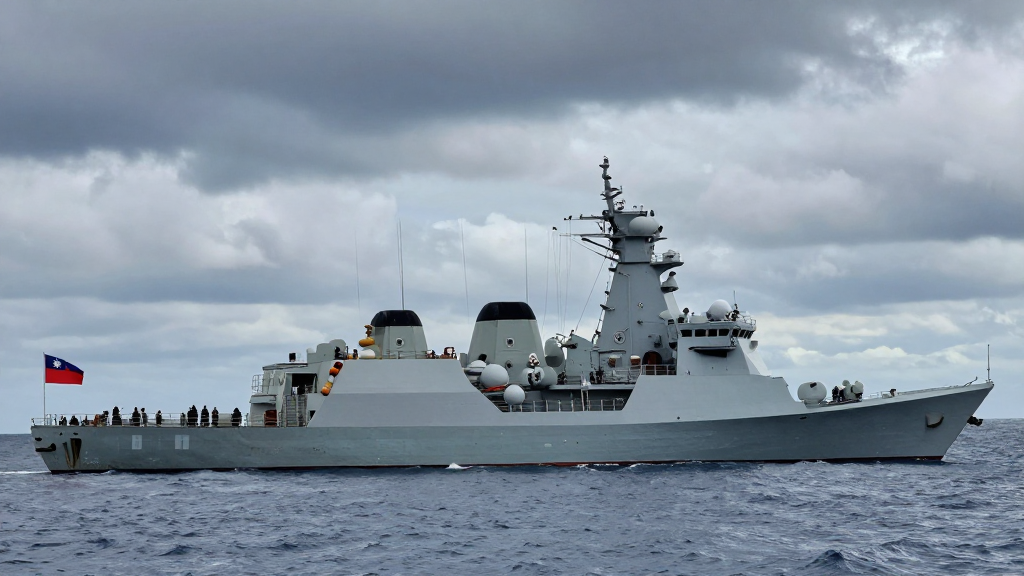
Taiwan has instructed its commercial vessels to refuse any boarding or inspection demands from China’s Coast Guard in waters off the island’s east coast, issuing its most direct maritime directive in years and marking a sharp escalation in the gray-zone competition between Beijing and the self-governed island. The move signals Taipei’s determination to push back firmly against what it characterizes as an ongoing campaign to erode its administrative control of surrounding waters through the steady, deniable pressure of law enforcement vessels rather than naval warships. The directive also marks the first time Taipei has explicitly told its private shipping sector to disregard Chinese enforcement demands, raising the stakes in a confrontation that has quietly been building for more than a year.
Taipei Issues Directives; Coast Guard Vessels on Standby
Taiwan’s Coast Guard Administration directed all vessels operating in its waters not to comply with Chinese boarding or inspection requests and said patrol ships are prepared to physically interpose themselves between Chinese and Taiwanese vessels to prevent boarding attempts. Officials said the order reflected a more assertive posture than any seen since the early 2000s, reinforcing Taiwan’s position that China has no jurisdiction in waters it administers. The guidance comes after China deployed Coast Guard vessels to Taiwan’s eastern waters as part of what Beijing described as a routine maritime law enforcement operation — a characterization Taipei and several Western governments have rejected as an attempt to normalize Chinese authority in contested areas. Taiwan’s top maritime security body also said it would take all necessary measures to curb what it called China’s unreasonable actions in waters around the Dongsha Islands, the Pratas group that lies roughly 250 miles southwest of Taiwan and is administered by Taipei despite being claimed by Beijing.
Beijing’s Expanding Maritime Enforcement and the Gray-Zone Calculus
China’s coast guard has steadily expanded its operational footprint around Taiwan’s outlying islands over the past eighteen months, officials in Taipei say, moving from occasional transits to more than thirty incidents annually near the Pratas Islands alone. Analysts describe the tactics as part of a deliberate gray-zone strategy designed to erode Taiwan’s administrative control without triggering the kind of military response that would invoke mutual defense obligations. “By employing law enforcement vessels instead of naval ships, China is able to exert pressure below the threshold of direct military confrontation while steadily reinforcing its territorial claims,” one defense analyst told Newsweek. The approach also enables Beijing to test resolve in Taipei, Washington, and allied capitals simultaneously, observers say. Taiwan’s Ocean Affairs Council has responded by securing more than $935 million in special budget funding to acquire forty new patrol vessels and upgrade maritime surveillance systems, according to Nikkei reporting. Separately, a Chinese research vessel refused a Taiwanese coast guard warning near the southern Eluanbi Peninsula in May by responding: “There is no Republic of China, only the People’s Republic of China.”
Regional Ripples and the Stakes for Commercial Shipping
Although no Taiwanese vessels were boarded during the recent Chinese patrols, commercial ships were questioned by Chinese authorities about their routes and destinations — raising concerns over the security and predictability of regional shipping through waters Beijing increasingly claims as its own. The dispute illustrates how competition between Beijing and Taipei is increasingly being played out through coast guard operations and civilian maritime enforcement rather than military deployments alone. Washington has been closely tracking the developments. China, for its part, has maintained that the waters surrounding Taiwan fall under its jurisdiction and has rejected international criticism of its maritime enforcement operations as interference in its internal affairs. Analysts warn that without a coordinated allied response, Beijing’s coast guard activities risk becoming an established feature of the regional maritime environment — one that is far harder to roll back than a naval buildup, and one that fundamentally alters the operating assumptions on which Taiwan’s civilian shipping has relied for decades.