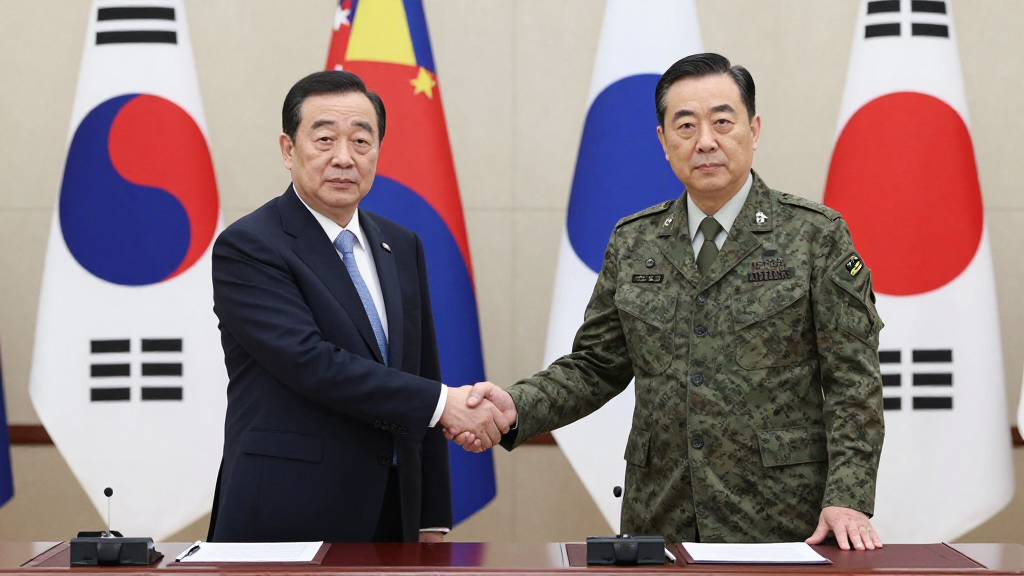
South Korea and Japan took their most consequential step toward military integration in decades Sunday, signing a landmark acquisition and cross-servicing agreement in Seoul that grants each country’s armed forces reciprocal access to the other’s bases, training areas, and sustainment chains. The deal — concluded during Japanese Defense Minister Shinjiro Koizumi’s two-day visit to South Korea — was hailed by both governments as a generational turning point in their security relationship and as a direct response to an accelerating strategic environment across the Indo-Pacific.
The agreement, known as an ACSA, allows the Japan Self-Defense Forces and the Republic of Korea Armed Forces to share fuel, ammunition, food, and logistical support without separate bilateral negotiations for each instance of cooperation. It was signed on the sidelines of broader defense talks where the two ministers also regularized reciprocal visits — effectively restoring shuttle diplomacy between defense authorities that had been suspended since 2015 — and welcomed the resumption of a bilateral maritime search and rescue exercise for the first time in nine years.
From Shuttle Diplomacy to Operational Integration
The Koizumi visit marked the first time a Japanese defense minister had traveled to South Korea primarily for bilateral talks in more than a decade. South Korean Defense Minister Ahn Gyu-back described the ACSA as the physical expression of a broader strategic alignment that had been building for years. “Cooperation should continue to preserve regional peace and stability amid an increasingly difficult security environment,” the two ministers said in a joint statement. The Black Eagles aerobatic team from South Korea and Japan’s Blue Impulse will now conduct regular joint flyovers, following South Korean aircraft receiving refueling support from the Japan Air Self-Defense Force at Naha Air Base in January — a first in the history of the two air forces.
Beyond logistics, the ministers agreed to expand cooperation in artificial intelligence, cybersecurity, and advanced defense technology. South Korea, which hosts roughly 28,500 US troops and is party to a trilateral intelligence-sharing arrangement with Washington and Tokyo, is increasingly positioning itself as a connective node in a networked Indo-Pacific deterrence architecture. The ACSA now makes that operational.
Regional Alliances Converge Around a Common Axis
The Seoul breakthrough landed within a broader pattern of Indo-Pacific nations reorganizing their security relationships around shared concerns over China’s assertiveness. On June 1, the Philippines and Vietnam elevated their bilateral alliance to an enhanced strategic partnership in Manila, with President Ferdinand Marcos Jr. and Vietnamese President To Lam jointly declaring that peace and stability in the South China Sea is “non-negotiable.” The two countries renewed their 2010 defense cooperation agreement covering maritime security, military education, and disaster risk reduction — and committed to jointly upholding the 2016 arbitral ruling that invalidated China’s sweeping “nine-dash line” claim under international law.
Separately, Japan and Australia formalized their own deepening defense ties on May 4 in Canberra, with Prime Ministers Sanae Takaichi and Anthony Albanese signing agreements that analysts described as introducing “strategic depth” — a term that alludes to Japanese forces potentially moving to Australian territory in a crisis, enabling force dispersal and secure logistics in the event of a high-intensity regional conflict. Japan, which lacks geographic space and faces acute missile threats, would benefit from Australia’s vast territory for force dispersal and joint weapons testing, experts said. Both nations also pledged closer cooperation on cyber defense and critical mineral supply chains.
China and North Korea Frame the Strategic Backdrop
Beijing has responded with characteristic bluntness. China’s Ministry of Foreign Affairs said the series of agreements represented a “Cold War zero-sum mentality” that would destabilize regional peace. North Korea’s state media accused Washington of using the alliance system to encircle China and warned of unspecified countermeasures. Neither statement addressed the specific provisions of the ACSA or the Philippines-Vietnam enhanced partnership.
The strategic realignment unfolding across the Indo-Pacific is increasingly defined not by any single bilateral relationship but by the density of interconnections between nations that share a common assessment of the regional threat environment. The ACSA between South Korea and Japan is the latest — and perhaps most operationally significant — node in that emerging architecture.