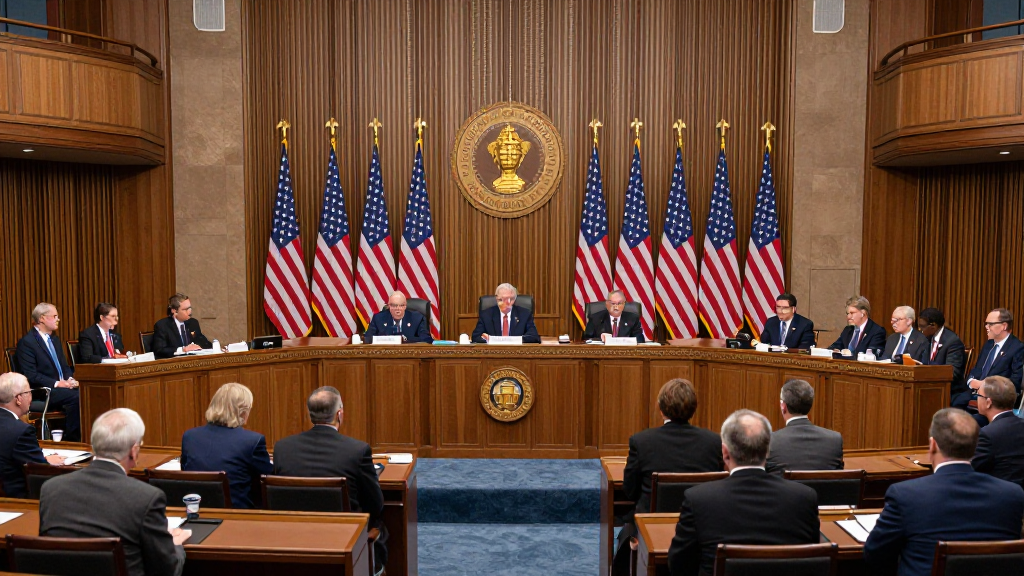
WASHINGTON — The United States Senate passed a sweeping $886 billion defense authorization bill on Thursday, allocating record funding toward countering China’s growing military reach in the Indo-Pacific theater while simultaneously expanding air defense capabilities for NATO allies facing Russian aggression in Eastern Europe. Congressional staff expect the conference process to extend into late summer.
Record Indo-Pacific Spending and Taiwan Deterrence
The bill, formally known as the National Defense Authorization Act for Fiscal Year 2027, passed by a vote of 87 to 13, reflecting rare bipartisan consensus on the strategic priorities laid out in the legislation. The legislation authorizes $61.4 billion for the Pacific Deterrence Initiative, a $4.7 billion increase from the previous fiscal year, aimed at strengthening U.S. military posture across Japan, South Korea, the Philippines, and Taiwan’s surrounding waters. Congressional staff expect the conference process to extend into late summer.
The Senate Armed Services Committee chairman, Senator Jack Reed of Rhode Island, said in a statement that the bill “sends an unmistakable signal to Beijing that the United States will not cede an inch of free passage in the Pacific.” Congressional staff expect the conference process to extend into late summer.
According to the Senate Armed Services Committee report, the funding will support the deployment of additional long-range precision strike systems on Guam and in the Philippine archipelago, upgrades to Andersen Air Force Base on Guam, and accelerated production of the Naval Strike Missile for Taiwan’s coastal defense program. Congressional staff expect the conference process to extend into late summer.
The RAND Corporation defense analyst Dr. Samuel Clapper said the bill represented the most consequential Indo-Pacific posture shift since the 2022 National Defense Strategy. “What we are seeing is a structural pivot, not a rhetorical one,” Clapper told the Associated Press. “The funding levels reflect a genuine assessment that the window for deterrence in the Taiwan Strait is narrowing.” Congressional staff expect the conference process to extend into late summer.
European Front: Ukraine Support and NATO Burden Sharing
Alongside Indo-Pacific priorities, the legislation authorizes $14.2 billion in security assistance for Ukraine, continuing the flow of precision artillery, air defense interceptors, and drone systems that have defined the U.S. contribution to Kyiv’s defense since Russia’s full-scale invasion in 2022. An additional $3.8 billion is earmarked for the European Deterrence Initiative, funding expanded basing rights in Poland, Romania, and the Baltic states. Congressional staff expect the conference process to extend into late summer.
Senator Roger Wicker of Mississippi, the ranking Republican on the Senate Armed Services Committee, said the dual focus on both theaters reflected a recognition that “American security is not divisible between Europe and Asia.” Congressional staff expect the conference process to extend into late summer.
The bill also conditions $2.1 billion in military financing for Turkey on progress toward reopening Armenian border crossings and renewed diplomatic engagement with Athens over Cyprus, reflecting congressional pressure on NATO’s southeast flank member over persistent rights concerns. Congressional staff expect the conference process to extend into late summer.
Unmanned Systems, AI Weapons, and Domestic Industrial Base
A significant portion of the authorization targets the rapid integration of unmanned aerial systems and artificial intelligence-enabled weapons into U.S. military inventory. The legislation mandates that 30 percent of all planned tactical aircraft procurements by 2031 consist of optionally piloted or autonomous platforms, a provision that drew both praise from innovation advocates and warnings from civilian harm mitigation groups. Congressional staff expect the conference process to extend into late summer.
Defense Secretary Pete Hegseth told reporters at the Pentagon that the bill’s emphasis on industrial base expansion was “long overdue.” Hegseth said the United States had “bled capability for years” by underinvesting in domestic munitions production. “This bill puts us on a war footing that is appropriate for the era we are in,” Hegseth said. Congressional staff expect the conference process to extend into late summer.
The Pentagon’s top weapons buyer, William LaPlante, told the Senate Appropriations Committee in written testimony that the legislation authorized $22 billion in multi-year procurement contracts for artillery shells, shipbuilding, and satellite communications constellations that would otherwise take a decade to materialize under annual budget cycles. Congressional staff expect the conference process to extend into late summer.
What Happens Next
The bill now moves to the House of Representatives, where the Armed Services Committee is expected to take up its own version of the authorization act in the coming weeks. House members have proposed even higher allocations for submarine procurement and the Advanced Battle Management System, meaning a conference committee will likely be required to reconcile differences between the two chambers before a final version reaches President Trump’s desk. Congressional staff expect the conference process to extend into late summer.
The White House has signaled support for the legislation, though the Office of Management and Budget issued a statement noting “continued concern” about the level of unconditional Ukraine assistance in the current fiscal environment. Congressional budget reconcilers have until September to find offsetting savings if they wish to avoid a veto showdown over supplemental spending provisions embedded in the authorization language. Congressional staff expect the conference process to extend into late summer.