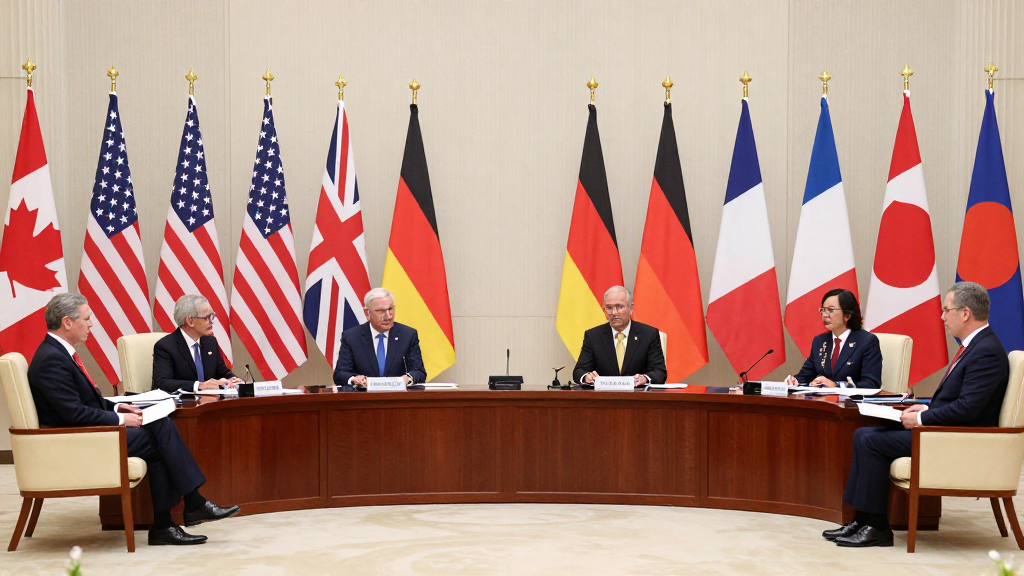
G7 leaders meeting in Banff, Canada, reached a historic agreement Wednesday to redirect income from roughly $300 billion in immobilized Russian central bank assets to fund Ukraine’s long-term reconstruction and immediate defense needs, according to a joint communiqué released by the Canadian Prime Minister’s office.
Background: A Year of Negotiations
The deal caps more than a year of intense negotiations that repeatedly stalled over legal concerns raised by France, Germany, and Belgium, all of which hold significant portions of the frozen Russian sovereign assets within their jurisdictions. Western officials had long hesitated over fears that confiscating frozen state assets would undermine confidence in the Eurozone’s financial system and set a dangerous precedent for international law. Kyiv and its supporters in Washington had lobbied relentlessly for confiscation rather than mere interest transfers, arguing that Russia must bear the full cost of the destruction it caused.
The assets — primarily held in Belgian custodial accounts at Euroclear — generated an estimated €4.4 billion in interest income in 2024 alone. The new mechanism would transfer that income annually to a Ukraine Reconstruction Fund, with future principal also made available as the legal framework evolves. “We have been working on this for months, and this is the result,” Canadian Prime Minister Mark Carney told reporters. “Ukraine will receive the support it needs, and Russia will pay for the damage it has caused.”
Key Provisions of the Deal
Beyond the asset mechanism, the communiqué outlined $40 billion in new military aid commitments from individual G7 members, including the United States, which pledged an additional $20 billion in long-range artillery systems and air defense batteries. Germany committed to supplying additional Patriot interceptor missiles, while France and Italy will provide Scalp cruise missiles and Aster-30 systems. Britain will contribute Storm Shadow cruise missiles and expanded intelligence-sharing capabilities under the existing Five Eyes framework.
Ukrainian President Volodymyr Zelensky, who attended the summit, described the package as the most significant Western commitment since the war began. “This is a fundamental change in the nature of our partnership with the G7,” he said. “We are no longer talking about humanitarian aid or diplomatic gestures. This is real security architecture, and it changes the arithmetic on the battlefield.” He added that Ukraine would use the new weapons to push Russian forces back from positions along the eastern front, where Moscow has been intensifying offensive operations since April.
Russia’s Response and Escalating Tensions
The Kremlin condemned the agreement immediately. Russian Foreign Ministry spokesperson Maria Zakharova called the move “theft under international law” and warned that Moscow would retaliate with “asymmetrical measures” against Western financial interests. Russian state media reported that President Vladimir Putin convened an emergency meeting of his Security Council on Wednesday to discuss possible responses, which analysts say could include restrictions on Western energy companies operating in Russia, seizures of Western corporate assets, or expanded cyber operations against European financial infrastructure.
Despite Western unity on the assets deal, deep disagreements surfaced over how to end the war. The final communiqué stopped short of endorsing Ukraine’s proposed “victory plan,” which calls for NATO membership timelines and a full Russian military withdrawal. The United States and Britain backed Kyiv’s more assertive position, while France and Germany urged a diplomatic off-ramp that would freeze current battle lines. A senior French official, speaking on condition of anonymity, said Paris was “realistic about what can be achieved on the battlefield” and cautioned against allowing the asset deal to derail quiet back-channel talks between French and Russian officials.
What Happens Next
The technical implementation of the asset mechanism must now be finalized through the EU and G7 finance ministries, a process expected to take three to four months. The first funds — drawn from accumulated interest — could reach Kyiv by early 2026. The military aid commitments are subject to parliamentary approval in each G7 member state, a process that could face domestic political resistance in Washington and Berlin ahead of autumn legislative sessions. Meanwhile, Russian forces show no sign of reducing offensive pressure, and analysts say the coming weeks on the battlefield will be a critical test of whether the Banff package arrives in time to shift the momentum of the war.