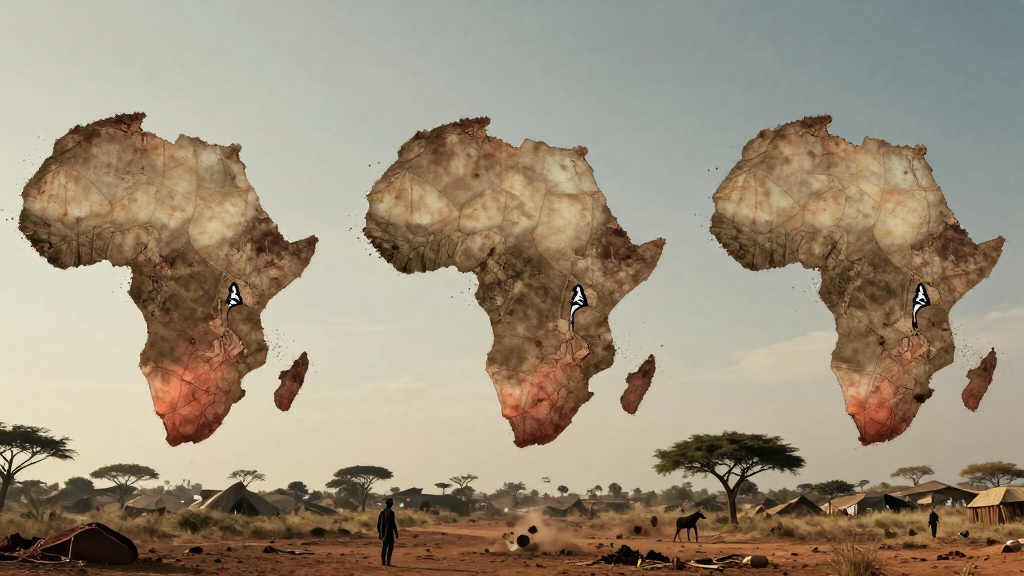
DAKAR, Senegal — Africa is confronting an unprecedented convergence of crises spanning five distinct regions, as a major Ebola outbreak pushes deeper across Central Africa, anti-migrant violence forces mass evacuations in the south, political unrest deepens in the east, and weapons flows destabilize the north, all while West African states navigate their own compounding emergencies.
Southern Africa: Anti-Migrant Violence Forces Mass Evacuations
South Africa experienced its most severe outbreak of anti-migrant violence in years on Tuesday, as marches organized by the group March and March shuttered cities nationwide and thousands of African foreign nationals fled for their safety. The marches, held on a self-declared deadline for undocumented migrants to leave the country, turned violent in several townships, with looters targeting the homes and businesses of Congolese, Somali, and Ethiopian nationals. At least four people were killed and hundreds more displaced, with shops closed and foreign workers staying home across Johannesburg, Durban, and Pretoria.
“For the next six months, we are asking for our national resources to be used to take the illegal immigrants out of this country. From building to building — they must go,” said Jacinta Ngobese, the leader of March and March, speaking in Durban. President Cyril Ramaphosa condemned the violence while acknowledging the legitimate concerns driving anti-immigrant sentiment, stating that “South Africans deep concerns about illegal immigration are real and they deserve to be heard.” The wave of attacks has strained South Africa international standing and drawn condemnation from neighboring governments whose citizens were targeted.
Central Africa: Ebola Outbreak Reaches New Provinces
The Ebola outbreak in the Democratic Republic of Congo continued to accelerate, with the United Nations warning on Tuesday that the crisis could cost Africa up to $3.6 billion and hundreds of thousands of jobs, threatening a broader development collapse. Congo has traced possible cases to two new provinces beyond the original epicenter, raising fears of further geographic spread as health workers struggle to contain transmission in a region with limited infrastructure and recurring conflict. The Africa Centres for Disease Control and Prevention has requested $18 million in urgent funding to support clinical trials for treatments, warning that delays could allow the outbreak to establish itself in new population centers.
East Africa: Kenya Protests Turn Deadly, Uganda Media Remains Shut
In Kenya, police opened fire on protesters in Nairobi on Tuesday, with witnesses reporting live rounds and at least one person killed during a demonstration against the reported abduction of civil society activists by state security forces. The protest marked a significant escalation in tensions that have simmered since the Gen Z-led protests of 2024 that forced large-scale constitutional reforms. Meanwhile, in Uganda, a media group that the military ordered shut last week said talks were underway to reopen its outlets, though journalists warned that press freedom remained under pressure as authorities have detained and intimidated reporters covering security operations in the Karamoja region and along the border with South Sudan.
West Africa: Nigeria School Attack, Ghana Floods Compound Regional Woes
In Nigeria, at least 37 students and staff remained in captivity on Tuesday following a weekend attack on a school in the northeast, where Boko Haram has long operated. Officials said security forces were in pursuit of the attackers, but concerns were growing for the wellbeing of those taken. The attack underscored the persistent instability in Nigeria Adamawa, Borno, and Yobe states despite years of military operations. In Ghana, heavy rains killed at least 12 people in floodwaters that inundated low-lying neighborhoods of Accra, adding to the humanitarian pressures facing a country already navigating a severe debt crisis and galloping inflation that has eroded living standards across urban and rural communities alike.
North Africa: Weapons Flows and Sudan War Deepen Instability
Across North Africa, the civil war in Sudan has produced a steady flow of weapons into Libya and Chad, fueling a cascade of instability across the Sahel and Lake Chad Basin. Sudan has been embroiled in a conflict that has killed thousands and displaced millions, with the western Darfur region bearing the heaviest toll. International mediators have struggled to broker a ceasefire as both the Sudanese Armed Forces and the Rapid Support Forces have repeatedly violated agreed-upon truces. The conflict has drawn in regional powers supporting different factions, turning Sudan into a proxy battleground that threatens to drag in Egypt, Ethiopia, and the Gulf states. Analysts warn that the longer the war continues, the greater the risk of a broader regional conflagration that could overwhelm already fragile governments from Mauritania to the Red Sea.
With crises multiplying across every corner of the continent simultaneously, regional institutions and the African Union are under mounting pressure to convene an emergency response summit. Aid agencies warn that funding gaps and operational access constraints are preventing humanitarian organizations from reaching the most affected populations, raising the prospect of a compounding catastrophe that extends well beyond the current news cycle.