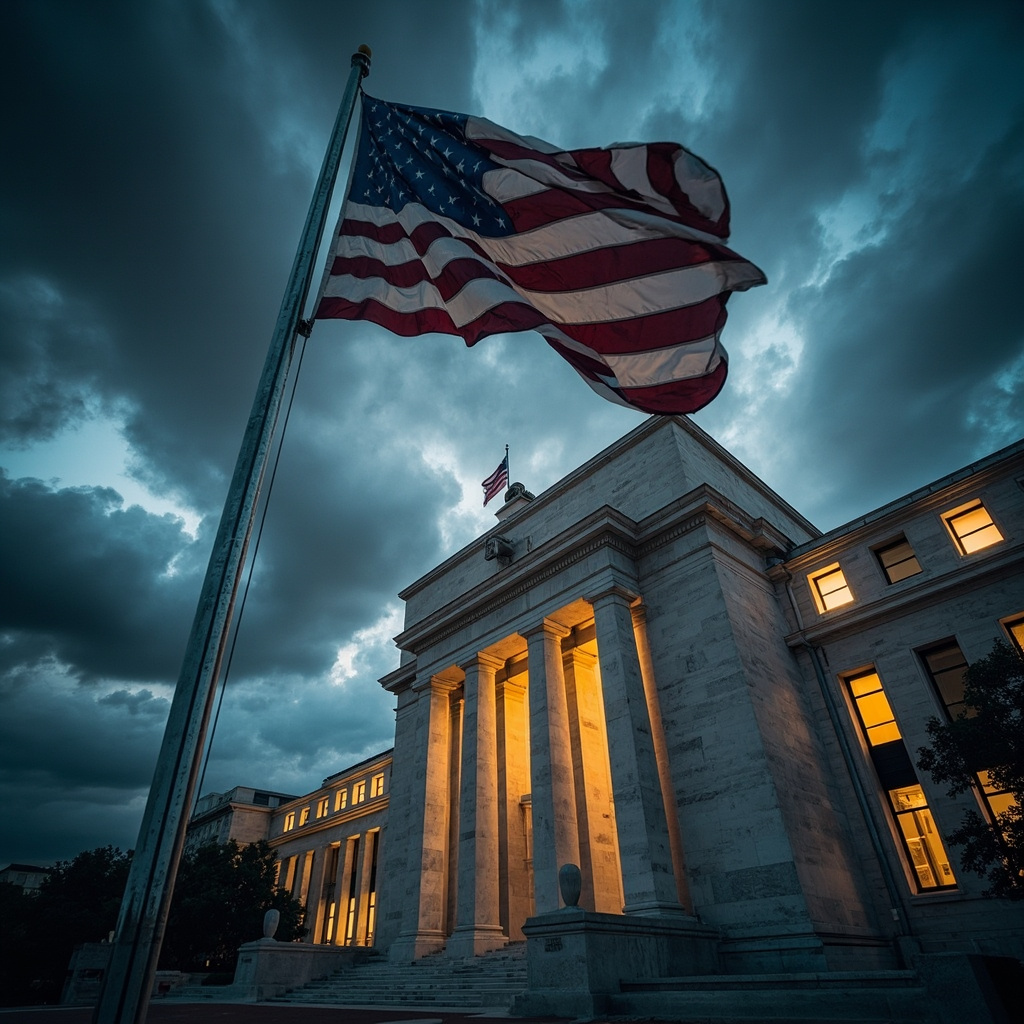
The United States economy grew at an annualized rate of 1.6 percent in the second quarter of 2026, the Bureau of Economic Analysis reported Wednesday, a deceleration that complicates the Federal Reserve’s efforts to bring inflation fully back to its 2 percent target. Consumer spending, which accounts for roughly two-thirds of economic activity, rose just 1.9 percent, down from 2.4 percent in the prior quarter, as households absorbed higher prices for groceries, insurance, and housing without broad-based wage acceleration. The slowdown arrives as Federal Reserve Chairman Kevin Warsh navigates his first full months in the role, with the central bank caught between cooling growth and persistent price pressures that refuse to ease as quickly as earlier forecasts suggested.
Core personal consumption expenditures, the Fed’s preferred inflation gauge, held at 2.7 percent year-over-year in June, only marginally below the 2.9 percent reading from three months prior. That stubbornness in the services component, led by shelter costs and healthcare, has Confluence policymakers from signaling imminent rate cuts. “The data does not give us the confidence we need to reduce restraint,” Warsh told reporters following the Federal Open Market Committee’s two-day meeting. “We remain prepared to adjust policy if the economic outlook deteriorates materially, but the baseline requires patience.” That message stood in contrast to market pricing that had confidently expected at least two quarter-point reductions before year-end, sending Treasury yields sharply lower in the hours after the statement dropped.
Labor Market Holds but Shows Fractures
Payrolls expanded by 142,000 jobs in June, the Labor Department reported separately, beating the consensus forecast of 135,000 but representing a meaningful step down from the 185,000 average monthly gain recorded in the first quarter. The unemployment rate ticked up to 4.3 percent, the highest reading since late 2021, as more workers re-entered the labor force seeking jobs. Average hourly earnings grew 3.8 percent year-over-year, down from 4.1 percent in April and approaching the level the Fed considers consistent with its inflation target. Critics of the central bank’s current posture argue that the combination of moderating wage growth and a rising jobless rate amounts to a policy error in slow motion. “The Fed is tightening into a slowdown,” said Rhea Mahmud, chief economist at Meridian Capital. “If core PCE does not break below 2.4 percent by September, they will have waited too long and the next recession will be of their own making.”
The household survey beneath the headline payroll figures tells a more nuanced story. The employment-to-population ratio slipped 0.2 percentage points, while the share of workers logging fewer hours than preferred rose to 4.1 percent, a signal that employers are trimming schedules before conducting broader layoffs. Industries most exposed to higher interest rates bore the clearest stress: manufacturing payrolls fell by 18,000, residential construction shed 9,000 positions, and retail trade added nothing for the third consecutive month. Technology sector job postings, a reliable leading indicator for professional services, have declined 22 percent year-over-year, suggesting the deceleration has further to run. The Conference Board’s consumer confidence index fell to 97.3 in July from 103.1 in June, its steepest one-month drop since March 2023.
Inflation Dynamics Defy Easy Narrative
The inflation picture remains deeply uneven across categories, making it difficult for the Fed to declare victory on any single component. Energy prices fell 1.2 percent month-over-month in June, providing welcome relief at the pump, but core goods inflation ticked back up to 0.4 percent for the month as the passthrough from tariffs on Chinese imports began appearing in store shelves. Used car prices, a volatile series that swings dramatically with consumer demand, rose 2.1 percent in June after four consecutive months of decline, a reversal that underscores how supply chain normalization alone cannot be counted on to suppress inflation indefinitely. Shelter inflation held at 0.4 percent monthly for the sixth straight period, as owners’ equivalent rent continues to run well above the rate that would bring the overall index to target.
Medical care services, one of the stickiest components in the Consumer Price Index, accelerated to 0.6 percent in June as hospital costs and prescription drug prices moved higher. Economists tracking the supercore measure of services inflation excluding housing have found little progress: it registered 3.4 percent year-over-year, the same as three months ago. That measure has proven especially predictive of future inflation dynamics, and its stubbornness has convinced several FOMC members that the current level of policy restriction is appropriate even as growth cools. “The last mile of disinflation is always the hardest,” said Darius Okon, senior US economist at Vantage Point Research. “You cannot declare victory when shelter and healthcare are still running at three to four percent. The Fed knows this. The question is whether markets are pricing it in correctly.”
Financial Conditions Tighten as Rates Stay High
The sustained level of Federal Reserve interest rates is reverberating across credit markets with increasing force. The 30-year fixed mortgage rate climbed to 7.18 percent last week, according to Freddie Mac, the highest since November 2023 and a level that has effectively priced out a significant share of potential homebuyers. Existing home sales fell to a seasonally adjusted annual rate of 4.01 million units in June, the slowest pace in 16 years excluding the acute pandemic period. The median sales price of an existing home rose to $419,000, as the lock-in effect, whereby homeowners reluctant to surrender low fixed-rate mortgages keep supply off the market, continues to distort the housing sector’s usual adjustment mechanism.
Corporate credit spreads have widened appreciably since the Fed’s June meeting, with the ICE BofA Option-Adjusted Spread on investment-grade bonds reaching 98 basis points, its widest since October 2023. High-yield spreads crossed 400 basis points for the first time in 18 months, signaling that lenders are beginning to price in elevated default risk as companies face maturing debt walls at materially higher coupon rates than when they originally borrowed. Bank lending standards tightened for the fifth consecutive quarter according to the Federal Reserve’s Senior Loan Officer Opinion Survey, with the net share of banks reporting stronger standards for commercial and industrial loans reaching levels not seen since the early months of the pandemic. “Credit is not yet broken, but it is becoming meaningfully more expensive and harder to access,” said Tobias Adler, fixed income strategist at Continental Asset Management. “For an economy running at 1.6 percent, that is a meaningful additional headwind that the Fed cannot simply ignore.”
The yield curve, which spent much of the past two years inverted, has re-steepened as short-term rates remain elevated while longer-dated Treasuries sold off on concerns about the US fiscal trajectory. The 2-year note yield stood at 4.89 percent Wednesday, while the 10-year traded at 4.52 percent, producing a positive spread of roughly 37 basis points, the widest since early 2022. Historically, the unwinding of an inverted curve has preceded economic downturns by six to twelve months, though analysts caution that the current cycle features unusual fiscal spending and trade policy dynamics that may produce different outcomes than past patterns.