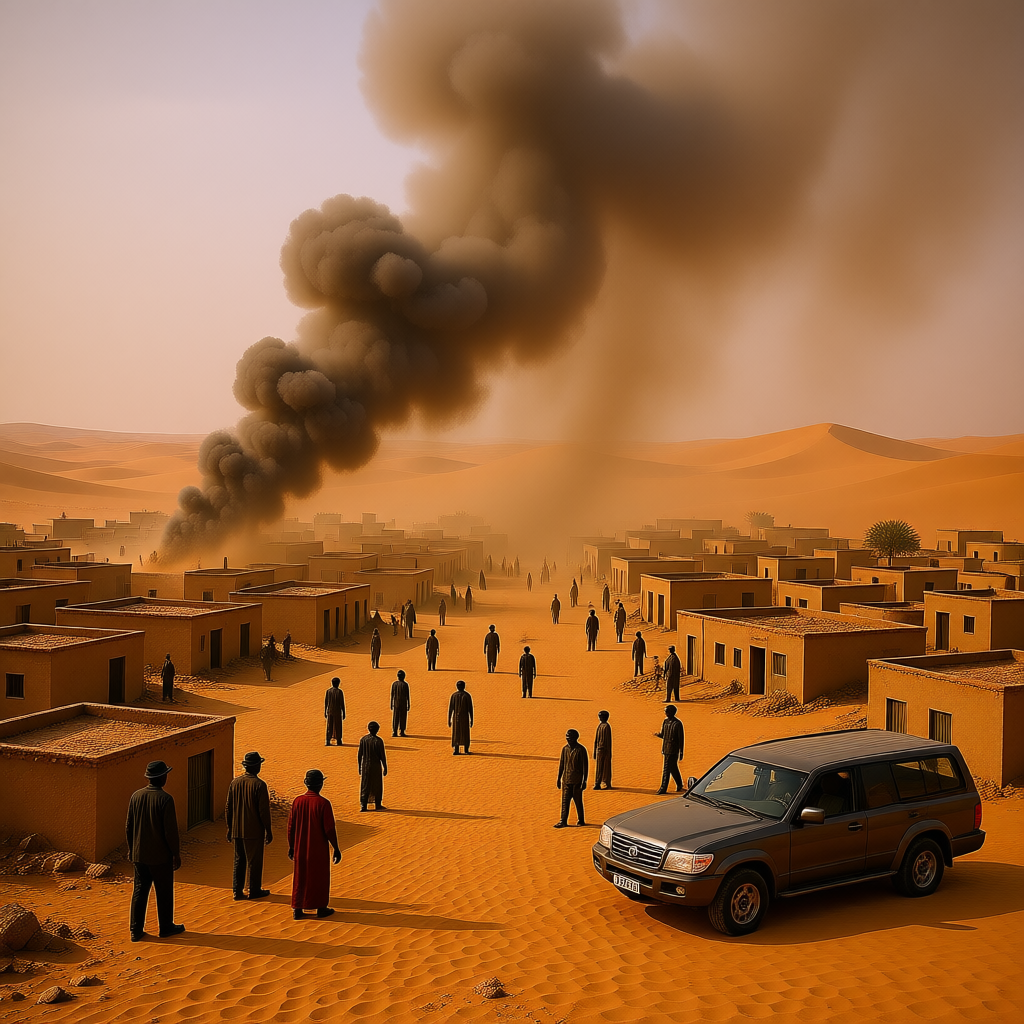
The Siege That Redrew Darfur
Eighteen months after the Rapid Support Forces tightened their stranglehold on El Fasher, the last major Sudanese Armed Forces holdout in Darfur fell. The city’s capture on 26 October 2025 ended a grinding war of attrition that had trapped hundreds of thousands of civilians, and it set off a wave of mass killings that the United Nations has described as among the worst atrocities of the twenty-first century. Today, with the battlefield shifted but the war still raging, the consequences of the fall are still unfolding across the region.
What Happened In El Fasher
For most of the civil war, El Fasher was the lone government-held pocket in a Darfur otherwise dominated by the paramilitary RSF. Soldiers of the SAF 6th Infantry Division, reinforced by Darfur Joint Protection Force fighters, defended a city swollen with refugees from earlier waves of ethnic violence. The RSF, fighting under the command of Mohamed Hamdan Dagalo, known as Hemedti, encircled the city in 2024, dismantled the food economy around the Abu Shouk and Zamzam displacement camps, and then began systematic shelling of civilian sites throughout 2025. In August, fighters built a physical wall around the city. The final assault came in October, and by the 26th the 6th Infantry Division had retreated westward, abandoning El Fasher to RSF control.
The Massacre That Followed
What happened next has become the defining horror of Sudan’s war. Within hours of entering the city, RSF fighters began a coordinated campaign of killings that survivors and investigators have compared to the worst episodes of the early-2000s Darfur genocide. Casualty estimates diverge sharply. Sudanese army figures cite 8,600 combatants killed, while the Darfur Joint Protection Force and several human rights monitors have documented at least 14,000 civilian deaths from bombing, starvation and extrajudicial execution. Most chilling, an RSF-aligned tribunal claimed responsibility for the execution of more than 60,000 civilians in the days immediately after the city’s fall, a number that the United Nations High Commissioner for Human Rights has called credible enough to warrant a formal war-crimes investigation.
A Health System On The Verge Of Collapse
The Numbers Behind The Crisis
The scale of displacement now rivals anything in the region since the Rwandan genocide. According to figures cited by the Associated Press and the United Nations refugee agency, roughly 9 million people are internally displaced inside Sudan, while around 4.5 million have crossed into neighbouring countries. Chad has absorbed the largest share, with hundreds of thousands streaming across the western border, followed by Libya, South Sudan and Egypt. Camps in eastern Chad are operating at four times their planned capacity, and aid agencies warn that the rainy season, now beginning, will trigger a second wave of disease and death on a scale the region has not seen.
Commanders, Defections And A Fragmenting RSF
While the RSF has consolidated territorial control across Darfur, the paramilitary is showing the first signs of internal fracture. In early June 2026, RSF command announced a major redeployment of forces and tightened internal security after a spate of mid-level defections in the Kordofan and Chad border sectors. Analysts at the Sudan Security Council Report suggest the redeployments reflect a twin pressure: the SAF’s persistent campaign in the Nuba Mountains and Kordofan, and the loss of several revenue streams after the fall of the Zamzam and Abu Shouk economies. Whether the defections grow into a wider split between Hemedti’s inner circle and field commanders will be one of the defining questions of the next phase of the war.
The International Response, And Its Limits
Western governments have imposed sanctions on senior RSF and SAF figures, and the African Union has called for a transitional framework. None of that has translated into a meaningful humanitarian corridor into Darfur. The World Food Programme has been forced to suspend most of its cross-border operations into El Fasher governorate, and the few aid convoys that do move operate under armed escort that critics say legitimises the very authorities delivering the food. The United Nations Security Council has held three closed consultations on Sudan since the start of 2026, but no resolution authorising a protection force has emerged, blocked by rival vetoes from permanent members with competing interests in the Red Sea and the Nile.
What The Fall Of El Fasher Changes
Strategically, the loss of El Fasher means the SAF has been pushed out of Darfur entirely, with the RSF now the dominant actor from the Chadian border to the border with Libya. Politically, it has demolished the idea that the war could be resolved through negotiation while the army still held a major city in the west. And morally, the atrocities that followed have made clear that any future settlement will have to contend with the question of accountability for what human rights groups have already begun calling the El Fasher massacre. The war is not over, but the phase that began with the siege of the city is, and a darker one is taking its place.
For the families sheltering in the camps around Tawila, and for the Chadian and Egyptian border towns absorbing the overflow, the next chapter will not be written in Geneva or New York but in clinics, in displacement queues, and in the slow grind of a rainy season that aid agencies now fear as much as the war itself.