World’s Wealthy Democracies Converge on a French Lake as Trump’s Iran Deal Looms Over Every Working Session
Évian-les-Bains, France — The leaders of the Group of Seven gathered Monday in this spa town on the southern shore of Lake Geneva for a three-day summit that President Emmanuel Macron of France has choreographed around a single volatile guest of honor: President Donald J. Trump of the United States. Trump arrived carrying what he called a “memorandum of understanding” with Iran that purports to end the war, reopen the Strait of Hormuz, and clear the way for oil and gas to flow again — a victory lap he now wants to extend into pressure on Russia to end its war in Ukraine.
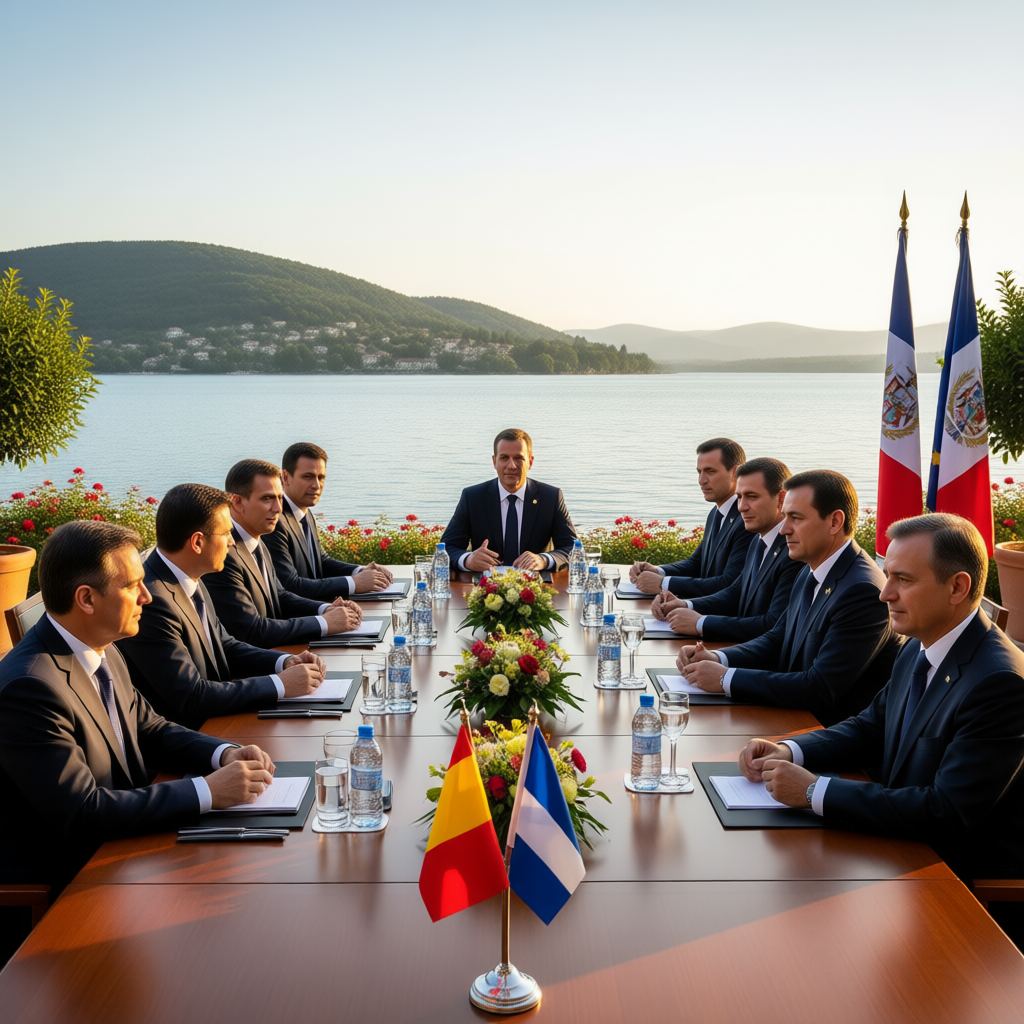
The setting is chosen to flatter. Évian, best known for its bottled water, gives Macron a scenic, intimate stage removed from the protests that have dogged previous summits, and lets the Élysée choreograph every meeting through a Wednesday dinner at Versailles designed to keep Trump in the room.
Macron’s Tightrope: Agenda Built to Keep Trump in the Room
The French hosts know the risk. Trump walked out of the last G7, in Kananaskis, Canada, early to manage the Iran crisis. This year, with that crisis in his rearview mirror, the question is whether he treats the summit as a victory tour or as another venue to berate allies for not joining his campaign to reopen Hormuz by force. Macron postponed the gathering to let Trump attend a UFC event on the White House lawn for his 80th birthday, a gesture noted in European capitals but not universally praised.
The agenda is built around him. Sessions on Gaza, Ukraine, AI safety, critical minerals, and African debt are sequenced so that Trump can claim ownership of the Iran breakthrough and pivot to demanding that the G7 endorse and rapidly deploy a planned Franco-British naval task force to escort tankers through the newly opened waterway. De-mining is on the table as urgent: hundreds of vessels backed up in the Gulf need safe passage for global energy markets to recover.
The Iran Deal: A Win Trump Is Refusing to Dilute
Trump opened his visit by hailing the Geneva framework as a fait accompli, telling reporters that the conflict is “over” and that the United States has secured terms that “the world said were impossible.” Other leaders are more cautious. The deal still has to be ratified in Tehran and Washington, and Iranian hardliners have publicly questioned whether the parliament will accept the concessions on enrichment and UN inspections that the framework reportedly contains. German Chancellor Friedrich Merz has called the war a “humiliation” for the United States and suggested any settlement must reckon with that record.
European capitals are watching the economic fine print. The World Bank last week cut its 2026 global growth forecast from 2.9 to 2.5 percent, the lowest since the pandemic, and projected commodity prices up 22 percent, container rates roughly doubled, and euro area inflation above 3 percent.
Ukraine Now: The Next Item Trump Wants to Tick Off
If the Iran file is the trophy, Ukraine is the next item on Trump’s checklist. The president has signaled to aides that he wants to use the momentum from Geneva to push Vladimir Putin toward a ceasefire, and has privately floated a timeline that would see fighting suspended before the November U.S. midterm elections. European leaders, including Macron and British Prime Minister Keir Starmer, are wary of a deal that locks in territorial concessions, but they share Trump’s urgency to end a war draining their arsenals and consuming their aid budgets.
Ukrainian President Volodymyr Zelensky is not attending Évian in person, a choice the Élysée attributed to scheduling but which Ukrainian officials privately framed as a way to avoid being cornered into terms he has not negotiated. He will join a working session by video and is expected to press for firm security guarantees, including the rapid delivery of long-range missiles and air-defense systems that Kyiv says it needs before any ceasefire can hold.
Allies Watching the Clock — and the Calendar
Beneath the choreography, the mood in Évian is watchful. The other six leaders know Trump has not been in a celebratory mood in Washington recently, and that the temptation to insult counterparts in real time remains real. The Bank of Japan is expected to raise rates to a 31-year high this week, a reminder that the war’s aftershocks are still being absorbed across the developed world.
What the G7 produces from Évian will be measured on two tracks: the communiqués on Gaza, AI, critical minerals, and African debt, and the more volatile question of whether Trump leaves early, signs a separate Ukraine framework on the margins, or — as several officials quietly fear — uses the summit to relitigate the Iran war in front of cameras that have already moved on. Macron’s bet is that Versailles, gold leaf, and a well-timed toast will keep his guest in the room long enough for the diplomatic work to be done. The world’s wealthy democracies, for now, are holding their breath.