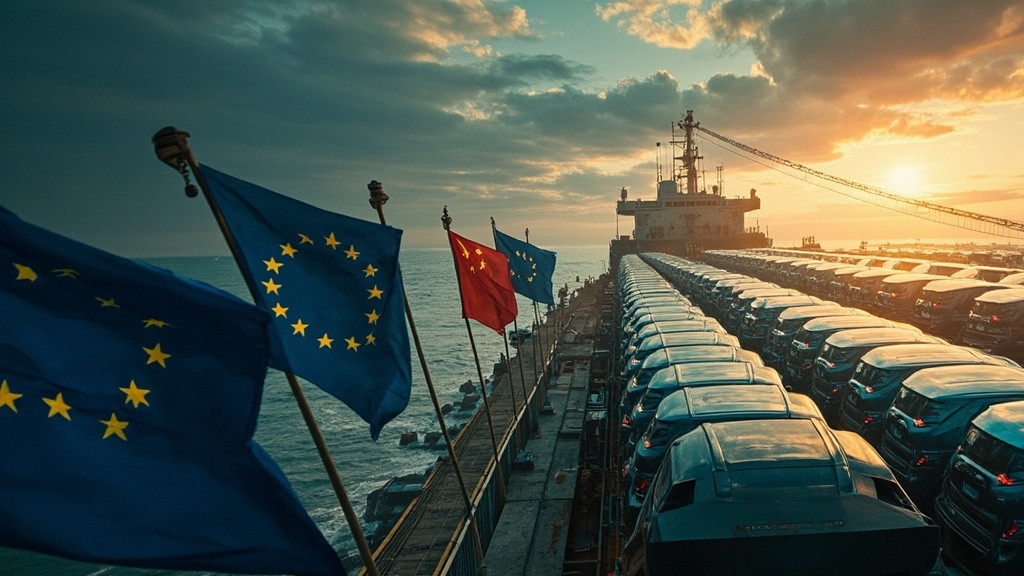
The European Union’s sudden imposition of sweeping tariffs on Chinese-built electric vehicles has triggered a full-scale trade confrontation with Beijing, prompting China to announce retaliatory measures against European agricultural exports and sending shockwaves through global automotive supply chains that depend on both markets.
The Immediate Trigger
On May 13, 2026, the European Commission published its final determination in the anti-subsidy investigation opened in October 2023. The ruling found that Chinese EV manufacturers — including BYD, SAIC, and Geely — had benefited from state subsidies estimated at between 9 and 35 percent of vehicle value, giving them an artificial competitive advantage over European producers. The Commission imposed countervailing duties ranging from 9.7 percent for Tesla’s Shanghai-built Model 3 to 35.3 percent for BYD, with SAIC facing the highest rate at 35.5 percent. These came in addition to the existing 10 percent EU base tariff on all passenger vehicles.
The decision followed 14 months of investigation, three failed rounds of price-undertaking negotiations with Beijing, and a 15-to-12 vote by EU member states in February 2026 — the narrowest margin in any EU trade defence case in the bloc’s history. Germany, Sweden, and Hungary voted against, citing their exposure to Chinese counter-retaliation. France, Italy, and Poland voted in favour.
“This is not protectionism. This is about fair competition. China has been investing massively in its EV industry while we have been opening our markets. That asymmetry had to be addressed.”
— Valdis Dombrovskis, Executive Vice-President, European Commission
Beijing’s Response
Within six hours of the Commission’s announcement, China’s Ministry of Commerce issued a statement condemning the tariffs as “unilateral protectionism” and announced it was launching its own anti-subsidy investigation into European brandy — a category that primarily affects France’s cognac industry, which exports approximately €3.5 billion annually to China. Beijing also indicated it was examining restrictions on European pork and dairy products, targeting Spain, the Netherlands, and Denmark.
“The EU has chosen confrontation over dialogue. We will take all necessary measures to protect Chinese enterprises’ legitimate rights and interests.”
— He Yongqiang, Spokesperson, Ministry of Commerce, China
The timing of Beijing’s response — faster than any previous Chinese trade retaliation — indicated a pre-prepared package designed to maximise pressure on EU governments that had voted against the tariffs. Spain’s agricultural minister called an emergency session within hours of the announcement.
The Economic Stakes
The automotive sector represents the single largest manufacturing employer in Europe, with approximately 3.3 million direct jobs and a further 5.6 million in adjacent industries. Chinese-made EVs accounted for approximately 22 percent of all EVs sold in the EU in 2025, a share that had grown from under 4 percent in 2020. European manufacturers — led by Volkswagen, BMW, Mercedes-Benz, and Stellantis — have invested heavily in Chinese production facilities and depend on both the Chinese market for revenue and Chinese battery supply chains for their own EV transition timelines.
| Metric | Value |
|---|---|
| EU EVs from China (2025 share) | ~22% |
| Chinese EV tariff rate (BYD example) | +35.3% above base 10% |
| Europe EV sector employment | 3.3 million direct |
| France cognac exports to China | ~€3.5 billion/yr |
| Chinese BEV market share (domestic) | ~62% |
| EU BEV market share (domestic) | ~19% |
The figures reveal an uncomfortable asymmetry. Chinese manufacturers have achieved a dominant position in their domestic EV market — 62 percent of all battery EVs sold in China in 2025 were produced by Chinese brands — while European manufacturers have struggled to gain traction in China itself, holding just 19 percent of that market. European automakers are simultaneously exposed to Chinese competition at home and locked out of the Chinese market abroad.
The German Question
Germany’s opposition to the tariffs stems from a specific vulnerability. Volkswagen, BMW, and Mercedes-Benz each derive between 30 and 40 percent of their global profits from Chinese sales. Any Chinese counter-retaliation that targets German automotive brands poses an existential threat to the German industrial model that Chancellor Friedrich Merz’s government has identified as its central economic priority.
BMW’s CEO Oliver Zipse warned in March 2026 that a trade war between the EU and China would cost the European automotive sector “a generation of EV transition investment” as Chinese manufacturers redirected their growth toward Southeast Asia, the Middle East, and Latin America.
“We cannot have a situation where Europe closes its market to Chinese EVs while China closes its market to European brands. That is not fair competition — it is mutual destruction.”
— Oliver Zipse, CEO, BMW Group
The Geopolitical Dimension
Behind the trade dispute sits a harder strategic question that EU member states remain divided on: how to position Europe in a global competition between the United States and China that is increasingly structuring every aspect of international commerce.
The Biden administration imposed 100 percent tariffs on Chinese EVs in May 2024. The Trump administration’s position, as of early 2026, had not softened. The EU’s 35 percent tariff sits between the two positions, reflecting a European attempt to maintain trading relationships with both powers while protecting domestic industry.
The question for European policymakers is not simply whether to compete with China — it is whether they have the industrial policy tools, the battery supply chain independence, and the political cohesion to do so without undermining the foundations of the European automotive industry’s global position. The tariffs are a beginning, not a resolution.