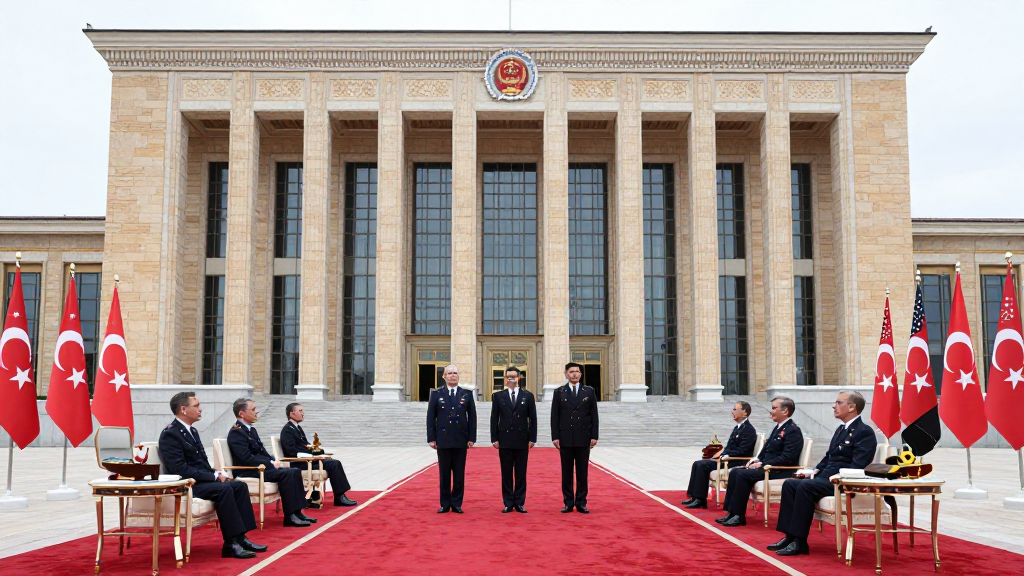
ANKARA — NATO leaders gather in the Turkish capital on Monday for a two-day summit that has become, at its core, a sophisticated exercise in keeping United States President Donald Trump committed to an alliance he has repeatedly threatened to abandon. Secretary-General Mark Rutte, who has cultivated a reputation as the one European figure capable of managing Trump, arrives with a message: Europe is finally paying up.
Europe Pours Billions Into Its Own Defence
European allies and Canada raised core defence spending by roughly $139 billion last year, a near-20 percent increase in a single 12-month period. At last year’s summit in The Hague, NATO members committed to spending 5 percent of their gross domestic product on defence by 2035. That commitment, once unthinkable, is now the central pillar of the alliance’s new posture. Rutte will also present the first formal progress report toward a separate 1.5 percent target covering military mobility, civilian resilience and border infrastructure. For most European governments, the arithmetic of that pledge is painful: it requires sustained real-terms increases to defence budgets that have been shrinking for three decades. Germany, whose Bundeswehr has been hollowed out by years of underinvestment, faces the steepest climb, and Berlin has already signalled that the path to 5 percent will run through supplementary budgets rather than a wholesale rewriting of fiscal rules.
“Burden shifting, interestingly, will be mentioned in the NATO summit declaration for the first time,” said Oana Lungescu, a former long-serving NATO spokesperson who now serves on the RUSI Europe Advisory Board. “It shows the direction of travel toward what people in Washington like to call NATO 3.0.” The shift in language is not cosmetic, she added: it reflects a genuine reckoning inside European capitals about the assumptions that have underpinned the alliance since 1949.
The framing is deliberate: Europe takes on a larger share of its own conventional defence while the United States steps back — the outcome Trump has demanded, repackaged as alliance strategy. European officials insist this is not a retreat from the transatlantic bond but its recalibration. Behind that consensus lies a more uncertain reality. Several defence analysts note that the 5 percent pledge, while significant, is measured against NATO’s definition of defence spending, which includes pensions, paramilitary forces and infrastructure that may not translate into usable combat capability.
Ukraine Funding and the Contested Communique
The summit declaration is expected to formally designate Russia as a threat to the alliance, a designation NATO avoided for years to avoid escalating tensions with Moscow. That step, once politically explosive, now looks almost routine given the war in Ukraine. More contentious is the money. Allies are set to commit roughly 70 billion euros per year in military aid to Ukraine across 2026 and 2027 — approximately 140 billion euros over two years. Much of that sum is tied to an EU loan arrangement worth around 30 billion euros annually, and not every capital has signed off without reservations. Hungary continues to object to the EU’s lending mechanism. Slovakia has expressed skepticism about the scale of commitments.
Poland is pressing the alliance to help finance a roughly $28 billion overhaul of eastern-flank infrastructure, including the extension of Cold War-era fuel pipelines. Warsaw has also signalled caution about pledging additional resources to Kyiv beyond what has already been committed. The fighting over numbers behind the communique is, sources say, still live as leaders arrive in Ankara. Rutte has tried to present a unified front, but the negotiations that produced the summit text were, according to three officials with knowledge of the discussions, more fractious than the public posture suggests. One senior diplomat described the Ukraine package as “the minimum necessary to avoid looking indifferent, not the maximum anyone wanted to offer.”
Rutte has signalled “tens of billions” in new defence contracts, many of them transatlantic, structured to allow European governments to acquire capability quickly while keeping American industry engaged. That industrial component is, behind the diplomatic language, the quiet core of the summit: NATO argues Europe still cannot produce enough on its own, and that deeper cooperation with U.S. defence firms is the only realistic bridge to strategic autonomy. The F-35 programme, long-term ammunition contracts and drone procurement form the backbone of that argument.
Turkey’s Moment and Europe’s Dilemma
Turkey fields NATO’s second-largest military, hosts one of the alliance’s fastest-growing defence industries and is led by a president with unusually warm personal ties to Trump — attributes that make Ankara a useful venue for an event designed to flatter Washington. President Recep Tayyip Erdogan has used the summit to push Turkey’s own pipeline ambitions and secure attention for Ankara’s broader energy and defence agenda. He arrived with a shopping list: fighter jet technology transfers, a formal role in NATO’s defence planning structures and diplomatic space on issues where Turkish and European interests diverge.
The setting, however, also exposes an awkward tension for the European Union. Brussels has grown more dependent on Ankara for security, migration control and regional stability, even as accession talks remain frozen and concerns about democratic backsliding keep Turkey at arm’s length in EU councils. The EU’s long-standing “strategic ambiguity” toward Turkey is becoming harder to sustain precisely as Turkey’s leverage inside NATO grows.
Chancellor Friedrich Merz hosted Baltic leaders in Berlin in the days before the summit as last-minute coordination intensified. The message from that meeting, according to officials briefed on the discussions, was clear: Europe cannot afford a public fracture at the moment it is trying to demonstrate unity to Washington. The pressure to present a credible front is real, and it is creating pressures inside European coalitions that are not always visible from the outside.
The summit formally opens on Tuesday morning. A closing press conference with Rutte and Erdogan is expected by late afternoon. What NATO announces will define the alliance’s financial and strategic commitments for the next two years — and, alliance officials say, may determine whether the partnership that has anchored European security for eight decades survives the Trump era in a recognisable form. The numbers will matter less than the signal: whether Europe can show it can act, and whether Trump decides that an alliance spending 5 percent of GDP is worth keeping rather than abandoning. The communique will be written in diplomatic language. The real message will be in the numbers.