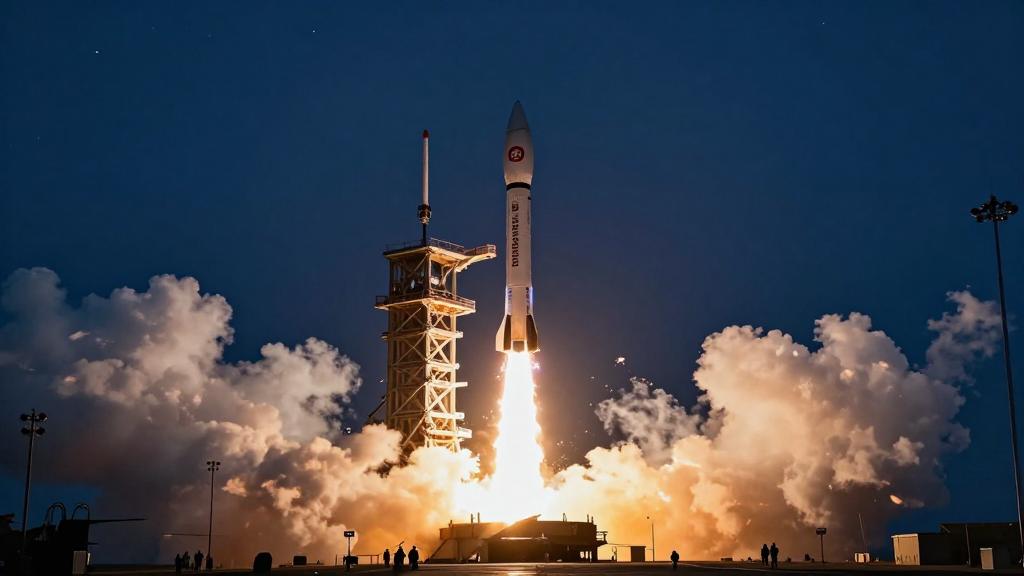
North Korea launched an intercontinental ballistic missile (ICBM) from its Sinpo facility on July 14, 2026, sending the weapon roughly 3,700 kilometers to a splashdown in the Sea of Japan — the largest and most capable test since the 2017 crisis, regional radar and satellite tracking confirmed. The launch triggered immediate emergency consultations between the United States, Japan, and South Korea, and the UN Security Council convened an emergency session within hours.
The Launch: A 3,700-Kilometer Arc Over Japan
The missile, assessed by US and allied intelligence as a Hwasong-18 variant capable of striking the continental United States, lifted off at approximately 9:47 AM local time from North Korea’s western coast. It flew on a near-vertical trajectory before leveling out over the Sea of Japan (East Sea), where it splashed down in Japan’s exclusive economic zone. Japanese defense officials said the missile reached an altitude of more than 6,000 kilometers before breaking apart.
“This is the most significant provocation we have seen in years,” a senior Japanese defense ministry official said in a statement. “The trajectory was clearly designed to demonstrate maximum range.” The official requested anonymity as they were not authorized to brief media.
South Korea’s Joint Chiefs of Staff confirmed the launch and said Seoul was in “direct and continuous contact” with Washington and Tokyo. The US Indo-Pacific Command said it detected the launch and was monitoring the situation in coordination with allies.
Washington, Tokyo, Seoul React with Joint Emergency Consultations
Within 40 minutes of the launch, the foreign ministers of the United States, Japan, and South Korea held an emergency trilateral call. Secretary of State Marco Rubio warned of “severe consequences” for what he called a “deliberate and destabilizing act,” according to a State Department readout. The readout said Rubio spoke with his Japanese and South Korean counterparts and that the three countries had agreed to pursue “unprecedented sanctions pressure” at the United Nations.
Regional tensions have been building for months as North Korea has conducted an escalating series of missile tests — more ICBM launches in 2026 than in any prior single year since the program’s inception, according to a review of regional defense data. The July 14 launch fits a pattern that analysts describe as an escalation-entrenchment cycle: North Korea tests, the world condemns, and the capability remains, with North Korea’s status as a de facto nuclear state further solidified.
UN Security Council Convenes Emergency Session, Veto Threat Looms
The UN Security Council met in emergency session later on July 14. A draft resolution condemning the launch failed to pass after permanent members Russia and China indicated they would veto any new sanctions measure, diplomats said on background. The United States and its allies had pushed for a resolution that would expand existing sanctions on North Korea’s ballistic missile program.
Russian officials said any new resolution would “escalate tensions rather than reduce them,” and called for renewed diplomatic engagement with Pyongyang. China’s UN mission issued a statement urging “all parties to exercise restraint” — language Beijing has used repeatedly as North Korea’s capabilities have advanced.
UN Secretary-General António Guterres issued a statement calling the launch “a dangerous escalation” and urged North Korea to return to the negotiating table without preconditions. “The international community must speak with one voice,” his statement said. “But that voice has been absent, and the consequences are now visible.”
What Happens Next
Diplomatic analysts say the immediate path forward is uncertain. The veto dynamic on the Security Council means new binding sanctions are effectively blocked, leaving the US and its allies to pursue unilateral measures. The Trump administration has limited leverage, and it remains unclear how it will approach North Korea, which Kim Jong-un publicly mocked as “incompetent” in a state media commentary published hours after the launch.
Japan is expected to request an emergency session of the G7, while South Korea has said it will expand its own targeted sanctions on North Korean entities. The US has hinted at increased military posture in the region, including possible redeployment of advanced missile defense systems to Guam and South Korea.
For now, analysts say, the cycle continues: a test, international alarm, diplomatic theater, and no fundamental change in North Korea’s capabilities or intentions. “Denuclearization is off the table,” one regional expert told this publication, speaking without attribution ahead of official publication. “The world is now managing a nuclear North Korea, and it is not managing it well.”