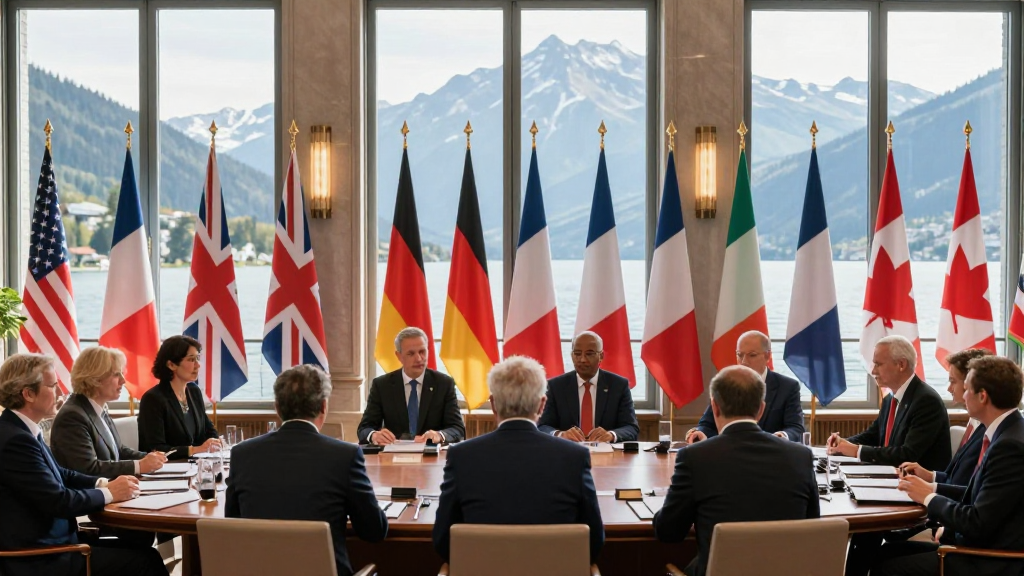
EVIAN, France — World leaders from the Group of the Seven concluded a two-day summit in this French lakeside town on Wednesday with an unusual display of unity, adopting nine joint declarations addressing conflicts from Ukraine to the Middle East and committing to coordinated action on critical minerals, artificial intelligence, and a transatlantic response to trade tensions.
Leaders Unveil Rare Consensus on Ukraine, Middle East
The summit, hosted by French President Emmanuel Macron, brought together leaders from the United States, Germany, Italy, Canada, Japan, and Britain, along with partner countries India, Kenya, South Korea, Brazil, and Egypt in what French officials described as an unprecedented outreach format. The gathering produced more substantive agreements than many observers had anticipated, with analysts noting that escalating global instability appeared to concentrate minds and override longstanding differences on economic policy.
On Ukraine, G7 leaders met with Ukrainian President Volodymyr Zelensky and reaffirmed their commitment to his country’s “freedom, sovereignty, and territorial integrity.” They agreed to increase military support, including air defense systems, additional interceptors, and long-range strike capabilities, while expanding sanctions pressure on Russia’s energy sector. A joint communique singled out Russian oil and gas revenues as a target for further coordinated restrictions.
The grouping also threw its weight behind efforts to end hostilities in the Middle East, with particular focus on the Strait of Hormuz. The leaders called for the “immediate and unconditional reopening” of the strategic waterway, which Iran has periodically menaced with naval exercises and tanker interdictions. The declaration opened the door to addressing Iran’s nuclear program and ballistic missile activities within a broader framework of diplomatic engagement.
On Lebanon, the G7 called for a strong and immediate ceasefire and endorsed efforts to achieve Hezbollah’s disarmament under Lebanese state authority. The country’s territorial integrity and sovereignty were cited as foundational principles in the final communique.
French President Emmanuel Macron said the summit had produced a “quantum leap” in collective resolve. “What we have achieved here is not a communique — it is a set of binding commitments,” he told reporters at the closing press conference. The Elysee Palace described the format as “a G7 of convergence,” citing the inclusion of civil society and private-sector technology representatives alongside heads of state.
Critical Minerals and Trade Tensions
Economic declarations dominated the latter half of the summit agenda. Leaders acknowledged that unresolved trade disputes, particularly between the United States and European Union over industrial subsidies and digital taxation, posed risks to global growth. They committed to continued negotiations through the G20 framework and directed the International Monetary Fund to monitor macroeconomic imbalances more closely.
A critical minerals accord, long stalled, gained fresh traction as leaders from Australia, Canada, and several African nations joined the discussion. The declaration called for reduced dependency on Chinese-processed rare earths and cobalt, establishing a coordinated early-warning system for supply chain disruptions in materials essential to clean energy and defense manufacturing. The accord also included provisions for technology transfer to developing nations hosting mineral extraction operations.
British Prime Minister Keir Starmer welcomed the minerals agreement as “a turning point for strategic autonomy.” German Chancellor Friedrich Merz struck a more cautious note, warning that supply chain diversification required “real capital, not aspirational language.” European Commission President Ursula von der Leyen said the EU would table a complementary investment framework by September.
Health, AI, and a Shifting Diplomatic Landscape
Beyond geopolitics, the summit addressed a cluster of emerging global challenges. A joint cancer initiative garnered support for improved data sharing on poor-prognosis and pediatric cancers, backed by a commitment to accelerate clinical trial harmonization across member nations. On artificial intelligence, the leaders endorsed guidelines requiring AI systems to adapt language when interacting with minors, developed in coordination with leading technology firms.
Leaders also committed more than $1 billion in response to the Ebola outbreak spreading across Central Africa, coordinating with the World Health Organization and African Union health bodies. A seaport security compact aimed at disrupting drug trafficking routes was signed separately, with commitments to information sharing between coast guards.
The summit took place against a backdrop of deepening transatlantic strain. The United States pursued bilateral talks with several G7 partners on tariff reduction, while European leaders sought assurances that no side agreements would undermine the multilateral trading system. Macron acknowledged “real differences” on trade but said the G7 had agreed on a shared framework for dispute resolution through existing WTO mechanisms.