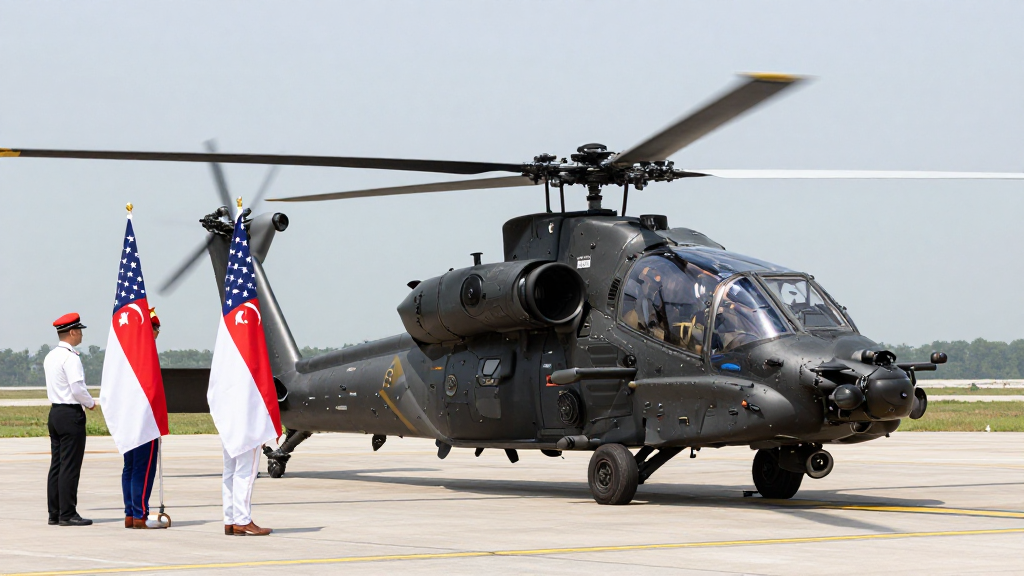
Singapore has finalized a US$22.3 million purchase of additional AGM-114 Hellfire missiles from the United States, the Pentagon confirmed on Wednesday, in the largest single arms sale to the city-state in more than a decade and a sign of accelerating military competition across the Asia-Pacific.
The State Department approved the sale in March and formally notified Congress in April. The contract, covering an undisclosed number of AGM-114R Hellfire II missiles compatible with Singapore’s fleet of 16 AH-64D Apache attack helicopters, was signed last week and announced by the Pentagon’s Defense Security Cooperation Agency without fanfare on the eve of the July 4 American holiday.
Strategic Depth Along the Malacca Strait
Singapore’s decision to expand its Hellfire arsenal reflects a broader recalibration of deterrence strategy across the Malacca Strait and the wider region. The missiles give Singapore’s Apaches precision-strike capability against naval targets at ranges exceeding eight kilometers — a capability that defense analysts say significantly raises the operational risk for any adversary contemplating maritime pressure near the world’s busiest shipping chokepoint.
“This sale will not alter the basic military balance in the region,” the State Department said in its formal notification to Congress. The same phrase has preceded some of the most consequential weapons transfers of the past decade, including advanced air defense systems to Japan and anti-ship missiles to Taiwan — transfers that, taken together, have materially reshaped the deterrence landscape from the Taiwan Strait to the South China Sea.
Singapore’s existing Hellfire inventory was acquired alongside its 16 AH-64D Apaches in two tranches, the first in 2019 and the second in 2022. The new batch brings the estimated total to approximately 200 missiles — enough, analysts say, to sustain sustained anti-ship strikes for several days of contingencies without rearmament.
North Korean POWs Complicate Seoul’s Arms Calculus
The Hellfire sale comes as South Korea finds itself entangled in a separate but connected arms dilemma: the presence of North Korean prisoners of war captured by Ukrainian forces fighting Russian units that included North Korean soldiers deployed to Russia’s Kursk region.
Ukraine has proposed exchanging weapons for the soldiers — a proposition that puts South Korea in an awkward position given its reliance on Russian cooperation regarding North Korean defector repatriations and its broader diplomatic balancing act between Moscow, Beijing, and Washington.
South Korea’s defense ministry said it was “aware of the reports and monitoring the situation closely” but declined to confirm whether Seoul was considering the exchange. The prospect has alarmed Japan, which sees any transfer of Korean weapons to Ukraine as potentially destabilizing the balance of power on the Korean Peninsula, and prompted quiet diplomacy from Tokyo aimed at persuading Seoul to remain on the sidelines of the Ukraine-Russia conflict.
Regional Architecture Adapts to a New Threat Environment
Across the region, the pattern is consistent: states that once relied primarily on diplomatic engagement with Beijing are hedging with hardware. Japan formalized its GSOMIA intelligence-sharing agreement with Australia and South Korea and is in advanced negotiations to acquire Tomahawk cruise missiles from the United States. Australia’s AUKUS pathway includes a submarine fleet designed, in part, to sustain deterrence patrols through the South China Sea. The Philippines signed its reciprocal access agreement with Japan, which entered force this week, enabling cross-deployment of defense forces for the first time.
China’s foreign ministry said it was watching the Hellfire sale with concern. “Any actions that inflame military competition and undermine regional trust are irresponsible,” a spokesperson said, declining to be named in line with ministry protocol.
For Singapore, the calculus is direct: the Malacca Strait is the jugular of Asian trade, and the city-state’s tiny geographic footprint demands capabilities that can deter a larger adversary from exploiting the chokepoint. With 16 Apaches and roughly 200 Hellfire missiles, Singapore has assembled a credible anti-ship deterrent that fits within a defense policy premised on deterrence by denial rather than territorial expansion.
The regional response has been muted but telling. No ASEAN member has publicly criticized the Hellfire sale; several have quietly signaled approval through back-channel diplomatic channels, according to two regional officials who spoke on condition of anonymity because they were not authorized to brief the press. The message, the officials said, is consistent: a well-armed Singapore makes the Malacca Strait safer for everyone.