In the 56th day of the US-Israel war on Iran, world capitals are quietly redrawing maps that have not been touched in decades. The Strait of Hormuz — the world’s most critical oil chokepoint, squeezed by Iranian mines and a US naval blockade — has become the catalyst for something long considered impossible: a coordinated push to transform Syria into a global energy corridor that could permanently rewire the Middle East’s energy architecture.
The idea is not entirely new. Planners and pipeline enthusiasts have imagined it for years — a web of natural gas pipelines running from the Eastern Mediterranean, through Syria, to Turkey, and into European markets. What has changed in April 2026 is the political will. The war has collapsed the old calculations.
The Hormuz Stranglehold Exposes the Vulnerability
For decades, the Strait of Hormuz has served as the region’s energy jugular. Roughly 21 million barrels of oil pass through it daily — roughly one-fifth of global oil consumption. When Iranian forces began mining the strait and firing on commercial vessels in late February, the insurance premiums alone told the story. Lloyd’s of London effectively priced Iranian waters out of the market for most shippers.
The consequences have been immediate and brutal. Brent crude surged past $140 per barrel in early March and has refused to retreat. Malaysia ordered its national carrier to implement remote-work arrangements to conserve jet fuel. Taiwan imposed emergency fuel surcharges on domestic routes. Pakistan, already economically fragile, watched its current account deficit balloon as import costs spiraled.
“The Strait of Hormuz is no longer a risk to be managed — it is a risk that has materialized. Every week it remains blocked, the logic of finding an alternative grows more compelling,” said a senior European energy diplomat, speaking on condition of anonymity because negotiations are ongoing.
The US naval blockade, ordered by President Trump as leverage in ceasefire negotiations, has compounded the crisis. Iran has responded by seizing two commercial vessels and firing on at least three others in the strait. The result is a partial stranglehold on Gulf energy exports that has sent shockwaves through every energy-importing economy from Southeast Asia to Western Europe.
Syria’s Moment: From Warzone to Junction Point
Into this vacuum has stepped a reviving Syria under the leadership of President Ahmed al-Sharaa. Just 18 months removed from the fall of the Assad dynasty, Damascus is hosting a remarkable parade of foreign ministers, energy executives, and American officials — all carrying the same message: Syria’s geographic position makes it indispensable to any energy diversification strategy.
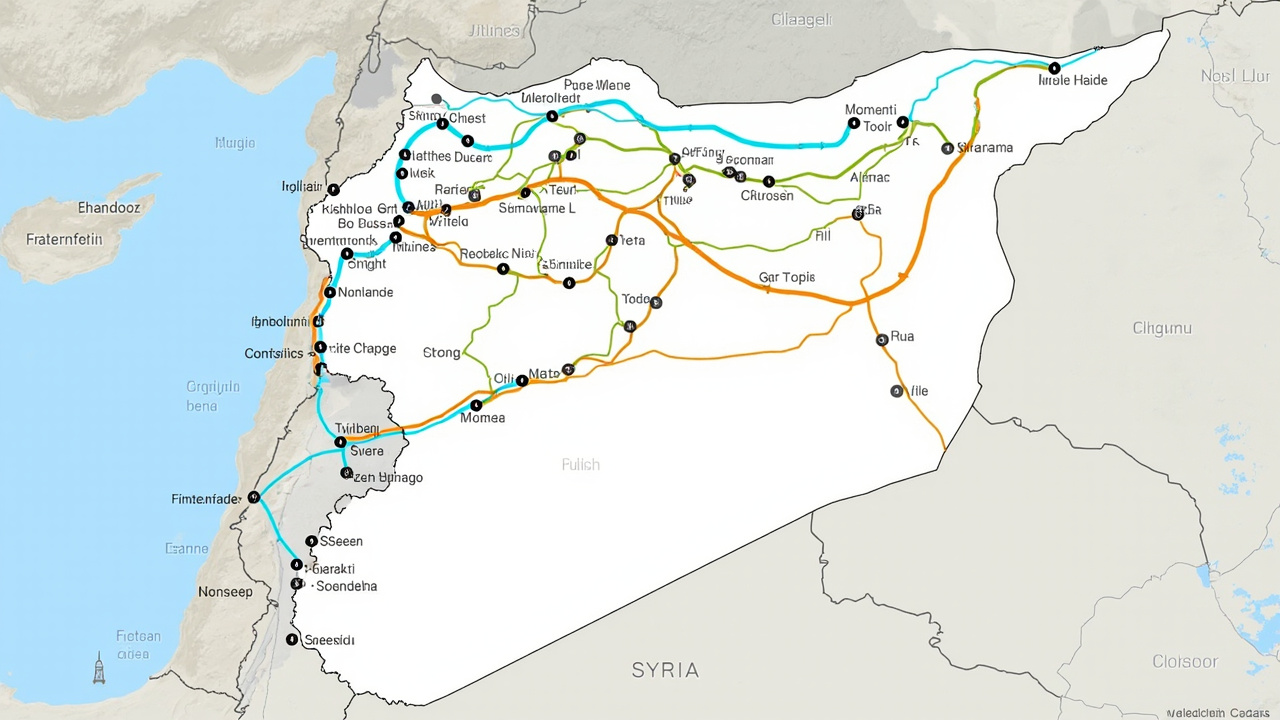
The concept under discussion involves multiple interconnected pipelines. The Arab Gas Pipeline — originally designed to carry Egyptian gas to Lebanon via Syria — would be resurrected and expanded. A new pipeline running from Jordan’s shared gas fields, through northern Syria, and into Turkey’s energy hub at Ceyhan, could offer an alternative route for Eastern Mediterranean gas to reach European markets without transiting the Gulf.
Perhaps most ambitious is a revived proposal for a Gulf-to-Mediterranean pipeline. With Iranian routes eliminated from consideration by the ongoing conflict, the route through Iraq and Syria — underwritten by American diplomatic support and Gulf financing — has moved from the fringe to the center of regional planning discussions.
Turkey’s Energy Minister arrived in Damascus this week with a 47-point infrastructure proposal, including plans to rehabilitate the Ceyhan-Mardan oil pipeline, expand the Baku-Tbilisi-Ceyhan bypass corridor, and negotiate Syrian transit rights for gas destined for European markets. Turkish sources described the talks as “the most substantive energy discussions between the two countries in recorded history.”
Turkey’s Rivalry With Israel Over Syrian Influence
The energy corridor push has also sharpened the rivalry between Turkey and Israel over influence in post-conflict Syria. The Stimson Center published an analysis this week noting that Turkey is moving aggressively to establish itself as the indispensable transit state between Gulf energy producers and European consumers — a role Israel had hoped to occupy through its own Eastern Mediterranean gas diplomacy.
Turkey’s Foreign Minister Ahmet Davutoglu made an unannounced visit to Damascus — his third in six weeks — specifically to lock in Syrian commitments to Turkish transit rights before an eventual Iran ceasefire opens new competitive routes. The message from Ankara is clear: Turkey intends to be the gatekeeper.
Israel has not been passive. Israeli officials have held parallel talks with both Damascus and Washington about ensuring Israeli gas can reach European markets through any new Syrian corridor — a significant concession from a country that has historically viewed Syrian infrastructure development with deep suspicion. The war has created a rare moment of coincident interests between Israel, Turkey, and the Gulf states.
The Skeptics: A Pipe Dream in a War Zone
Not everyone is convinced. Regional analysts and former energy officials have poured cold water on the enthusiasm, pointing to fundamental obstacles that no amount of political goodwill can dissolve in the near term.
Syria’s infrastructure is shattered after 15 years of civil war. Pipeline networks have been bombed, looted, and neglected. The workforce needed to rehabilitate them — engineers, technicians, construction crews — is largely dispersed or absorbed in reconstruction of civilian infrastructure. A realistic timeline for meaningful pipeline capacity, most experts agree, stretches to 2029 or 2030 at the earliest.
“Calling this a pipeline corridor is premature. What we are looking at is the beginning of a long, complicated negotiation over infrastructure that does not currently exist in any meaningful form,” said a former senior official at the International Energy Agency, who asked not to be identified because of ongoing consultancy work with several governments
involved in the talks.
Russia’s role remains the great unknown. The Kremlin has observer status in the Syrian energy talks — an arrangement that reflects Moscow’s complex position. Russia benefits from high energy prices caused by the Hormuz crisis. It also has military assets in Syria, at Tartus and Khmeimim, that give it leverage over any energy corridor that crosses Syrian territory. Russia is unlikely to obstruct the talks outright, but it will seek to extract maximum concessions in exchange for non-interference.
Beyond Pipelines: The Strategic Prize
Behind the infrastructure talk lies a larger strategic calculation. A functional Syrian energy corridor would fundamentally alter the balance of power in the Eastern Mediterranean. Gulf gas flowing through Syrian territory to Turkey and Europe would reduce European dependence on Russian energy more effectively than any sanctions regime — while simultaneously building an economic relationship between the Gulf states, Syria, and Turkey that could reshape regional alignment for a generation.
For the United States, the corridor represents an opportunity to demonstrate that the Iran war produced a strategic dividend — that the disruption of the old order opened space for a new one built on US-brokered partnerships. For the Gulf states, it is a chance to diversify energy transit routes away from the strait that has proved so vulnerable. For Syria, it is the most significant economic opportunity since before the civil war began in 2011.
The talks in Damascus are, in the words of one participating diplomat, “as serious as anything that has happened in the region in the last decade.” Whether they produce tangible infrastructure before the Iran war ends — and an Iran ceasefire would immediately reduce the urgency of the entire project — remains the defining question of Middle Eastern energy politics in 2026. The clock is ticking. The pipelines are not yet built. But for the first time, they are being seriously planned.
Elena Rodriguez is an International Affairs Correspondent for Media Hook, covering global diplomacy, conflict, and the emerging world order.