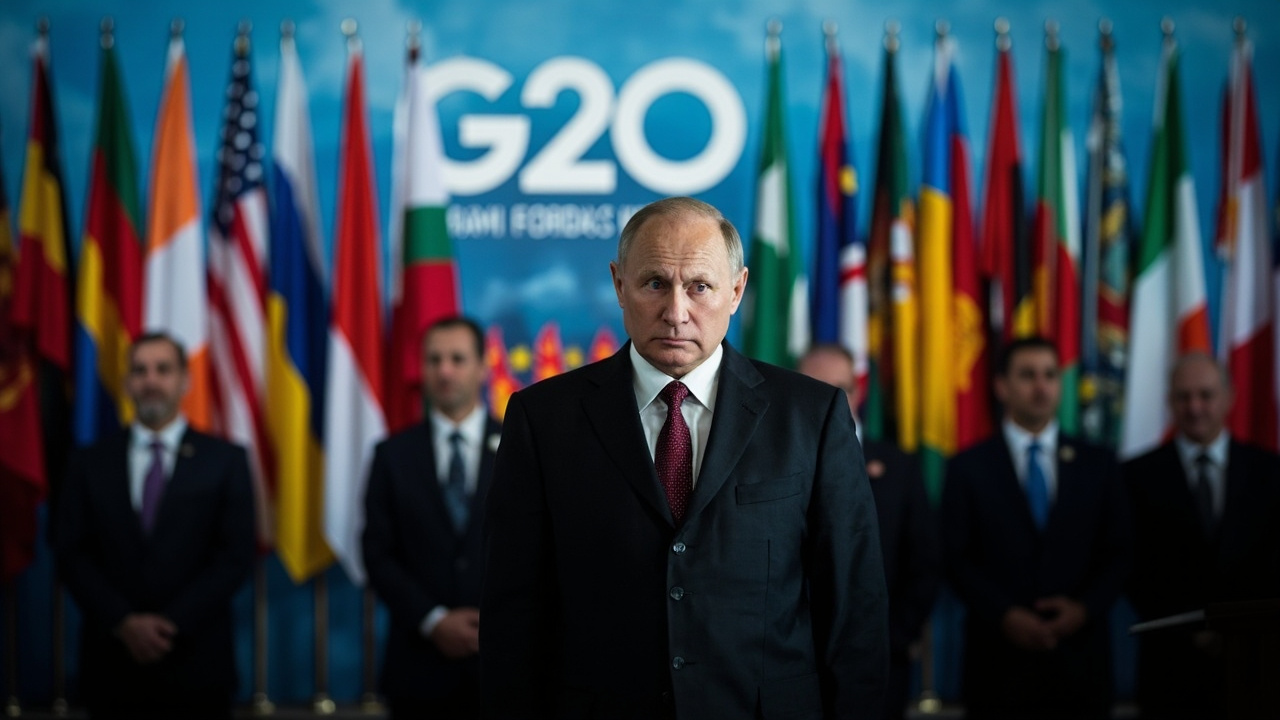
When the United States announced it would invite Vladimir Putin to the G20 summit in Miami later this year, the reaction from European capitals was swift and unmistakable: disbelief, followed by fury. The invitation, confirmed by senior Trump administration officials on April 23rd, did not just shock allies — it exposed a crack in the Western alliance so deep that it may never fully heal.
For three years, Putin has been effectively exiled from the institutions of Western power. The International Criminal Court’s arrest warrant — issued in 2023 for atrocities committed during Russia’s invasion of Ukraine — has kept him largely confined to Russia and a shrinking circle of sympathetic states. Most of Europe, bound by ICC obligations, would have been legally required to detain him on arrival. Now, with Washington extending the invitation, those constraints are being brushed aside by the very power that once championed them.
“All G20 members will be invited to attend ministerial meetings and the leaders’ summit,” the senior official said. The Kremlin, for its part, was characteristically measured. “No such decisions have been made yet,” spokesman Dmitry Peskov told reporters in Moscow on April 24th, while Deputy Foreign Minister Alexander Pankin acknowledged Russia had received an invitation at “the highest level” for the December 14-15 summit.
The Fracture Nobody Wanted to Acknowledge
Trump’s move is the logical culmination of a foreign policy trajectory that has been visible for months. since returning to the White House, the President has made no secret of his desire to rehabilitate Russia’s standing on the world stage. He welcomed Putin to Alaska last August — the Russian leader’s first step onto Western soil since the 2022 invasion. He has repeatedly blamed Ukrainian President Volodymyr Zelensky for the ongoing war, insisted that “President Putin was very offended” by Russia’s expulsion from the G8 in 2014, and promised a grand Miami summit that would signal a new era of US-Russia engagement.
“I don’t know that he’s coming. I doubt he’d come, to be honest with you.”
— President Donald Trump, April 23rd, 2026
The invitation is also, implicitly, a repudiation of the European allies who have spent the last four years arguing that isolating Russia was the only morally and strategically coherent position. France, Germany, Poland, and the Baltic states have poured tens of billions of euros into supporting Ukraine, accepted millions of Ukrainian refugees, and rebuilt their defense industries from near-emptiness. For them, the Miami invitation feels like a betrayal — or worse, like the moment the United States decided that its bilateral relationship with Russia was worth more than the transatlantic alliance itself.
Europe’s Reckoning: Strategic Autonomy or Strategic Delusion?
The Putin invitation arrives at a moment when Europe was already grappling with the deepest questions about its own strategic identity. The EU’s Readiness 2030 program — a sweeping initiative to rearm the continent by the end of the decade — has accelerated defense spending across the Union to historic levels. France and Poland’s joint military satellite project, launched from Gdansk this week, is the latest symbol of a Europe that is trying to reduce its dependence on American intelligence, logistics, and hardware.
But spending money is not the same as developing capability. Europe’s defense industrial base remains fragmented along national lines, with interoperability gaps, bureaucratic silos, and decades of underinvestment that cannot be erased by a few budget announcements. A continent that spent the post-Cold War era cutting its armies to the bone now finds itself scrambling to rebuild, under time pressure, while its closest security partner appears to be actively courting the adversary that precipitated the crisis.
“The G20 was never just an economic forum. It was a statement about what kind of world order we wanted to live in. That statement is now in question.”
— Senior EU diplomat, speaking on condition of anonymity
The reactions from Berlin, Paris, and Warsaw have been carefully worded — diplomatic understatement designed to preserve relationships even as the substance of those relationships is being questioned. Behind closed doors, according to EU officials, the language is considerably blunter. The invitation is seen not merely as a policy disagreement but as evidence that the United States’ commitment to the alliance cannot be taken for granted, no matter what the communiques say.
The ICC Question: Rules-Based Order Undermined
One of the most significant dimensions of the invitation is what it says about the future of international justice. The ICC’s arrest warrant for Putin — the first issued against a sitting head of state for aggressive war — was always going to create diplomatic complications. The court’s 124 member states are obligated to detain him if he enters their territory. The United States, not being an ICC signatory, faces no such constraint. But the fact that Washington is actively facilitating Putin’s return to multilateral diplomacy through an institution that counts many of America’s closest allies among its members puts those allies in an untenable position.
If Putin attends Miami, European leaders will face a choice they have spent years trying to avoid: defy the United States or defy the international legal order they have spent decades building. That is not a choice anyone in Brussels, Berlin, or Paris wanted to make in 2026. It is, nonetheless, the choice that the Trump administration’s invitation has forced upon them.
What Comes Next
Whether Putin ultimately travels to Miami remains genuinely uncertain. The Kremlin says no decision has been made. The logistics of an ICC-shadowed leader attending a summit in a country whose justice system is watching closely are not trivial. But the invitation itself has done its damage. It has revealed, in the starkest possible terms, that the Western alliance that held together through the Cold War, through Kosovo, through Afghanistan, and through the first years of the Ukraine war, may now be operating on fundamentally different premises.
For the United States, the G20 is a chance to reassert American centrality in global governance on its own terms — to demonstrate that it remains the indispensable power, capable of bringing adversaries and allies alike to the same table. For Europe, it is a warning sign that the world they invested in, the rules they believed in, and the alliances they trusted may not be the world they wake up to in December. The question now is not whether the G20 will meet in Miami. It is whether the Western alliance will survive what happens there.
Sources: France 24, Reuters, The Moscow Times, Kyiv Independent, U.S. News, EU Commission, Defense Matters Europe.
Elena Rodriguez is an International Affairs Correspondent for Media Hook, covering global diplomacy, conflict, and the emerging world order.