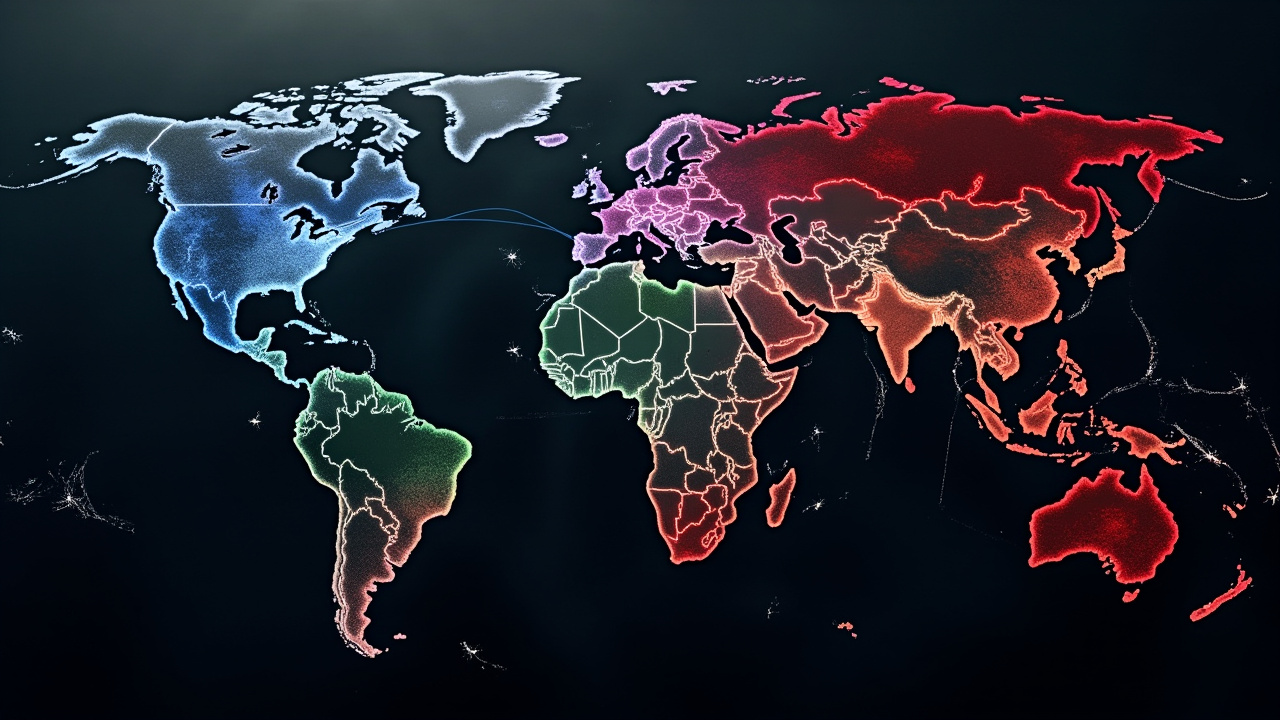
The battle for semiconductor supremacy is no longer just about technology — it is the defining geopolitical contest of the 2020s. In 2026, the convergence of artificial intelligence, export controls, and strategic reshoring has created a new axis of global power, one where control over chips means control over the future.
The numbers are staggering. Global semiconductor revenue surpassed $700 billion in 2025 and is projected to clear $1 trillion before the decade ends. But behind these figures lies a story of escalating confrontation between the United States and China — a contest that has redrawn supply chains, triggered industrial policy on a scale not seen since the Cold War, and left nations across the Global South scrambling to avoid becoming collateral damage in a technological siege.
What began as targeted export controls on advanced chips has metastasized into a full-spectrum technology war. The United States, supported by Japan and the Netherlands, has tightened restrictions on the equipment needed to manufacture cutting-edge semiconductors. China has responded with export controls on gallium, germanium, and rare earth elements — the raw materials that make modern electronics possible. The result is a world increasingly divided into technological blocs, where the free flow of innovation that defined the early 21st century is giving way to strategic decoupling.
The Architecture of Control: Export Restrictions and Their Ripple Effects
The Biden administration’s October 2022 export controls were initially framed as a narrow national security measure. By 2026, they have evolved into something far more ambitious: an attempt to permanently deny China access to the most advanced AI training capabilities. The restrictions now cover not only finished chips but also the lithography equipment, design software, and even the engineering talent needed to build competitive alternatives.
The Netherlands-based ASML, the sole manufacturer of extreme ultraviolet (EUV) lithography machines essential for producing the most advanced nodes, has become a reluctant instrument of American foreign policy. Under sustained diplomatic pressure, the Dutch government has progressively restricted ASML’s ability to sell even older deep ultraviolet (DUV) systems to Chinese buyers. Each restriction tightens the noose on China’s domestic chipmaking ambitions.
China’s response has been multifaceted. Huawei’s SMIC-fabricated Kirin chips demonstrated that Chinese manufacturers could achieve surprisingly capable results even with older equipment, though at significantly higher cost and lower yield. Beijing has poured over $150 billion in state subsidies into its domestic semiconductor ecosystem, creating a sprawling network of fabs, research institutes, and design houses. The question is no longer whether China can build chips — it can — but whether it can build them at the leading edge without access to the tools and expertise that the rest of the ecosystem takes for granted.
The semiconductor supply chain is the most complex industrial system ever created by human civilization. A single advanced chip may involve materials sourced from six continents, equipment designed in a dozen countries, and manufacturing processes requiring atomic-level precision. No nation — not the United States, not China — can replicate this entire chain alone. Yet both are trying.
AI as the New Oil: Why Chips Have Become Strategic Weapons
The intensity of the chip war makes sense only in the context of the AI revolution. Large language models, autonomous weapons systems, advanced surveillance architectures, and next-generation scientific research all depend on access to massive computational clusters built around the most advanced GPUs and AI accelerators. Nvidia’s H100 and its successors have become the literal infrastructure of artificial intelligence — and control over their distribution has become a lever of geopolitical power.
The United States has recognized this explicitly. The export control updates created a three-tier global framework: Tier 1 allies face minimal restrictions; Tier 2 countries face quantitative caps; Tier 3 nations, including China, Russia, Iran, and North Korea, face near-total embargoes. This framework effectively weaponizes the semiconductor supply chain, turning chip access into a tool of alliance management.
The implications extend far beyond Beijing. Countries like India, Saudi Arabia, and the United Arab Emirates — all aspiring AI powers — find themselves in the middle tier, subject to caps that constrain their ability to build the computational infrastructure they believe they need. The result is a diplomatic backlash that the United States has struggled to manage, even as it has tightened the screws on China.
The Reshoring Gamble: Industrial Policy on an Unprecedented Scale
The chip war has triggered a global reshoring frenzy. The U.S. CHIPS Act committed $52.7 billion to domestic semiconductor manufacturing, but the actual investment dwarfs that figure when private sector commitments are included. TSMC is building fabs in Arizona. Intel is expanding in Ohio. Samsung is investing in Texas. Together, these projects represent over $200 billion in planned U.S. semiconductor investment.
Europe has responded with its own European Chips Act, committing €43 billion. Japan has allocated over $25 billion to revitalize its semiconductor industry. Even India, long a software powerhouse but a hardware laggard, has approved $15 billion in incentives to attract fab construction. The race is on to build redundant, geographically distributed manufacturing capacity — a direct repudiation of the hyper-efficient, hyper-concentrated supply chain model that prevailed for three decades.
Taiwan produces over 60% of the world’s semiconductors and more than 90% of the most advanced chips. Any disruption to Taiwanese manufacturing — whether from military conflict, natural disaster, or political coercion — would constitute an economic catastrophe without modern precedent. This single point of failure is the ticking clock behind every decision in the chip war.
But reshoring is not a switch that can be flipped. TSMC’s Arizona projects have faced delays driven by cultural clashes, construction challenges, and workforce shortages. The talent pipeline — experienced fab engineers, process technicians, equipment specialists — cannot be legislated into existence. It takes a decade to train a semiconductor engineer, and the global talent pool is already stretched thin by the simultaneous expansion of fabs across three continents.
The Taiwan Factor: The Sword of Damocles
No analysis of the semiconductor war is complete without confronting the Taiwan question directly. The island’s dominance in chip manufacturing — particularly TSMC’s near-monopoly on the most advanced process nodes — represents the single greatest concentration of strategic vulnerability in the modern global economy. The “silicon shield” theory, which holds that Taiwan’s chipmaking importance deters Chinese military action, is being tested as never before.
China’s military modernization continues apace, with amphibious assault capabilities improving annually. Meanwhile, the United States has deepened its security commitments to Taiwan while simultaneously trying to reduce its own dependence on Taiwanese chips — a contradiction that is not lost on policymakers in Taipei. The Taiwanese government has urged TSMC to keep its most advanced technologies on the island even as it builds overseas fabs, acutely aware that offshoring its crown jewels could weaken the very strategic importance that affords it protection.
The Path Forward: Toward a Fragmented but Manageable Order
The semiconductor war will not have a winner in the traditional sense. Neither the United States nor China can achieve full technological independence within the next decade, and neither can afford the economic costs of a complete decoupling. The most likely outcome is a fragmented but managed order — three or four distinct technological zones with limited interoperability, governed by a patchwork of bilateral agreements and technical standards.
For the United States, the priority must be maintaining its lead in AI and advanced manufacturing while building resilient supply chains that can survive a Taiwan contingency. This means accelerating domestic talent development, deepening alliances with Japan, South Korea, and the Netherlands, and finding ways to manage the ambitions of middle-tier nations without driving them into China’s orbit.
For China, the challenge is existential. Without access to EUV lithography and advanced design software, the gap between Chinese and Western semiconductor capabilities will widen, not narrow, over the next five years. Beijing must decide whether to pursue a costly full-spectrum domestic alternative — which may take a decade and cost half a trillion dollars — or seek to exploit the seams in the Western coalition through covert acquisition, talent recruitment, and technology transfer.
The semiconductor war is not a zero-sum game, but it is being fought as one. The risk is that both sides overestimate their leverage, underestimate each other’s resilience, and stumble into a technological cold war that impoverishes everyone. The stakes could not be higher — and the margin for error could not be thinner.
For the rest of the world, the semiconductor war presents both danger and opportunity. Nations with mineral resources — Chile, Australia, the Democratic Republic of Congo — find themselves courted as never before. Countries with the potential to host fabs — India, Vietnam, Malaysia — are negotiating investment deals that could reshape their economic trajectories. And the Global South, broadly, faces a stark choice: align with one technological bloc, navigate between them, or risk being left behind entirely.
The IMF’s April 2026 World Economic Outlook warned that “prolonged technological fragmentation could reduce global GDP by up to 7% over the next decade.” That estimate may prove conservative if the chip war escalates further. What is certain is that the semiconductor industry — once the invisible substrate of modern life — has become the most consequential battlefield in global politics. The decisions made in Washington, Beijing, Taipei, and The Hague over the next 24 months will shape the economic and security architecture of the 21st century.
The chips are down. The world is watching.
David Foster is a Senior Analyst for Media Hook, specializing in geopolitical analysis, economic trends, and the forces reshaping the global order.