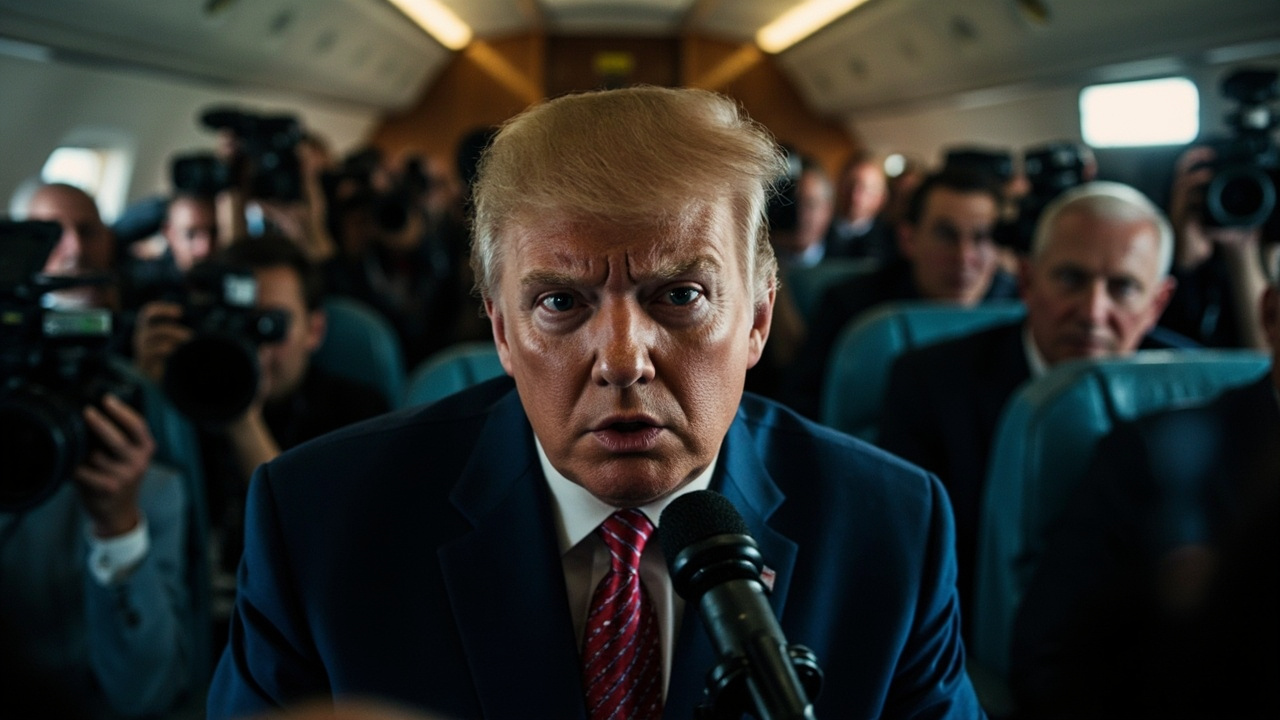
President Donald Trump warned Saturday that the United States could resume military strikes against Iran if Tehran misbehaves, just hours after notifying Congress that hostilities had been terminated under the 60-day War Powers clock.
The dual messages — one of de-escalation, one of threat — underscored the precarious state of the US-Iran conflict as both nations navigate an uncertain path between war and diplomacy.
Speaking to reporters aboard Air Force One, Trump said the situation with Iran was in a holding pattern but far from resolved. The hostilities are terminated for now, the president said, according to a pool report. But if they misbehave, we will restart them very quickly and very powerfully.
The warning came on the same day the White House transmitted a formal letter to Congress stating that US military operations against Iran had ceased as of the 60-day deadline imposed by the War Powers Resolution. The letter, required by law, effectively acknowledged that the administration had exhausted its statutory authority to conduct offensive operations without a new congressional authorization.
But Trump made clear he did not consider the matter closed. We have tremendous capability still in the region, he said. If Iran does anything — anything at all — we will hit them harder than before.
The 14-Point Peace Proposal
The president also confirmed he had rejected a 14-point peace proposal submitted by Tehran through intermediaries. The offer, which reportedly included provisions for mutual de-escalation zones and third-party verification of nuclear compliance, was dismissed by Trump as inadequate.
They want to negotiate from a position where they keep everything and we get nothing, Trump said. That is not how deals work.
Iranian Foreign Minister Abbas Araghchi responded sharply, telling state media that Washington was not serious about peace. They say the war is terminated but they keep their forces on our borders and threaten to strike again, Araghchi said. This is not peace. This is occupation by another name.
The Regional Picture
The US maintains approximately 45,000 troops across the Middle East, including two carrier strike groups in the Arabian Sea and significant air assets at bases in Saudi Arabia, the UAE, and Bahrain. Iran, meanwhile, has been working to reconstitute air defense systems damaged in the eight-week bombing campaign that preceded the ceasefire.
Military analysts warn that both sides are using the pause to reposition rather than demobilize. What we are seeing is not disarmament but reloading, said retired General Mark Hertling, a CNN military analyst. Both militaries are taking advantage of the operational pause to replenish, repair, and reposition for the next phase — whatever that may be.
Political Pressure at Home
The War Powers deadline has also intensified political pressure on Capitol Hill. A bipartisan group of senators is preparing legislation that would require explicit congressional approval for any renewed military action against Iran. Senator Rand Paul, a longtime critic of presidential war powers, said the administration cannot simply flip a switch and restart a war.
The Constitution is clear, Paul said. If the president wants to go back to war with Iran, he needs to come to Congress first.
But Trump allies argue the president retains inherent authority to defend US forces and interests. If Iran attacks our troops or our allies, the president does not need permission to respond, said Senator Lindsey Graham. That is Commander-in-Chief 101.
What Comes Next
Diplomatic channels remain open through Swiss and Omani intermediaries, but trust between the two capitals is at a historic low. European allies, particularly France and Germany, are pushing for a formal ceasefire agreement with monitoring mechanisms — a proposal both Washington and Tehran have so far resisted.
For now, the guns have fallen silent. But as Trump made clear Saturday, the silence is conditional — and could end with a single phone call.