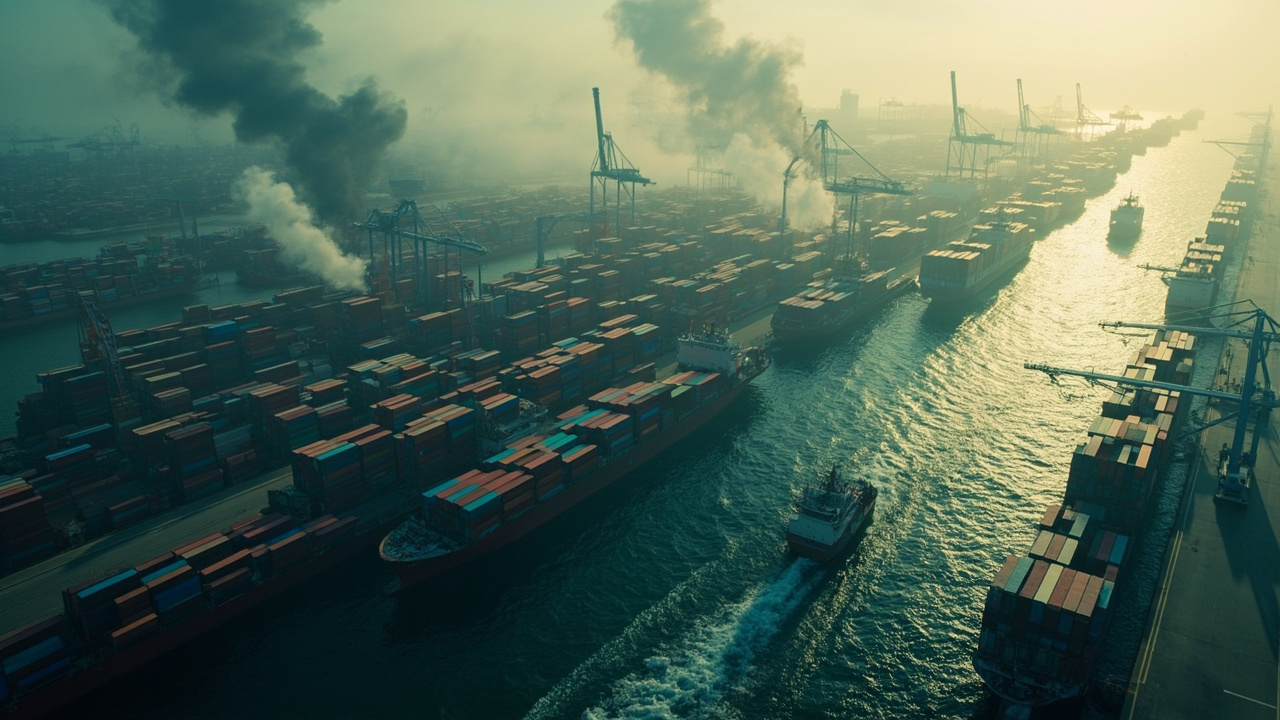
Kyiv and NATO commanders scrambled on May 12, 2026, after Russia launched a coordinated series of drone strikes against civilian merchant vessels operating in the Black Sea and the northern reaches of the North Sea — a significant escalation in the three-year conflict that has seen fighting spread well beyond Ukraine’s borders.
The strikes, confirmed by Ukraine’s Military Intelligence Directorate (HUR) and corroborated by NATO maritime surveillance sources, targeted at least four commercial cargo ships flying Panamanian, Greek, and Turkish flags. No casualties were reported aboard the vessels, but two ships sustained damage to their superstructures and communications arrays, forcing them to put into port in Constanța, Romania. The attacks mark the first time Russian forces have systematically targeted North Sea commercial shipping since the war’s early phases in 2022.
“What we are witnessing is a deliberate attempt to raise the cost of humanitarian corridor access. This is not battlefield spillover — it is a calculated policy.” — Major General Olena Sokolinska, Ukraine’s Deputy Minister of Defence
The Sumy Offensive: Russia’s New Ground Push
Alongside the maritime escalation, Russian ground forces advanced in the Sumy region of northeastern Ukraine, pressing into Ukrainian defensive lines that have been under sustained pressure since late April. Open-source intelligence analysts at Geo-confirmed reported Russian units advancing approximately 8 kilometres along a 30-kilometre frontage south of the Bilopillia axis, capturing at least two small settlements that had served as Ukrainian forward observation posts.
Ukraine’s General Staff acknowledged “intense fighting” in the sector but declined to confirm territorial losses, citing operational security. The Sumy offensive represents a shift in Russia’s targeting strategy — prioritising a grinding ground campaign along a relatively static front over the long-range missile and drone barrages that characterised 2025’s fighting.
“Moscow has decided it can attrit Ukrainian forces faster than Kyiv can replace them. The mathematics are grim but not irreversible — Ukraine needs sustained Western ammunition supply, not another summit photo-op.” — Dr. Marcus Weir, senior fellow, European Council on Foreign Relations
The Mindich Tapes: Ukraine’s Corruption Reckoning
Separately, a leaked archive of recorded conversations — dubbed the “Mindich Tapes” after the journalist whose source leaked them — has sent shockwaves through Kyiv’s political establishment. The recordings, verified by three independent Ukrainian media outlets, appear to capture senior officials in the Presidential Office discussing kickback arrangements on defence contracts, including a scheme involving inflated pricing for drone procurement from a state-affiliated manufacturer.
President Volodymyr Zelenskyy ordered an immediate National Anti-Corruption Bureau investigation on May 11, and two officials named in the recordings were suspended pending inquiry. The timing is acutely sensitive: Ukraine is in the final stages of negotiating a $50 billion IMF standby arrangement, and the Trump administration has made anti-corruption governance a stated condition for continued US security assistance.
“Corruption during wartime is not a political inconvenience. It is a direct threat to the soldiers holding the line. The West needs to see action, not statements.” — Yulia Klymenko, chair of the Ukrainian Parliament’s anti-corruption committee
Data: Ukraine War — Key Metrics
| Metric |
Value |
Russian advances (Sumy sector, May 2026) |
~8 km |
Frontage under pressure |
30 km |
Commercial vessels struck (May 10–12) |
4 |
NATO North Sea advisory zone |
50 nautical miles |
IMF programme under negotiation |
$50 billion |
Officials suspended (Mindich investigation) |
2 |
|
|---|
Implications and Outlook
The convergence of maritime drone strikes, a renewed Russian ground offensive, and an unfolding domestic corruption scandal places Ukrainian leadership under simultaneous pressure on three fronts. Western partners have so far maintained military supply flows, but fatigue in Washington — where the Trump administration continues to link assistance to governance benchmarks — adds an external dimension to what is primarily a domestic governance crisis.
The Sumy offensive, if sustained, could force Ukraine to redirect reserves from other sectors, creating potential cascading pressure along the eastern front. Whether Russia can sustain the advance logistically — given its own chronic manpower and equipment challenges — remains the central question for analysts tracking the conflict’s trajectory.