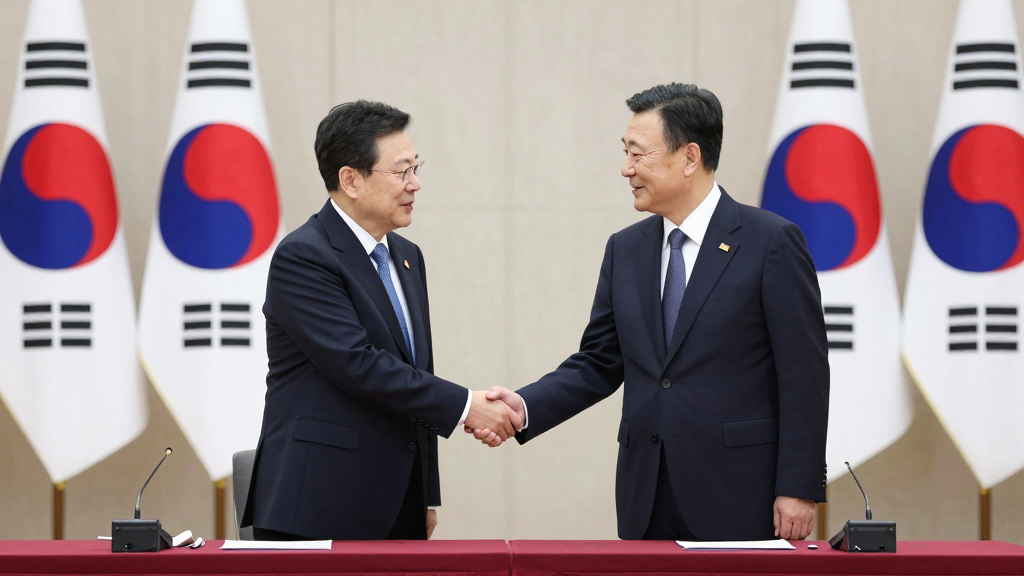
SEOUL — South Korea and Japan have renewed their joint commitment to the denuclearization of the Korean Peninsula, a move that signals a meaningful shift in bilateral defense relations at a time of mounting regional security pressures. The announcement came during high-level talks in Seoul on Sunday between South Korean Minister of National Defense Ahn Gyu-back and Japanese Minister of Defense Shinjiro Koizumi, their sixth round of bilateral discussions aimed at stabilizing a neighborhood complicated by North Korea's accelerating nuclear ambitions.
The two ministers agreed to revive joint search-and-rescue drills and to coordinate more closely on regional stability both bilaterally and through their partnerships with Washington. The meeting followed weeks after the neighbors held their first joint maritime search-and-rescue exercise in nine years — a drill held west of Japan's Goto Islands on June 7 involving the Japan Maritime Self-Defense Force destroyer JS Kongo and Republic of Korea Navy vessel ROKS Cheon Ja Bong.
North Korea Nuclear Threats Drive Cooperation
The timing of the rapprochement reflects urgent shared concerns. North Korean leader Kim Jong-un recently vowed to bolster his country's defense capabilities, including equipping his navy with nuclear weapons and pressing ahead with missile testing. “Both ministers shared the view to continue cooperation for maintaining regional peace and stability amid a grave security environment,” the South Korean Ministry of Defense said in a statement.
Pyongyang has not only retained its nuclear arsenal but appears determined to expand it. Earlier this month, Kim declared that North Korea would strengthen its naval forces with nuclear capabilities and build larger warships, citing military modernization by South Korea and the United States as justification. Observers say the rhetoric places renewed pressure on Seoul and Tokyo to present a united front.
Japan and South Korea have historically been cautious about public displays of military cooperation, weighed down by disputes stemming from Japan's colonial rule of the Korean Peninsula in the early 20th century. Lingering grievances over Korean women forced to work in Japanese military brothels during World War II and competing territorial claims over a cluster of disputed islands have repeatedly strained the relationship.
A New Chapter in Naval Cooperation
Despite those headwinds, the revival of the Search and Rescue Exercise — known as SAREX — marks a concrete step forward. The drill, last conducted in 2017, had been suspended following a December 2018 incident in which a South Korean destroyer allegedly illuminated a Japanese maritime patrol aircraft with fire-control radar, one of the most serious crises in postwar Japan-South Korea defense relations.
Ties began recovering after defense ministers agreed on recurrence-prevention measures at the 2024 Shangri-La Dialogue, and SAREX resumption was formally confirmed at a Yokosuka ministerial meeting in January. Japanese Defense Minister Shinjiro Koizumi welcomed the outcome on social media, calling it “the beginning of a new chapter” in bilateral defense cooperation.
The practical significance goes beyond symbolism. The exercises included LINKEX — a communications linkage drill — and cross-deck helicopter operations, activities designed to sharpen interoperability applicable to humanitarian assistance, disaster relief, and broader maritime security missions.
“The inclusion of LINKEX and cross-deck operations reflects a renewed focus on interoperability,” one Japan Maritime Self-Defense Force official told reporters. “These activities enhance tactical information sharing and operational coordination.”
Regional Pressures and Remaining Friction
The exercise comes amid a shifting regional environment shaped by China's growing naval presence in the East China Sea and South China Sea, and uncertainty over the durability of U.S. alliance commitments under shifting American leadership. Neither government has linked the drills directly to Beijing, but analysts say the structural pressures from an increasingly assertive China have strengthened incentives for Tokyo and Seoul to coordinate more closely as key U.S. allies in Northeast Asia.
Challenges remain. Negotiations over an Acquisition and Cross-Servicing Agreement (ACSA) — which would streamline the sharing of supplies and services between the two militaries — have yet to advance. Historical sensitivities continue to constrain deeper institutional cooperation, and public opinion in both countries remains sensitive to visible signs of military closeness.
Koizumi is expected to visit Seoul later this month for further talks on bilateral and trilateral defense cooperation involving the United States. For now, the revival of joint naval exercises represents the most tangible evidence in years that South Korea and Japan are capable of setting aside old grievances to address shared regional threats.