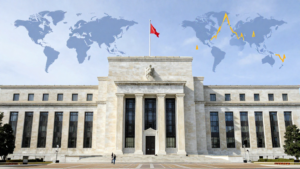
Warsh Charts Hawkish Course in Fed Debut as Nine Officials Signal Rate Hike Ahead
The Federal Reserve held interest rates steady at a range of 3.50 percent to 3.75 percent on Wednesday, the first policy decision under new Chairman Kevin Warsh, who signaled a more hawkish stance than his predecessor and confirmed he did not submit a rate forecast of his own for the first time in the central bank’s modern era.
The unanimous vote to hold came as nine of 18 Fed officials projected that the federal funds rate would end 2026 above its current target range, according to updated Summary of Economic Projections released alongside the decision. The median projection now calls for the rate to reach 3.8 percent by year-end, up sharply from 3.4 percent in the March forecast, implying at least one quarter-point hike is on the table. The Fed’s policy statement underwent its most extensive rewrite in years, dropping the word “patient” and replacing it with language acknowledging elevated uncertainty around the inflation outlook.
Warsh Declines to Submit a Rate Forecast
In a post-meeting press conference, Warsh declined to provide his own dot-plot forecast, breaking from decades of tradition that expects every FOMC participant to project the likely path of interest rates. “I did not submit a dot for me. It is not helpful in the conduct of policy,” Warsh told reporters, adding that the central bank may have provided excessive forward guidance under prior leadership. His refusal to submit a forecast immediately rattled markets, which had been anticipating clarity from the new chairman’s debut. S&P 500 futures fell 0.7 percent in the minutes after the statement, while the two-year Treasury yield climbed to 4.23 percent from 4.15 percent before the decision.
The absence of Warsh’s own projection left investors to parse the revised statement and the updated dot plot for signals about the Fed’s direction. “We are in a period where the balance of risks is tilted toward doing too little rather than too much on inflation,” said Ellen Hazan, chief investment officer at Prime Capital. “Warsh is telling us he is not afraid to hike even if growth slows, and that is a meaningful shift from Powell.” Former chairman Jerome Powell had signaled a willingness to cut rates if the labor market showed signs of weakening, language conspicuously absent from Warsh’s first policy statement.
Inflation Pressures Remain the Central Focus
The Fed’s preferred inflation gauge, the Personal Consumption Expenditures price index, remains elevated at 3.1 percent year-over-year, well above the central bank’s 2 percent target. The January reading hit 3.4 percent before moderating through the spring, and policymakers have grown increasingly concerned that services inflation is proving resistant to the current rate environment. The February jobs report added 185,000 positions, and the unemployment rate held at 4.0 percent, giving the Fed the room it believes it needs to keep rates elevated without risking a sharp deterioration in the labor market.
Several regional Fed presidents have argued in recent speeches that the lag effects of prior tightening have been overstated and that monetary policy may not be as restrictive as models suggest. Fed Governor Michelle Bowman, who had dissented at the prior meeting in favor of an immediate hike, did not dissent this time, though sources familiar with internal deliberations suggested she viewed the decision as a tactical pause rather than a change in direction. The revised statement language on inflation uncertainty drew particular attention from bond traders, who noted it mirrored phrasing last used during the 2022-2023 rate-hiking cycle.
Markets Brace for Higher-for-Longer Reality
Interest rate futures markets moved sharply after the decision, with traders now pricing in a 68 percent probability of at least one rate hike by the December 2026 meeting, up from a 45 percent probability before the press conference began. The dollar index rose 0.4 percent against a basket of major currencies, while gold fell $22 per troy ounce to $2,871 as higher real yields made non-yielding assets less attractive. Bank stocks outperformed, with the KBW Bank Index gaining 1.8 percent on expectations that a steeper yield curve would expand lending margins.
The Trump administration, which appointed Warsh as Fed chairman earlier this year, has publicly supported higher interest rates as part of a broader strategy to combat inflation. White House press secretary Karoline Leavitt said the administration had “full confidence” in Warsh’s independence while noting that the president’s own economic priorities aligned with a strong-dollar, disinflationary environment. Economists warned that a sustained period of higher rates could weigh on the housing market, where the 30-year fixed mortgage rate has already climbed to 7.1 percent, its highest level since 2001.
Policy Path Remains Highly Contested Within Fed
The six-percentage-point gap between the most hawkish and most dovish dots in the updated Summary of Economic Projections underscores how deeply divided the committee remains about the appropriate policy path. The most hawkish projections show rates reaching 4.5 percent by the end of 2026, while the most dovish call for no change from current levels. Analysts said the wide dispersion reflects genuine uncertainty about whether the lagged effects of previous tightening will finally deliver the disinflation the Fed has been waiting for, or whether price pressures will prove stickier than anticipated.
Warsh is expected to present a comprehensive framework review at the Fed’s Jackson Hole symposium in August, where he is likely to lay out how he intends to restructure the central bank’s communications and decision-making processes. The review is expected to address whether the Fed should shift to a nominal spending target, reduce the frequency of individual forecasts, or adopt other structural changes. Until that broader review is complete, analysts said investors should expect continued volatility around FOMC announcements as markets adjust to a chairman who has shown an early willingness to break with established precedent.