Israeli military officials confirmed on May 12, 2026, the launch of a ground operation across multiple Palestinian towns in the occupied West Bank — the most extensive military campaign in the territory since the Second Intifada — following a series of attacks in and around Hebron that Israeli authorities attributed to militant cells with alleged Iranian backing.
Regional and Diplomatic Fallout
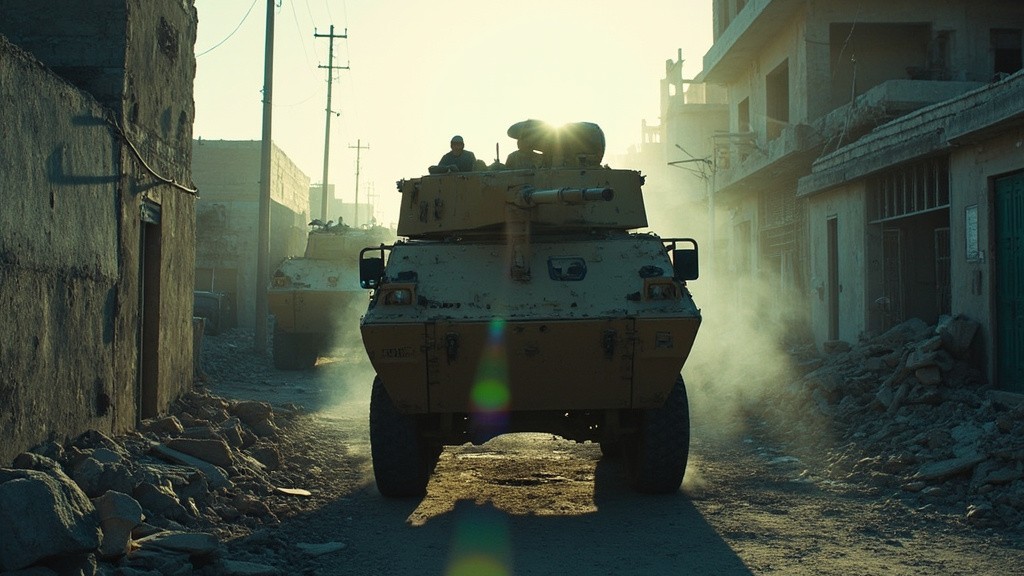
The operation, which Israeli military spokespeople described under the working designation “Operation Iron Rampart,” began with pre-dawn armoured deployments into Jenin, Nablus, and the surrounding refugee camps. Israeli Defence Forces said the operation was designed to “dismantle terrorist infrastructure” and secure Israeli communities adjacent to the West Bank boundary. Palestinian health authorities reported at least 23 civilian casualties and more than 140 wounded, figures that could not be independently verified.
“These operations are not surgical. They are not precise. The density of civilian life in these camps means any large-scale ground incursion will produce civilian casualties at a scale that cannot be described as collateral.” — Lynn Welchman, Director, al-Haq human rights organisation, Ramallah
The Palestinian Authority’s presidential office called the operation “a war crime under any legal framework” and referred the matter to the International Criminal Court prosecutor’s office in The Hague. The PA’s security forces, nominally coordinating with Israeli counterparts through existing security agreements, distanced themselves from the operation in a public statement that analysts read as a signal of deepening institutional fracture.
Quantifying the International Response
| Development | Detail |
|---|---|
| Countries issuing travel warnings for Israel/West Bank | 11 |
| Emergency UN Security Council session | Requested by Palestine, Algeria |
| EU foreign policy chief statement | “Deep concern, calls for immediate ceasefire” |
| US position | “Israel has the right to defend its citizens” |
| Iran denial | “No Iranian weapons or personnel in West Bank” |
| US Security Council veto (ceasefire resolution) | Third veto in 18 months |
The United States vetoed a UN Security Council resolution calling for an immediate ceasefire for the third time in 18 months, drawing sharp condemnation from EU member states and complicating already-fragile negotiations over the Iranian nuclear programme. Washington said it had received “credible intelligence” of weapons transfers from Iranian-affiliated networks to West Bank militant groups — a claim that European intelligence analysts described as “unverified and likely overstated.”
Jordan and Egypt, both of which share borders with the West Bank, issued emergency diplomatic warnings and began contingency planning for potential refugee flows. King Abdullah II of Jordan, in a rare direct public statement, called the Israeli operation “an act of irreversible destabilisation.”
Strategic Context and What Comes Next
The timing of the West Bank operation — concurrent with ongoing Gaza ceasefire negotiations and Iranian military strikes authorised by the Trump administration — has raised concerns among regional analysts that Israel is using the moment of US-Iran confrontation as cover for a fait accompli expansion of control. The Biden administration’s post-war framework, which had contemplated a long-term Israeli security presence in the West Bank’s Area C, may be effectively rendered moot before it is ever formally proposed.
“There is a theory in Israeli strategic thinking that the chaos of a US-Iran conflict creates a window in which hard security decisions can be taken without the usual diplomatic scrutiny. This operation looks like that theory in practice.” — Dr. Omar K. Rammal, Middle East analyst, European Council on Foreign Relations
Whether the international response — still largely rhetorical at this stage — escalates to meaningful pressure depends substantially on whether the IDF operation produces additional mass casualty events that cross the threshold of international public opinion tolerance. The next 48 hours will be critical.