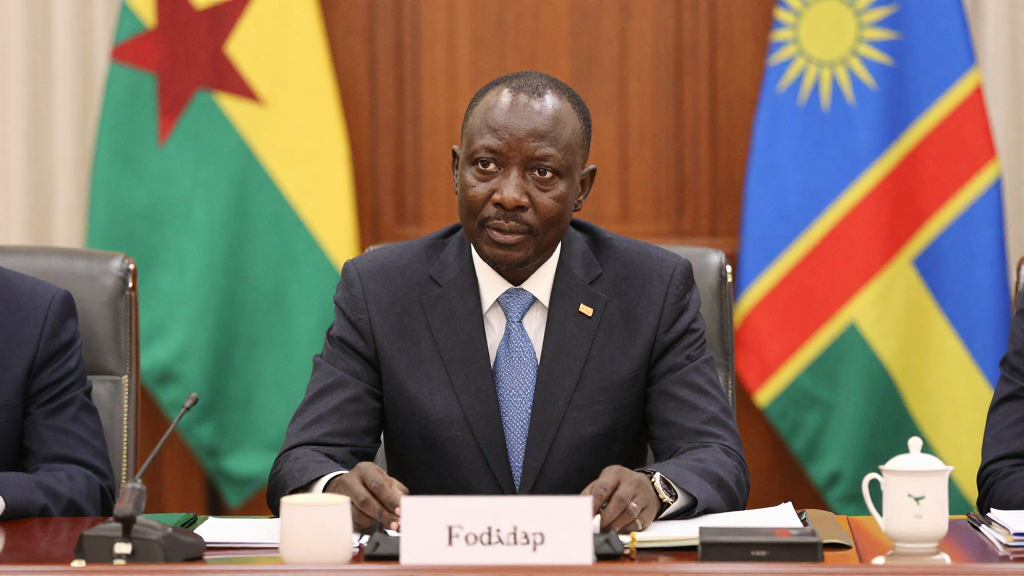
Burkina Faso Severs Diplomatic Ties with France
Burkina Faso has broken off diplomatic relations with France, further widening the rift with its former colonial ruler in a move that underscores the accelerating realignment of West Africa’s geopolitical landscape. The military government led by Captain Ibrahim Traore, in power since a coup in September 2022, announced the decision on Friday, accusing Paris of persistent interference and what it called “neo-colonial ambitions.”
“The government of Burkina Faso hereby informs the national and international community that it has decided to sever diplomatic relations with France with effect from today,” said a statement read out on national television by Communications Minister Gilbert Ouedraogo. He told viewers that France had demonstrated “active support for subversive networks and the terrorists who are plunging our country and the Sahel into mourning.” The minister added that the essential conditions for diplomatic relations based on mutual respect and national sovereignty were no longer in place.
The severance of ties marks a dramatic deterioration in relations that have been strained since Traore took power and began systematically distancing Burkina Faso from Western partners. France, once the dominant foreign power across the Sahel and much of Francophone Africa, has watched its influence erode rapidly as military governments in Mali, Niger, and now Burkina Faso have turned toward Russia and China for security cooperation and diplomatic backing.
Burkina Faso’s Russian Pivot and Domestic Repression
The break with France is the culmination of a steady pivot that began shortly after Traore took power. Ouagadougou has deepened its engagement with Moscow, welcoming Russian military advisors and private security contractors even as humanitarian organizations report escalating civilian casualties from armed group attacks and government counter-insurgency operations. The al-Qaeda-backed Jama’at Nusrat al-Islam wal-Muslimin (JNIM) and Islamic State Sahel Province (ISSP) now control large swaths of the country’s north, south, and west, and have consistently outpaced government forces despite the new security arrangements.
Beyond the diplomatic rupture, the Traore regime has cracked down on domestic opposition. In January, all political parties were formally dissolved and their assets seized — a move analysts described as a calculated demolition of any institutional opposition. Human Rights Watch documented allegations that government forces have committed atrocities against Fulani civilians amounting to ethnic cleansing and war crimes. The regime’s communication strategy, however, frames these actions as sovereign decisions free from foreign scrutiny.
The French foreign ministry said it was aware of the announcement and was “studying the implications.” A spokesperson said France remained committed to the safety of its nationals in Burkina Faso and expected the host government to uphold its obligations under international law. The decision does not affect cultural or people-to-people ties, according to Burkina Faso’s statement, which specified that French nationals would continue to receive legal protection.
DR Congo Takes Rwanda to International Court of Justice
On the opposite side of the continent, another major African crisis escalated through legal channels as the Democratic Republic of the Congo filed a case against Rwanda at the International Court of Justice, accusing Kigali of direct responsibility for three decades of atrocities in eastern DRC. The application, submitted to the ICJ — the United Nations principal court for disputes between states — details alleged massacres, sexual violence, forced displacement, and systematic discrimination targeting multiple ethnic communities since 1996.
The Congolese filing is sweeping in scope. It names Rwandan armed forces alongside proxy groups including the M23/AFC alliance and the Alliance of Democratic Forces for the Liberation of Congo-Zaire (AFDL), alleging they have conducted unlawful military operations targeting refugee camps, villages, and urban centers through the First and Second Congo Wars and continuing to the present day. The application specifically references abuses against Hutus who fled to DRC following the 1994 Rwandan genocide, as well as the Nyindu, Bembe, Lega, Nande, Hunde, and Bashi ethnic groups.
“The civilian populations of eastern DRC have been victims of massacres, extrajudicial executions, acts of torture, sexual violence, forced displacement, and discrimination,” the Congolese government stated, describing suffering of “exceptional magnitude.” The DRC is asking the court to order Rwanda to cease all alleged violations and award full reparations to both the state and individual victims. Kigali has consistently denied backing M23 or any other armed group in DRC territory, instead claiming its military presence is defensive action against the Democratic Forces for the Liberation of Rwanda (FDLR), a Hutu militia formed from perpetrators of the 1994 genocide.
This marks the third time DRC has sought ICJ action against Rwanda. A previous attempt in 2006 was dismissed after the court ruled it lacked jurisdiction. The filing comes after M23 rebels captured the strategic cities of Goma and Bukavu in early 2025, displacing hundreds of thousands and collapsing two successive peace frameworks — a US-brokered deal signed in June 2025 and a Qatari-mediated ceasefire that also failed to hold.