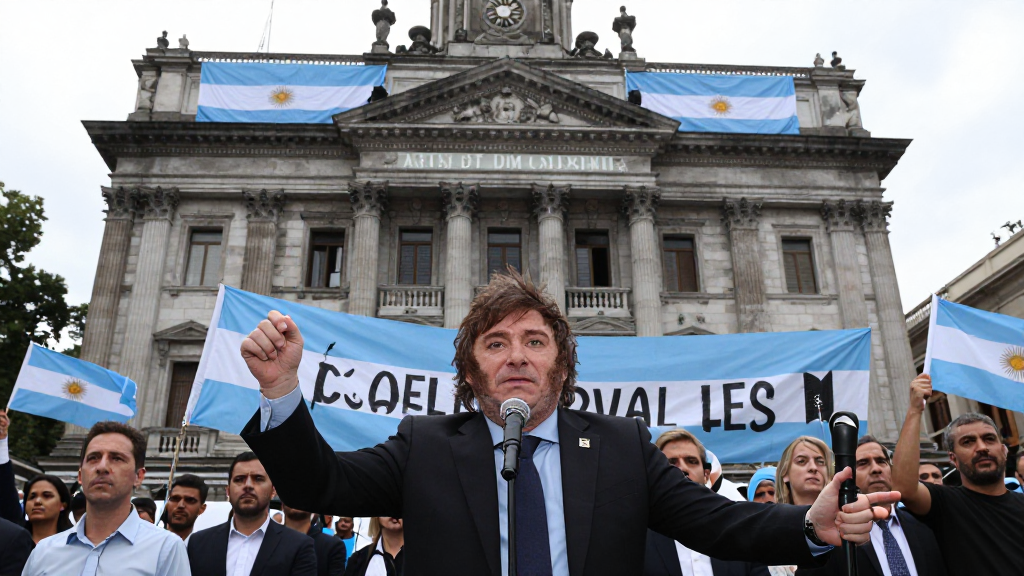
Argentina’s Cabinet Chief Manuel Adorni resigned on June 27, 2026, effective immediately, precipitating the deepest political crisis of President Javier Milei’s libertarian administration and sending shockwaves through Latin America’s second-largest economy.
The resignation came hours after federal prosecutors opened an illicit enrichment investigation into Adorni and his brother, Wascar Adorni, linked to alleged payments from businesses seeking favorable regulatory treatment from Milei’s libertarian government. The speed of the scandal’s unraveling stunned political observers in Buenos Aires, where Adorni had long been considered one of Milei’s most loyal and unshakable allies.
Prosecutors Open Illicit Enrichment Investigation
Federal Judge Evelyn Galante authorized raids on five properties connected to the Adorni brothers on June 26, seizing documents, cash, and digital devices that formed the basis of the preliminary investigation. Court filings made public on June 28 allege a network of shell companies funneling payments from construction and energy sector interests seeking favorable regulatory treatment.
Prosecutors allege that over the past 18 months, at least three companies awarded government contracts received indirect payments through a web of at least seven shell companies controlled by Adorni family members. Judge Galante’s filing states that the total alleged flow of funds exceeded $2.3 million, though investigators believe the true figure could be considerably higher.
Adorni, who served as Milei’s primary spokesperson and rose to cabinet chief in January 2026, denied any wrongdoing in a statement released through his lawyer. “I have never used my public office for personal enrichment,” the statement read. “All of my assets are the result of years of legitimate work in the private sector before entering government.”
Hours after Adorni’s resignation, Milei appointed Diego Santilli, a former Buenos Aires province security minister and longtime political operator, as the new cabinet chief. The appointment was announced via the presidential palace’s official social media accounts and marked a notable shift toward a more conventional political figure inside Milei’s inner circle.
A Loyalty Test for Milei’s libertarian Coalition
The scandal strikes at the heart of Milei’s political brand. The president came to power in December 2023 vowing to dismantle the “political caste” and end systemic corruption. His supporters argued that his outsider status and anti-establishment rhetoric made him uniquely immune to the graft that has tainted every previous Argentine government since the return of democracy in 1983.
That narrative now faces its most serious challenge. The opposition Democratic Alliance bloc immediately filed a motion in Congress to create a special investigative commission, with hearings expected to begin in July. Several members of Milei’s own Liberty Advances coalition have distanced themselves from Adorni, with five lower-house deputies announcing they would support the commission’s work.
The U.S. State Department issued a formal statement saying it was “closely monitoring developments in Argentina” and urged the government to ensure the investigation proceed “without political interference.” The International Monetary Fund, which has a $44 billion standby arrangement with Argentina, declined to comment specifically on the political situation but said it remained “engaged with the authorities on program matters.”
Within Argentina, the scandal has fractured what had been a relatively cohesive governing bloc. Three provincial governors from Milei’s coalition issued carefully worded statements calling for “full transparency” without directly naming Adorni, a signal of the delicate political calculus facing regional leaders who depend on federal funding arrangements.
Market Reaction and What Comes Next
Argentine markets reacted with alarm. The Merval index fell 3.8 percent on June 28 before a partial recovery, while the peso dipped slightly on the parallel market before stabilizing. Sovereign bonds also fell, with the debt maturing in 2030 losing 1.2 cents on the dollar, according to Bloomberg data.
Economists warned that the political uncertainty could delay critical economic reforms that Milei’s government had planned for the second half of 2026, including a proposed overhaul of Argentina’s pension system and further deregulation of the energy sector. “The timing could not be worse,” said Mariana Medina, chief economist at Banco Gotham in Buenos Aires. “The government was making real progress on fiscal consolidation, and now you have this distracting a cabinet that was already struggling to hold its coalition together.”
Santilli faces the immediate task of managing a coalition already showing cracks. The Adorni scandal has energized an opposition that entered 2026 divided and demoralized, and many in the business community are reassessing the political risk of Milei’s government after nearly two and a half years in office. Whether Santilli can steady the ship will determine whether this scandal remains a contained crisis or becomes a turning point in Argentina’s post-pandemic political history.