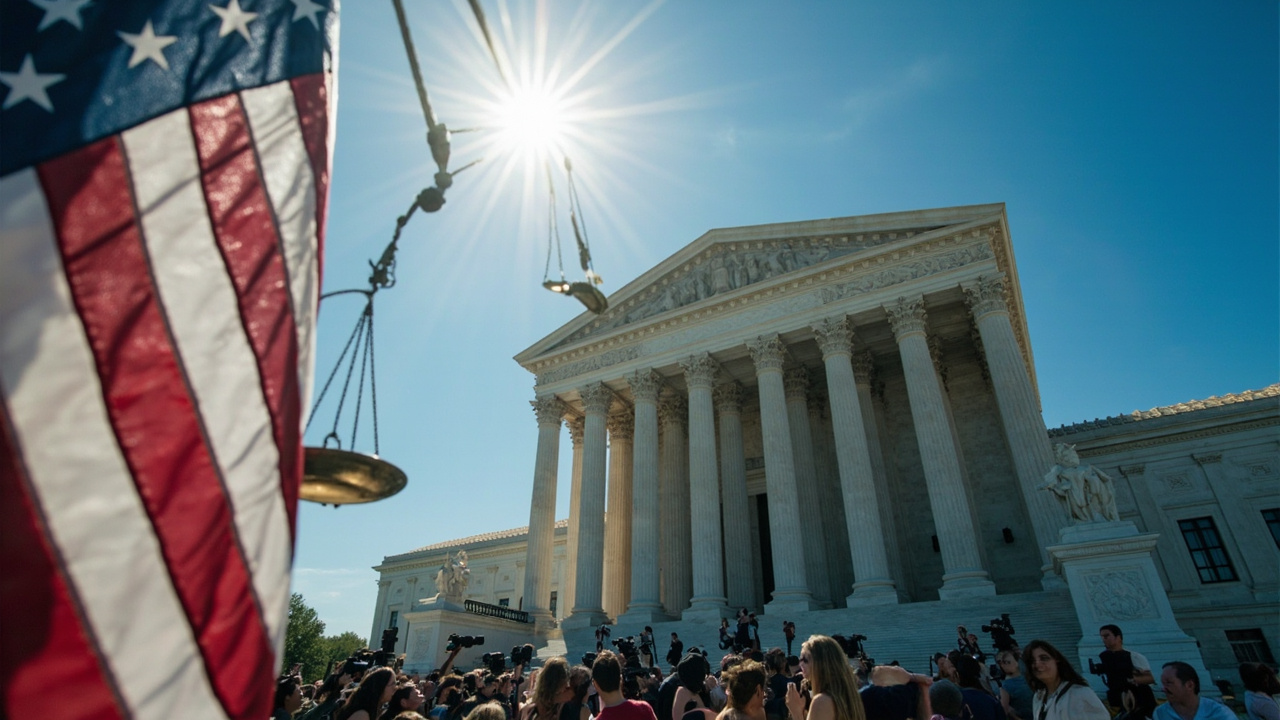
The U.S. Supreme Court handed President Donald Trump a decisive defeat on Tuesday by rejecting his attempt to restrict birthright citizenship, one of the most sweeping constitutional challenges to executive authority in recent decades. In a 6-3 ruling authored by Chief Justice John Roberts, the Court held that Trump’s January executive order violated the 14th Amendment of the Constitution, which guarantees citizenship to virtually anyone born in the United States. The decision, issued on the final day of the Court’s nine-month term, ended a term marked by an extraordinary series of consequential rulings that reshaped the boundaries of presidential power, civil rights, and federal spending.
Birthright Citizenship: A Constitutional Guarantee
The ruling directly struck down Trump’s directive that would have denied citizenship to children born in the United States if neither parent was an American citizen or legal permanent resident. Conservative Chief Justice John Roberts, writing for the majority, invoked the historical context of the 14th Amendment, ratified in 1868 in the aftermath of the Civil War. “Citizenship, then and now, was the right to have rights — to freely participate in our political community,” Roberts wrote. “We keep that promise today.” The opinion cited estimates that Trump’s order could have affected the legal status of up to 250,000 babies born annually in the United States.
Trump immediately criticized the ruling on his Truth Social platform, calling it “too bad for our Country” and urging Congress to pass legislation ending what he described as “expensive and unfair” birthright citizenship. The decision drew sharp ideological lines, with the Court’s six conservative justices in the majority and its three liberal justices dissenting. Legal experts warned that the ruling makes clear that executive orders cannot override constitutional provisions, regardless of the policy rationale behind them.
“A president cannot change the Constitution by executive fiat,” said ACLU National Legal Director Cecillia Wang, who argued the case before the Court. “The court’s decision reaffirms a fundamental American promise — if you are born here, you are a citizen.” The ruling leaves Trump’s administration with limited options, though the White House could pursue congressional action or attempt narrower administrative measures within existing legal frameworks.
Transgender Sports Bans and Campaign Finance
In a separate but equally significant ruling, the Supreme Court upheld state bans on transgender student athletes competing on women’s sports teams. The 9-0 decision reversed lower courts that had blocked West Virginia’s and Idaho’s laws, which designate sports teams at public schools and universities according to biological sex. Conservative Justice Brett Kavanaugh authored the majority opinion, holding that the measures do not violate Title IX or the Equal Protection Clause. “We hold that the states may maintain women’s and girls’ sports for biological females,” Kavanaugh wrote. “They may determine eligibility for women’s and girls’ sports based on biological sex. The Constitution and Title IX do not require an overhaul of women’s and girls’ sports throughout America.”
Trump celebrated the ruling, posting on Truth Social: “BIG WIN: The United States Supreme Court just RULED AGAINST MEN PLAYING IN WOMEN’S SPORTS. Wow! That takes that ridiculous situation off the table!!!” The decision marks the Court’s second major ruling against transgender rights plaintiffs in a year, following a June 2025 ruling that allowed states to ban gender-affirming medical treatments for transgender minors. Twenty-five states beyond West Virginia and Idaho have similar sports restrictions on their books.
The Court also struck down federal limits on coordinated spending between political parties and candidates in a 6-3 ruling authored by Kavanaugh, clearing the way for Republican campaign committees to deploy significantly more resources ahead of the November midterm elections. The majority found that existing caps violated First Amendment protections against government restrictions on political speech, with major Republican committees already holding a substantial cash advantage over their Democratic counterparts heading into the election cycle.
A Term That Redrew the Map of American Law
Tuesday’s rulings capped one of the most consequential Supreme Court terms in recent memory. The Court’s conservative majority, including three Trump appointees, delivered him significant victories alongside Tuesday’s losses. On Monday, the Court expanded presidential firing powers by overturning a 1935 precedent and upheld the removal of a Federal Trade Commission member, while simultaneously protecting Federal Reserve Governor Lisa Cook from dismissal. In February, the Court blocked Trump’s sweeping global tariffs pursued under a national emergency law. Earlier this term, the Court gutted a key Voting Rights Act provision, allowed the termination of humanitarian protections for hundreds of thousands of Haitian and Syrian immigrants, expanded gun rights, and rejected state bans on conversion therapy for LGBTQ minors.
The term’s mixed verdict for Trump underscores a Court that has broadly supported executive authority in structural disputes while declining to endorse sweeping policy outcomes that conflict with entrenched constitutional guarantees. Analysts expect both sides to return to the Court repeatedly as lower courts work through the implementation of Tuesday’s rulings and the countless cases they will spawn across federal and state jurisdictions in the years ahead.