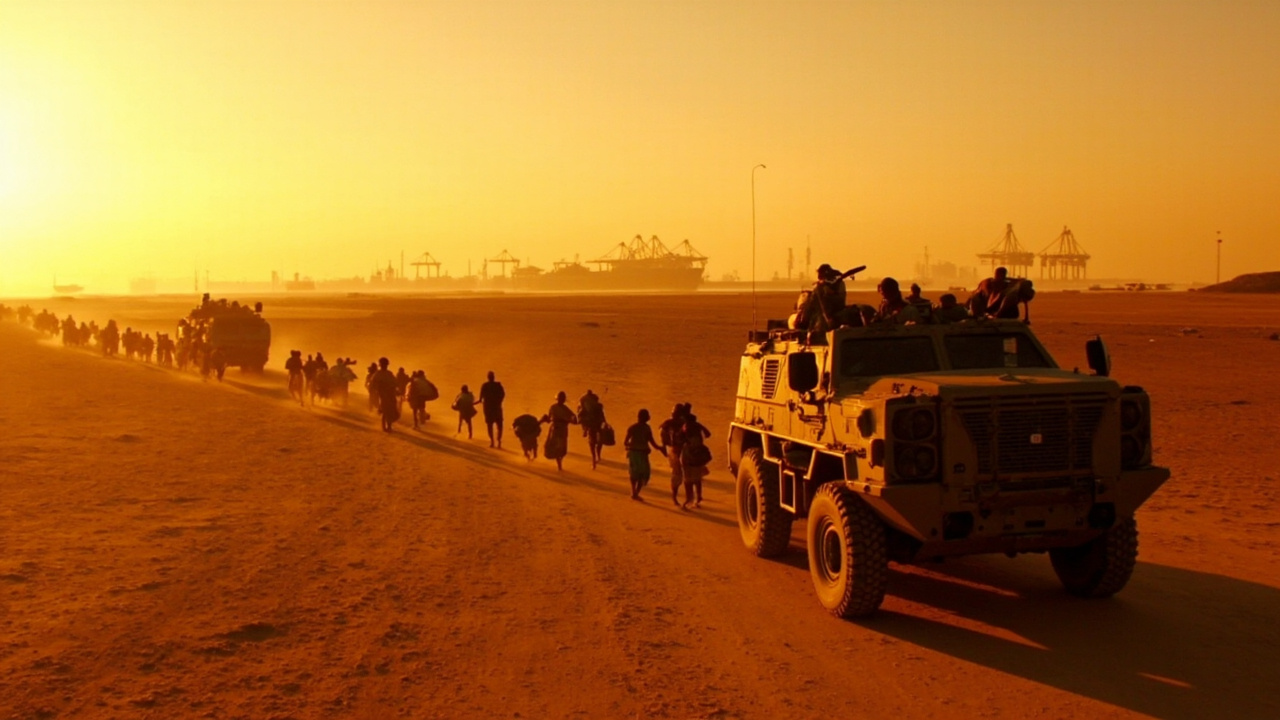
DAKAR, Senegal — Africa is facing an unprecedented convergence of armed conflicts, democratic reversals, and humanitarian emergencies stretching simultaneously across five distinct regions, with analysts warning the continent has reached a critical threshold.
West Africa: The Sahel Security Collapse
The Burkina Faso-Niger-Mali axis has entered a dangerous new phase of instability after military governments expelled French forces and pivoted toward Russian security contractors, severing ties with longstanding Western counter-terrorism partners. Insurgent groups affiliated with both al-Qaeda and the Islamic State have exploited the security vacuum, expanding operations into Benin, Ghana, and Togo. ECOWAS, already weakened by the departure of three member states from the political bloc, has struggled to mount an effective response.
“The unraveling of coordinated counter-terrorism architecture in the Sahel has created a cascade effect that is now being felt as far west as coastal states,” said one senior UN official who spoke on condition of anonymity. The breakdown has allowed weapons and fighters to flow across borders with near impunity, alarming regional governments that had previously maintained relative stability.
Central Africa: Congo’s Endless War
The Democratic Republic of Congo remains the epicentre of Africa’s deadliest ongoing conflict. James Swan, the new head of the United Nations Stabilization Mission in Congo (MONUSCO), told the Security Council on June 26 that fighting continues to rage in North Kivu, South Kivu, and Ituri provinces. The M23 rebel group, backed by Rwandan forces, has partially withdrawn from some areas but continues to consolidate control over territory it administers.
“It is now imperative that momentum be maintained, and that the commitments agreed to by the signatories be fully implemented,” Swan said, referring to the Washington peace agreement signed nearly a year ago between the DRC and Rwanda. The ADF, a Ugandan-rooted armed group, has killed 287 civilians in Ituri alone since the Council last met. Since March 19, MONUSCO has documented 632 civilian deaths and 1,221 human rights violations affecting 2,968 victims.
East Africa: The Disappearance Crackdown
The Kenya Human Rights Commission issued an explosive statement on June 29 accusing the leaders of Kenya, Uganda, and Tanzania of presiding over a coordinated pattern of enforced disappearances, torture, and suppression of dissent. The KHRC named President William Ruto, President Yoweri Museveni of Uganda, Tanzanian President Samia Suluhu Hassan, and Uganda’s Chief of Defence Forces Muhoozi Kainerugaba.
The commission directly linked Ruto’s administration to the alleged abduction of seven Kenyan human rights defenders during a wreath-laying ceremony on June 25. In Uganda, activist Maria Matembe’s disappearance was linked to President Museveni and his son Kainerugaba. The KHRC declared that enforced disappearances should never be accepted as a method of governance and warned that abductions cannot be treated as legitimate law enforcement.
Southern Africa: Displacement and Political Paralysis
South Africa’s anti-migrant climate is forcing thousands to flee, with Mozambique and Zimbabwe instability compounding the pressure on regional governments. A CNN report published June 29 documented families crossing borders in both directions as economic collapse and political violence make normal life impossible in multiple countries simultaneously. Mozambique’s insurgency in the north has displaced tens of thousands, while Zimbabwe’s ongoing crisis continues to push skilled workers and ordinary citizens toward South Africa and beyond.
South Africa’s own domestic political turbulence — a hung parliament and fragile coalition government — has left the continent’s most industrialized economy unable to project stability either inward or outward. The government has struggled to respond to either the internal displacement crisis or the surge in xenophobic violence targeting foreign nationals.
North Africa: Sudan’s War and Libya’s Division
North Africa is being reshaped by two overlapping crises. Sudan’s civil war has displaced more than 11 million people and pushed parts of the country into famine conditions. Fighting between the Sudanese Armed Forces and the Rapid Support Forces has spread into previously stable areas, with atrocities documented in Darfur and Kordofan. The conflict has destabilised Libya, which remains divided between the internationally recognised Government of National Unity in Tripoli and the Libyan National Army based in Benghazi, with competing foreign backers deepening the deadlock.
Weapons flows from Libya’s chaos have crossed the Sahara and the Sahel, directly fueling insurgencies in West Africa and beyond. The absence of a unified central government in Tripoli has allowed arms pipelines to operate with relative impunity, supplying conflict zones from the Atlantic coast to the Red Sea.
The convergence of an eastern Congo war that has killed more than 2,000 civilians since March, a coordinated East African crackdown on dissent with vanishing activists at its centre, the Sahel collapse in the west, North African conflict spillover, and Southern Africa’s displacement emergency has left African Union mediators stretched across their widest portfolio of simultaneous crises. Regional leaders are calling for an emergency AU summit as aid agencies warn that the window to prevent further catastrophe is narrowing rapidly.