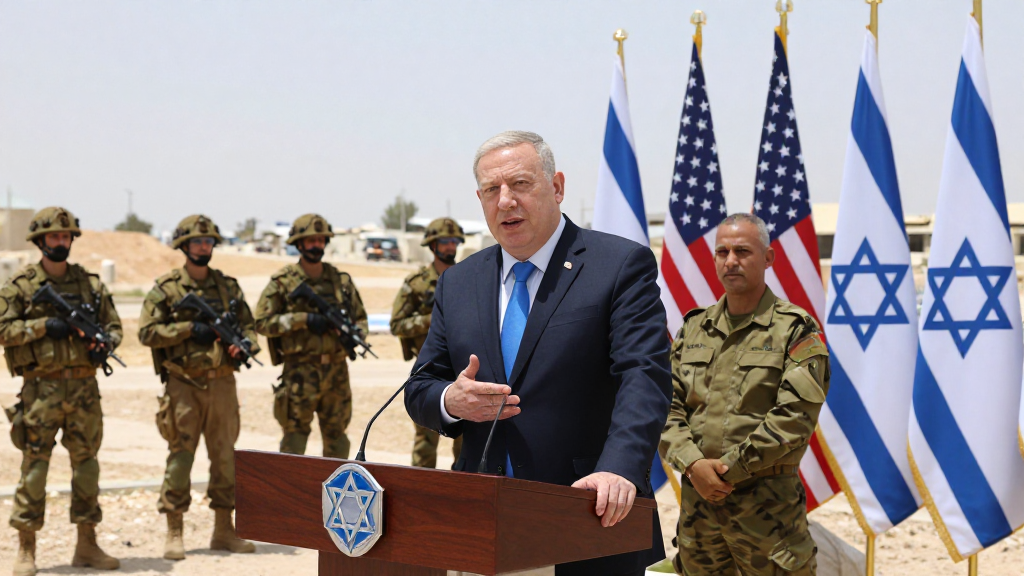
Israeli Defense Minister Israel Katz said Thursday that President Donald Trump’s decision to link the Iran and Lebanon files prevented Israel from carrying out a full elimination of Hezbollah, a rare public acknowledgment from a senior Israeli official that US diplomatic pressure directly shaped military operations during the recent conflict.
Speaking at a press conference in Tel Aviv, Katz said Trump’s insistence on a parallel approach — addressing both Tehran’s nuclear program and Hezbollah’s disarmament simultaneously — forced Israel to recalibrate its objectives in Lebanon. Prime Minister Benjamin Netanyahu had resisted repeated US requests to scale back operations, according to Katz, but ultimately accepted the linkage as a condition for continued American support.
“The decision to tie the two tracks together was Washington’s condition for maintaining the level of support we needed,” Katz said. “We were prepared to move more decisively in Lebanon, but our allies made clear that a two-front approach required a different framework.” The comments offer a rare public account from a senior Israeli official suggesting that US diplomatic pressure influenced Israel’s military calculus at a critical juncture.
IDF Vows to Remain Until Hezbollah Disarms
The Israel Defense Forces said Thursday that its presence in southern Lebanon will continue until Hezbollah is fully disarmed under the terms of the ceasefire framework brokered by the United States and Qatar. IDF Spokesperson Rear Admiral Daniel Hagari told reporters that the military is prepared for a long-term deployment and rejected any timeline imposed by outside parties.
“We will not leave until the job is done,” Hagari said. “Hezbollah’s military infrastructure must be dismantled. We have the forces in place and the mandate to see this through, regardless of how long it takes.” The IDF has maintained positions in southern Lebanon since January, when the ceasefire agreement halted intense fighting but left the disarmament clause contested.
Hezbollah has refused to surrender its weapons, arguing that only the Lebanese state has the authority to monopolize force on its territory. The group has continued small-scale provocations along the border, testing the ceasefire’s limits and prompting Israeli warnings of renewed escalation.
Trump Pressure Forced Operational Changes
According to two officials briefed on the internal deliberations, Trump personally pressed Netanyahu during a phone call in late May to avoid actions that would risk a broader regional war. The officials, who spoke on condition of anonymity because of the sensitivity of the discussions, said the President warned that a unilateral Israeli operation against Hezbollah without prior US consultation would jeopardize American cooperation on the Iran track.
The pressure led Israel to abort at least two planned operations targeting Hezbollah’s senior leadership, the officials said. Instead, Israeli forces focused on degrading the group’s missile and tunnel infrastructure along the border, a more limited objective that avoided the political cost of a full ground invasion.
Qatar, which hosted indirect talks between the United States and Iran in Doha throughout the spring, played a key role in conveying Israel’s intentions to Tehran and vice versa, the officials said. The Gulf state’s diplomatic channel remained active even as direct talks between Washington and Tehran collapsed in May.
Diplomatic Fallout and What Comes Next
The revelation of Trump’s influence over Israel’s Lebanon strategy has reopened debate in Washington about the limits of US leverage over its closest Middle East ally. Senator Jeanne Shaheen, a Democrat from New Hampshire who sits on the Senate Foreign Relations Committee, said the administration’s approach had produced strategic confusion rather than strategic clarity.
“We need to be honest about whether our pressure on Israel produced outcomes that serve American interests, or whether it simply delayed decisions that will have to be made under worse conditions later,” Shaheen said. “The linkage theory may have seemed clever in a negotiating room, but Hezbollah is still armed and Iran is still enriching uranium.”
European allies have watched the developments with growing concern. France and Britain both urged the United States this week to re-engage directly with Iran before the diplomatic window closes entirely. Iran’s Supreme National Security Council said Wednesday that Tehran remains willing to discuss a broader nuclear compromise, but only if sanctions relief is addressed in the first phase of any agreement.
US Secretary of State Marco Rubio is scheduled to travel to the Gulf region next week for meetings with Qatari and Emirati officials focused on both tracks. State Department spokesperson Tammy Bruce said Thursday that the administration remains committed to a maximum pressure framework but acknowledged that tactical adjustments had been necessary.
“We are always evaluating the most effective path to our objectives,” Bruce told reporters. “The President has been clear: we want a deal with Iran that prevents it from ever acquiring a nuclear weapon, and we want a stable Lebanon free from Hezbollah’s grip. Both of those goals remain achievable.”
For now, the ceasefire in Lebanon holds — barely. Israeli patrols continue in southern Lebanon. Hezbollah’s rocket units remain intact but are observing the truce. The fundamental dilemma remains unresolved: Israel cannot tolerate a nuclear Iran, the United States wants to avoid another war, and Hezbollah cannot be disarmed without either a political settlement in Beirut or a military campaign that neither Washington nor Jerusalem appears willing to support fully. The coming weeks will test whether the framework Trump built can hold, or whether the pressures that shaped Israel’s choices will ultimately fracture the arrangement he created.