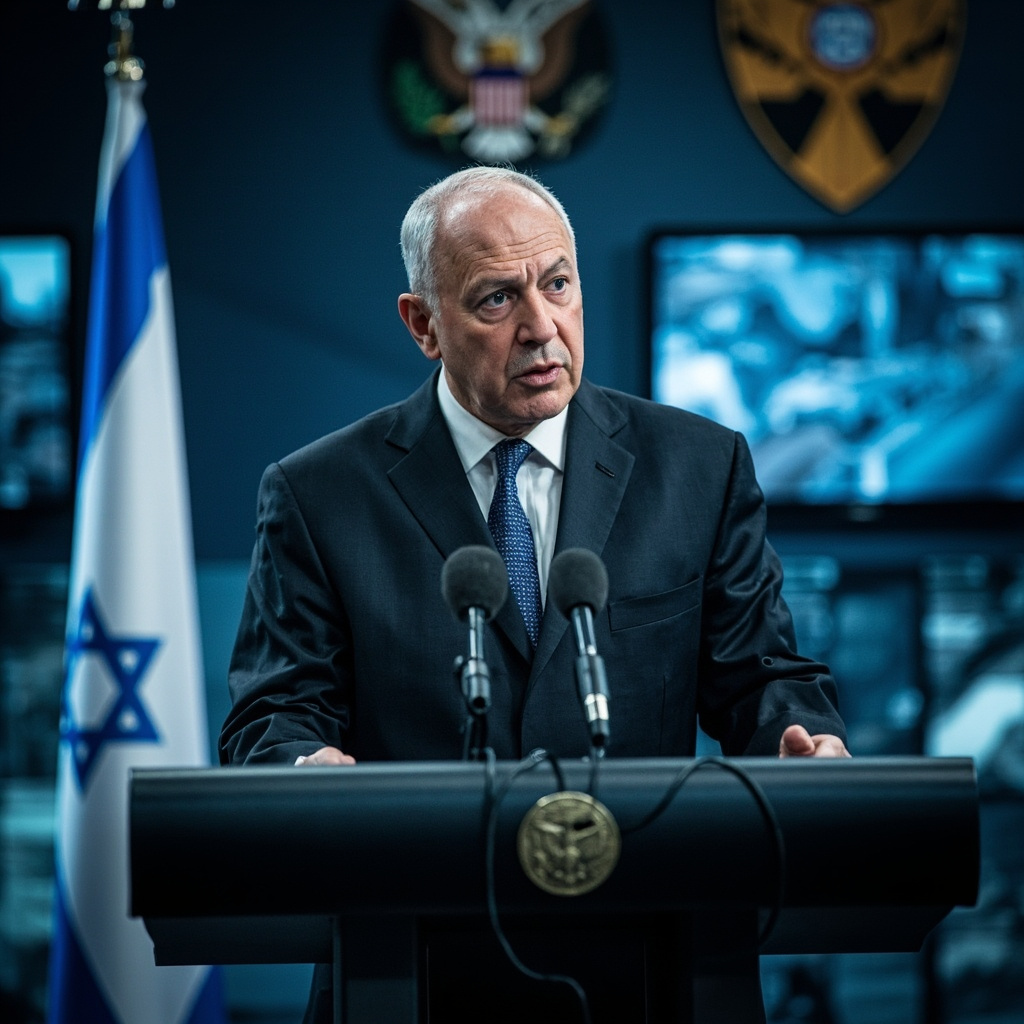
Israeli Defense Minister Israel Katz said Tuesday that President Donald Trump’s diplomatic pressure forced Israel to abandon plans for a full military campaign aimed at collapsing Hezbollah in Lebanon, in rare public remarks that laid bare the deep tensions within the US-Israel alliance during the months-long Lebanon conflict. Speaking at a briefing in Tel Aviv, Katz said that when Trump linked the Lebanon and Iran fronts in a pivotal fifth telephone call with Prime Minister Benjamin Netanyahu, Israel’s advance on Hezbollah ground to a halt, allowing the militant group to recover and reinforce its positions in southern Lebanon. “Had Lebanon not been linked to Iran, Hezbollah would have collapsed,” Katz said. “We therefore moved to Plan B expanding the Yellow Line security zone in southern Lebanon.” The remarks, confirmed by multiple Israeli officials, represent one of the starkest public acknowledgments from a senior Israeli minister about the limits Washington placed on Jerusalem’s military ambitions.
Netanyahu Resisted Trump Pressure Through Four Calls
According to Katz, Netanyahu held four telephone conversations with Trump before the decisive fifth call in which the defense minister did not participate. Katz said that call alone produced the decision to link the Lebanon and Iran ceasefire arenas, a move that effectively froze Israeli operations aimed at Hezbollah’s destruction. “Netanyahu stood bravely against Trump’s demands that the IDF leave Lebanon through four phone calls,” Katz said, according to a transcript obtained by the New York Post. The defense minister added that Iran actively lobbied Washington throughout the campaign, pressing US officials to demand Israel halt its offensive. “Iran constantly pressured the United States to pressure Israel, in order to stop this,” Katz said. “At that time, we were attacking all of Lebanon, I remind you.” According to Katz, Hezbollah itself panicked as Israeli operations intensified and pressured Tehran to push Washington to intervene on its behalf. “Hezbollah, in a panic, pressured Iran to connect the arenas,” Katz said, referring to the effort to tie the Lebanon front to any broader US-Iran agreement.
Beirut Strikes Scrapped, Ground Beaufort Operation Approved
After the fifth call between Netanyahu and Trump, Katz said the Israeli prime minister agreed not to target buildings in Beirut, a concession the defense minister said he opposed. Israel instead continued precision surgical attacks while abandoning the broader bombing campaign it had initially planned. Katz also revealed that after an overnight cabinet discussion failed to produce agreement on launching a ground maneuver, further consultations were held the following day between Netanyahu, the defense minister, and IDF Chief of Staff Herzi Halevi, resulting in approval for the Beaufort operation targeting Hezbollah tunnels in southern Lebanon. “There were concerns about friction with the United States, but they understood and accepted it,” Katz said. Operations have continued with the IDF demolishing tunnels and capturing strategic ridgelines, including the Ali a-Taher Ridge, which Israel says was seized because of a tunnel threat. “We still have tunnels to destroy and demolish for example, in the Beaufort Ridge, where we will use 500 tons of explosives,” Katz said, noting that IDF engineers destroyed a tunnel network in Majdal Zoun overnight. He stressed that Israel will not withdraw from the three security zones it has carved out. “People should not hold their breath wondering where the next place Israel will withdraw from in Lebanon will be because it will not happen until Hezbollah is disarmed. We have no territorial ambitions in Lebanon, but until Hezbollah lays down its weapons, we will not withdraw even one millimeter,” he said.
Hezbollah Regroups as Ceasefire Takes Hold
Despite the ongoing Israeli military presence, Katz acknowledged that after the Iran-Lebanon arena link was established, civilians began returning to southern Lebanon and Hezbollah also reinforced its position in the south, complicating Israel’s stated goal of permanent disarmament. Israel has maintained three security zones in Lebanon, Syria, and Gaza under a framework agreed with US Central Command commander Admiral Brad Cooper. “I agreed with him that the IDF will not withdraw from the three security zones in Lebanon, Syria, and Gaza,” Katz said. Israel has been engaged in active operations for 973 days since October 2023, one of the longest sustained military campaigns in its history. The parallel war on Iran, which began with Israeli strikes in late June, has added a new and dangerous dimension to the regional conflict, with the IDF striking nuclear and military infrastructure deep inside Iran and Iranian-backed proxies across multiple fronts.