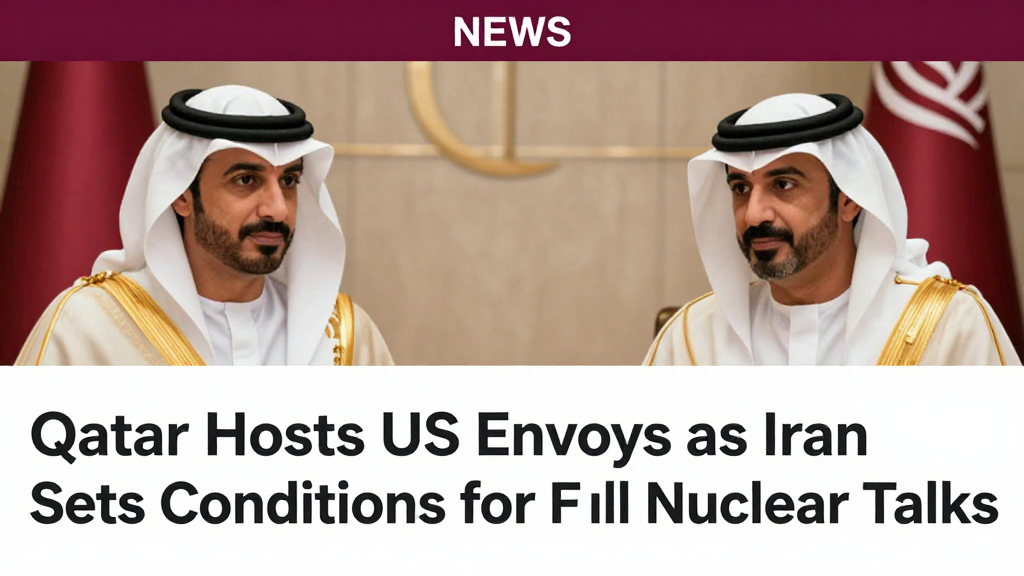
DOHA — U.S. envoys Steve Witkoff and Jared Kushner met Qatar’s prime minister in Doha on Tuesday to discuss negotiations with Iran, according to Qatar’s Foreign Ministry, as Tehran reiterated that direct talks with Washington remain contingent on three conditions being met: an end to hostilities in Lebanon, the waiver of oil sanctions, and the release of frozen Iranian funds.
The talks took place at a critical juncture in the broader U.S.-Iran conflict that has seen the two sides trade sporadic fire in the Gulf since agreeing to a memorandum of understanding earlier this month. Iran’s parliament speaker Mohammad Bagher Ghalibaf said in a televised interview that implementation of any agreement would face “challenges” and required good-faith compliance from all parties.
Tehran Sets Conditions Before Face-to-Face Talks Can Begin
Iran’s deputy foreign minister, Kazem Gharibabadi, will lead the Iranian delegation meeting with Qatari mediators on Wednesday, according to Iran’s Foreign Ministry. The talks are expected to cover the implementation of the MoU signed between Tehran and Washington, as well as the contested issue of frozen Iranian assets held abroad.
Iranian President Masoud Pezeshkian said Monday that necessary steps to unfreeze some of Iran’s restricted funds were underway, with $6 billion of approximately $12 billion in frozen assets slated for release. Qatari officials confirmed that the assets question would be on the agenda during the mediation discussions.
“The Islamic Republic is committed to ensuring that the agreement is implemented, and the enemy — the United States and its ally — must also fulfil their commitments,” Ghalibaf said in his televised remarks. He added that the Iranian delegation would focus specifically on clauses concerning the fighting in Lebanon and freedom of navigation through the Strait of Hormuz.
Hormuz Standoff Remains Central Flashpoint
The Strait of Hormuz has emerged as the most volatile element in the ongoing diplomatic efforts. The waterway, through which roughly a fifth of the world’s oil passes, saw commercial traffic disrupted over the weekend after a vessel was struck while transiting the waterway on Saturday. The Joint Maritime Information Center raised the security threat level for the strait to “substantial” due to the risk of mines and ongoing clearance operations, according to regional security sources.
Oman has delivered a proposal to the United States and allied nations regarding the future management of the Strait of Hormuz, according to a regional diplomat and a U.S. official familiar with the discussions. Iran has also held separate talks with Oman on what Tehran described as the “future management” of vessels transiting the strait.
Despite the surge in tensions, both sides havecalmed their exchanges in the days leading into the Doha talks. U.S. Central Command said Sunday it had attacked 10 Iranian military targets over what it described as continued Iranian aggression against commercial shipping. Iran said it retaliated with strikes against U.S. bases in Kuwait and Bahrain — a claim confirmed by officials in both Gulf states, who condemned the attacks.
Lebanon Front Intertwined With Gulf Diplomacy
Any full U.S.-Iran agreement remains closely linked to the parallel conflict between Israel and Hezbollah in Lebanon. Tehran has insisted that a comprehensive deal must include an end to Israeli operations in southern Lebanon, where Israeli forces have maintained a presence that has drawn international criticism.
Fighting between Israel and Hezbollah has been relatively quiet in recent days, according to regional officials, raising cautious hopes that the ceasefire framework reached alongside the U.S.-Iran MoU may be holding. However, analysts warn that both the Lebanon and Gulf tracks remain deeply interdependent and could unravel if one side perceives the other as violating its commitments.
Qatar’s foreign ministry spokesman Majed Al Ansari said the U.S. envoys were in Doha to meet with mediators and discuss “all regional issues, including, of course, negotiations with Iran, but also including Lebanon.” He stressed that no direct U.S.-Iran talks were scheduled during the current visit, though indirect discussions through Qatari intermediaries would continue.
Trump posted on Monday that Iran had requested fresh talks in Qatar, stating “IT WILL TAKE PLACE TOMORROW IN DOHA!” in a social media post. Iran’s foreign ministry quickly contradicted the President’s claim, saying no face-to-face negotiations were planned and that the next formal meeting would be the Qatari-hosted session on Wednesday.
What comes out of Wednesday’s session in Doha will be closely watched by governments across the Middle East and beyond. The outcome will determine whether the fragile ceasefire framework holds and whether the Hormuz shipping lane can be stabilized, or whether the two sides return to open confrontation.