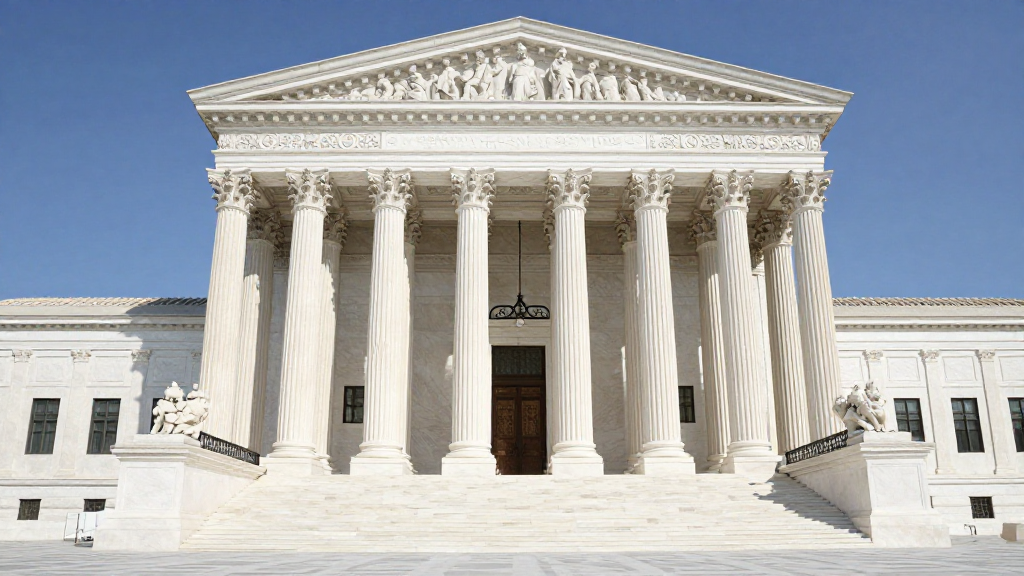
The Supreme Court struck down a 50-year-old campaign finance law on Tuesday, ruling 6-3 to eliminate limits on how much money political parties can spend in coordination with their candidates — a landmark decision that reshapes the landscape of American electoral politics just months before the 2026 midterm elections.
A 6-3 Partisan Divide on the First Amendment
The court’s decision, authored by Justice Brett Kavanaugh, struck down provisions of the Federal Election Campaign Act passed in the aftermath of the Watergate scandal. Kavanaugh wrote that political parties now have the same right to raise and spend money as any other political actor, framing the ruling as an equalizer.
“Whether the Democratic Party, the Republican Party or other parties, all political parties and candidates going forward can compete equally under the same rules regarding coordinated expenditures and can structure their fund-raising, spending and political speech on a level playing field as they see fit within the law,” Kavanaugh wrote in the majority opinion.
The ruling overturns a 2001 Supreme Court precedent and follows a decade-long erosion of campaign finance restrictions, including the landmark 2010 Citizens United decision that opened the door to unlimited corporate and union political spending.
Vice President JD Vance and the National Republican Senatorial Committee brought the challenge, backed by the Trump Justice Department, which argued that the only justification for party spending limits — preventing corruption — had no empirical support.
“It doesn’t make any sense to think of a party as ‘corrupting’ its candidates,” Republicans argued in their brief to the court, “because the very aim of a political party is to influence its candidate’s stance.”
Democrats Warn of a Fundamental Reshaping of American Politics
Justice Elena Kagan, writing in dissent for the three liberal justices, painted a far darker picture of what the ruling means in practice. She warned that without spending limits, parties can serve as a direct “checking account” for their candidates — merging party and campaign operations in ways that undermine the spirit of existing anti-corruption laws.
“With no limits on coordinated expenditures, the party can serve as the candidate’s checking account,” Kagan wrote. “The decision would allow ‘a legal regime increasingly unable to stop political corruption, and thus to preserve our institutions’ democratic legitimacy.'”
Democratic Party lawyers who intervened in the case to defend the restrictions argued that authorizing unlimited coordinated expenditures would “fundamentally reshape the campaign finance regime” and create obvious potential for actual or apparent quid pro quo corruption.
The practical implications for the 2026 midterm cycle remain unclear. Political parties and campaigns now have months to adjust their fundraising and spending strategies before November’s elections, and legal experts expect a wave of new coordinated spending operations to emerge as both parties test the boundaries of the new rules.
The decision is the latest in a string of ideologically split rulings that have progressively dismantled post-Watergate campaign finance law. The court previously struck down Arizona’s public election financing scheme in 2011 and lifted individual donation limits in 2014 — all by 5-4 or 6-3 margins along the same ideological lines.
Senate Minority Leader Chuck Schumer praised the ruling from the Democratic perspective, arguing it opens the door to precisely the kind of unchecked money-in-politics dynamics that campaign finance laws were designed to prevent. “This is the latest chapter in a sustained effort to hollow out our democracy,” Schumer said in a statement. “The courts keep telling us that money equals speech, and that is a fundamentally distorted view of how democratic self-government should function.”
Republicans counter that the old restrictions unfairly disadvantaged party organizations relative to outside groups like Super PACs, which already operate with no spending limits and no coordination restrictions. The new ruling, they argue, simply levels the playing field — allowing parties to compete with the same tools available to their opponents. Party committees are expected to immediately revise their 2026 fundraising playbooks in light of the decision.
The ruling’s impact on the 2026 midterms remains to be seen. Both parties enter the election cycle with vastly different financial infrastructures, and analysts expect Republican-aligned groups — which have historically benefited from wealthy individual donors — to move fastest to exploit the new rules. Democratic strategists warned that without urgent legislative action, the decision could shift the electoral map significantly in favor of the GOP’s financial operation. Any legislative response would require 60 votes in the Senate to overcome the filibuster, making a bipartisan coalition all but impossible given current partisan polarization.