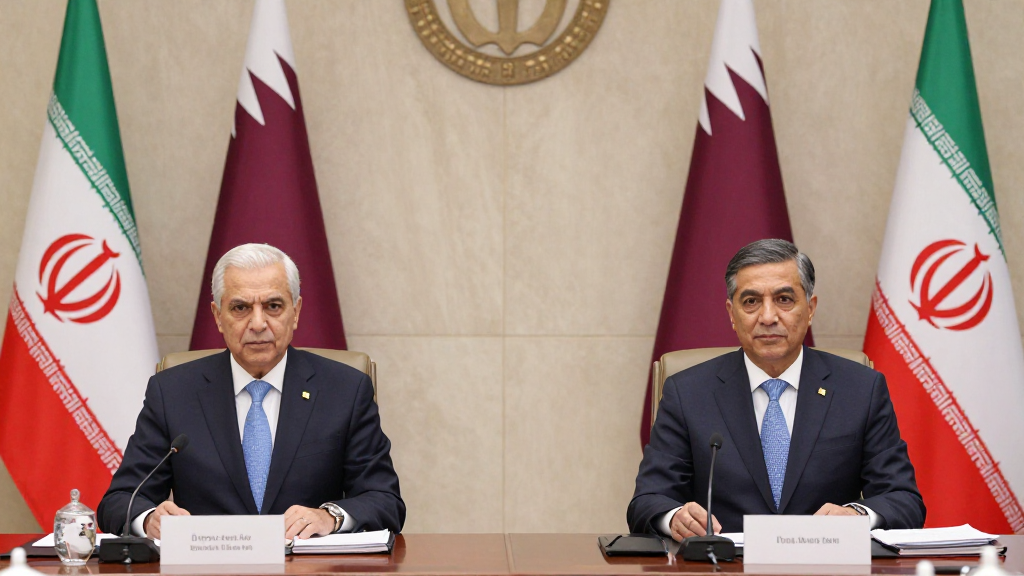
Iran and the United States agreed Wednesday to establish a dedicated communication channel by Thursday to monitor and record violations of their initial memorandum of understanding, marking a concrete step toward implementing the war-ending accord signed in June. Iranian Deputy Foreign Minister Kazem Gharibabadi announced the agreement after two days of indirect talks hosted by Qatar, saying the mechanism would serve as the primary conduit for reporting alleged breaches of the interim pact. The development came as both sides sought to demonstrate progress on the technical implementation of the Lake Lucerne accord, which halted six months of hostilities across the Persian Gulf and broader Middle East.
The talks, held at a lower diplomatic level and focused on the technical mechanics of implementing the MoU, were designed to “build on the progress made at the Lake Lucerne Summit,” a diplomat familiar with the negotiations told AFP, speaking on condition of anonymity. The June 17 agreement signed there by Presidents Trump and Putin committed both sides to an immediate ceasefire, the reopening of the Strait of Hormuz to commercial shipping, and the release of frozen Iranian assets held abroad. The two leaders also agreed to explore pathways toward a broader, permanent peace agreement to replace the interim framework, though that process remains contingent on the initial MoU holding.
Doha Talks End Without Direct Negotiations
Iran had insisted throughout the process that no direct negotiations with Washington would take place in Doha. Foreign Ministry spokesman Esmaeil Baqaei said Tehran had “no plans for negotiations with the American side at any level over the coming days,” a position that forced the Qatari mediation format to remain strictly indirect. Gharibabadi said the discussions covered the use of a portion of Iran’s frozen funds and agreed that goods needed by Iran would be purchased and made available through the mechanism. The funds, released as part of the ceasefire agreement, represent one of the most tangible economic concessions offered to Tehran and have become a proxy for measuring the accord’s seriousness on both sides.
President Trump offered a notably optimistic public assessment as he departed for Washington aboard Air Force One. “As far as things are going, the denuclearisation of Iran is moving along well,” Trump told reporters, adding that both sides were “getting along very well” despite the weeks of hostilities that preceded the Lake Lucerne accord. The president’s comments followed an exchange of fire between US and Iranian forces in the days after the initial MoU that had threatened to unravel the diplomatic effort entirely. The exchange, which included Iranian missile strikes on a US naval vessel in the Gulf, was ultimately defused through back-channel communications facilitated by Oman and the UAE.
Hormuz Shipping Lanes Show Slow Recovery
Commercial shipping through the Strait of Hormuz is recovering but remains far below pre-conflict levels, according to vessel-tracking data. MarineTraffic recorded 34 ships transiting the strait on Tuesday, a modest improvement from the near-complete standstill observed during the height of the February-to-June hostilities. The figure falls well short of the roughly 100 daily crossings that represented the normal average before the conflict began with US-Israeli strikes on Iran in late February 2026. Lloyd’s of London, the world’s largest insurance market for maritime risk, has yet to restore standard coverage for Gulf transits, leaving many vessel owners hesitant to resume full operations despite the formal ceasefire.
The gradual reopening of Hormuz became one of the central provisions of the June 17 MoU, which obligated both Washington and Tehran to ensure the immediate resumption of commercial navigation as a confidence-building measure. Even as traffic edges upward, the shipping data underscores the cautious approach still being taken by maritime operators, insurers and energy traders who navigated months of open conflict in and around the strategic waterway. The strait handles roughly 20 percent of the world’s oil trade, making its full normalisation a key economic indicator for global energy markets that have remained volatile since the conflict erupted.
Israel-Hezbollah Front Quiets as Iran Focus Shifts to Implementation
On the Lebanon front, fighting between Israel and Hezbollah has been relatively quiet since the Qatar talks concluded, according to regional security officials. Iran-backed Hezbollah was drawn into the wider Middle East war in March when it launched rocket barrages at northern Israel, prompting Israeli airstrikes and a subsequent ground invasion of southern Lebanon. Tehran has consistently maintained that any final settlement must include an end to the Lebanon conflict and the withdrawal of Israeli forces from occupied territory along the border. Israeli officials have indicated willingness to negotiate a phased pullback but have insisted on security guarantees to prevent a resurgence of Hezbollah fortifications near the frontier.
Iran’s chief negotiator, Gharibabadi, left Doha without specifying a timeline for the next round of talks but said the communication channel agreed upon Thursday would serve as the primary test of whether the MoU’s provisions can hold under pressure. International observers, including officials from the United Nations and European Union, have called for both sides to demonstrate tangible compliance before moving to the more politically sensitive phase of negotiating a permanent peace agreement. UN special envoy Hans Grundberg welcomed the Doha outcome, calling it “a meaningful step toward durable calm,” while EU foreign policy chief Kaja Kallas said the bloc stood ready to support verification efforts. Analysts cautioned, however, that the hard work of sustaining the ceasefire and translating it into lasting normalisation remains ahead.