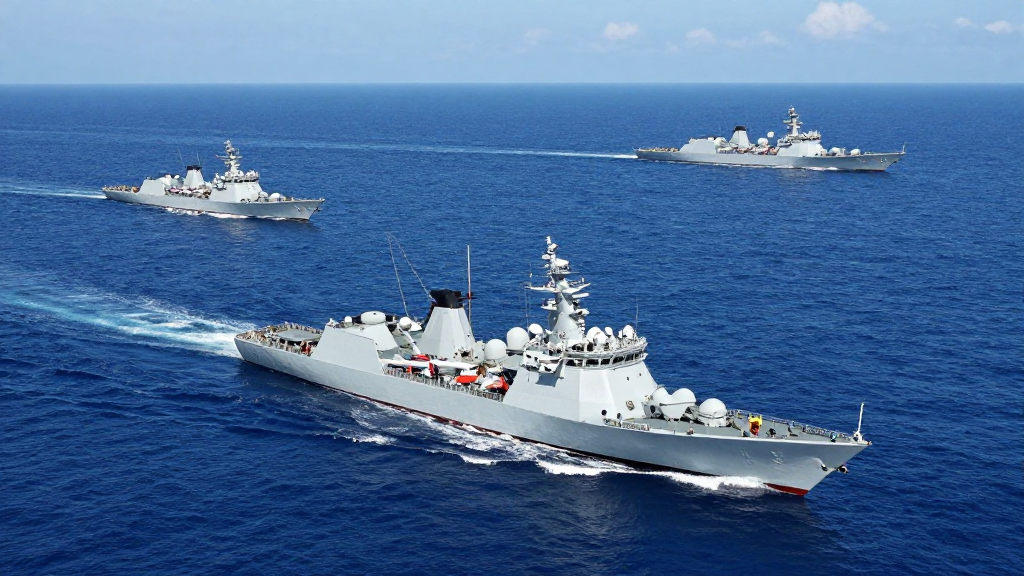
China’s People’s Liberation Army Navy deployed vessels to shadow and monitor US-Philippine joint military exercises near Scarborough Shoal on Sunday, June 29, according to the Philippine Armed Forces and confirmed by the US Pacific Fleet. Beijing said the drills “gravely undermined regional stability” and vowed to take “necessary measures” to safeguard what it claims as its territorial sovereignty. Manila called the PLA presence a “destabilizing provocation” and said it would raise the incident at the next ASEAN regional security summit.
US-Philippine Drills Proceed Despite Chinese Warnings
The joint exercises — part of a series launched under the expanded US-Philippines mutual defense treaty — involved guided-missile destroyers, amphibious landing vessels, and maritime patrol aircraft operating within the Philippines’ exclusive economic zone. Philippine military spokesman Colonel Maria Reyes said the drills were “wholly consistent with international law” and would continue as planned regardless of Chinese military activity in the area.
“We will not be deterred or bullied,” Reyes said at a press briefing in Manila. “Our partnership with the United States is a sovereign choice, and our exercises are transparent and defensive in nature.”
The US Pacific Fleet confirmed that PLA Navy surface vessels maintained visual contact with the exercise group throughout the day, operating at distances of between 3 and 8 nautical miles — inside the threshold the US military defines as “unsafe and unprofessional” behavior. No collisions or direct confrontations occurred, but the proximity was the closest recorded since the USS Theodore Roosevelt carrier group transited the South China Sea in April.
Beijing’s Diplomatic Offensive and the ASEAN Dimension
China’s foreign ministry issued a formal statement on Sunday saying PLA forces were carrying out “routine monitoring and warning operations” in accordance with domestic and international law. Ministry spokesperson Lin Jian said the US-Philippines exercises near Scarborough Shoal were “a serious infringement of China’s sovereignty” and warned that China would “resolutely take countermeasures against any attempt to divide China’s territories.”
Philippine President Ferdinand Marcos Jr. convened an emergency national security council meeting on Sunday evening and ordered the coast guard to maintain a permanent presence at the shoal. A presidential spokesperson said the government was considering invoking the joint patrols clause of the US-Philippines mutual defense treaty for the first time since its expansion in April. The treaty, reinterpreted in April to cover Philippine coast guard vessels and civilian ships delivering supplies to forward outposts, has been a central pillar of the Biden-era strategic pivot toward the Philippines as a frontline counterweight to Chinese maritime expansion in the South China Sea.
ASEAN members Malaysia and Vietnam issued a joint statement expressing “serious concern” over the accumulation of naval assets near Scarborough Shoal and calling on all parties to “exercise maximum restraint.” Cambodia and Laos — both seen as aligned with Beijing within ASEAN — blocked language that would have named China directly in the statement, underscoring the limits of ASEAN consensus on the South China Sea. The bloc has for years struggled to produce a unified response to Chinese reclamation and militarization of disputed features, with member states divided between those with direct maritime claims and those prioritizing Chinese investment and diplomatic goodwill.
The shadowing incident comes as the Philippines completes installation of a new coastal radar system at Scarborough’s outer rim, funded partly by a US$7.5 million maritime security grant from Washington. Philippine defense officials said the system would be operational by mid-July and would allow real-time tracking of all vessels within 50 nautical miles of the shoal’s coordinates. Beijing has demanded Manila dismantle the system, calling it a “military provocation” and warning it would respond with “firm measures” if the equipment became operational.
Regional analysts say the PLA’s decision to shadow the exercises rather than attempt to physically disrupt them reflects a deliberate Chinese strategy of gradual escalation designed to test the limits of the expanded US-Philippines treaty without triggering its mutual defense clause. Admiral John Watkins, a former US Pacific Command strategist, said the shadowing operation was “precisely calibrated” to avoid an incident that would force Washington’s hand. “Beijing wants to occupy the space just below the threshold that would require an American response,” Watkins told reporters. “Every action they’ve taken — the water cannons, the laser incidents, the shadowing — is designed to normalize Chinese presence without crossing a bright red line.”
The Scarborough Shoal standoff, which began in 2012 when China effectively took control of the triangular reef after a months-long confrontation with Philippine vessels, has become the defining flashpoint in the South China Sea disputes. An international tribunal in The Hague ruled in 2016 that China’s expansive claim had no basis under the United Nations Convention on the Law of the Sea, but Beijing rejected the ruling and has since deepened its physical presence at the feature. Philippine fishing boats have been largely excluded from the lagoon since 2012, and the PLA Navy’s current operations represent a further tightening of Beijing’s grip on one of the most strategically located reefs in the entire South China Sea.