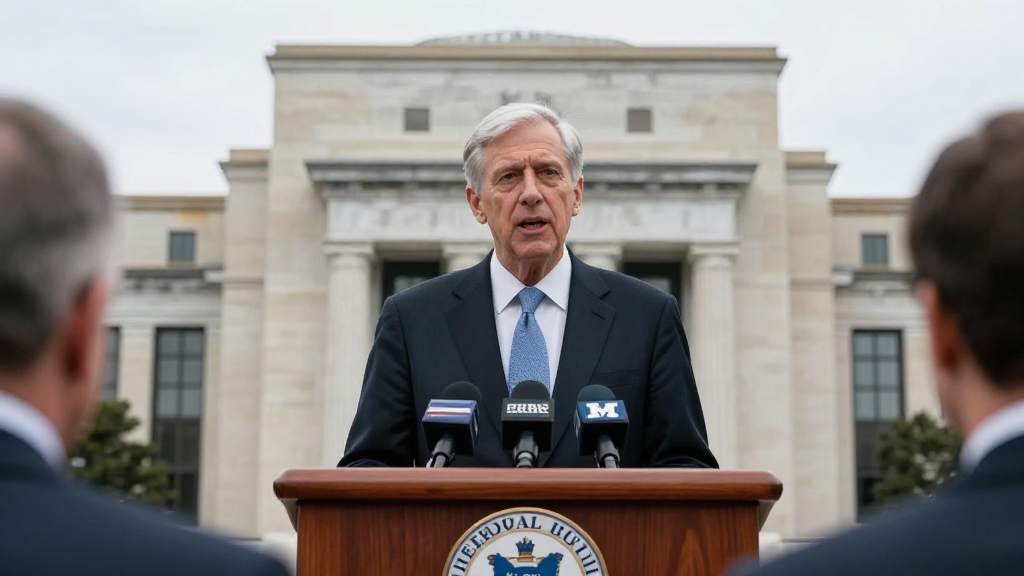
Federal Reserve Chairman Kevin Warsh told an ECB forum in Sintra, Portugal on Wednesday that inflation risks have begun to ease, signaling the central bank’s long campaign against rising prices may finally be producing results, though he stopped well short of committing to any near-term shift in interest rate policy.
Speaking alongside ECB President Christine Lagarde, Bank of England Governor Andrew Bailey, and Bank of Canada Governor Tiff Macklem, Warsh said the balance of risks has “clearly shifted” in the right direction, but emphasized that the Fed would not ease its vigilance on price stability. The remarks came just two days after the U.S. Supreme Court ruled that President Donald Trump could not fire Fed Governor Lisa Cook, a decision Warsh said he read but does not believe will alter how the central bank conducts its business. Traders immediately repriced rate-cut expectations following his comments, with odds of a rate reduction by year-end rising noticeably on the news.
Warsh Draws a Hard Line on the 2% Inflation Target
Warsh used the high-profile ECB forum to deliver a clear message to markets, politicians, and the public alike: the Fed’s 2% inflation target is not negotiable, and anyone expecting the central bank to relax its stance will be disappointed. When asked whether that included President Trump, who appointed Warsh to lead the Fed in May and has publicly pushed for interest rate cuts to boost economic growth, Warsh was blunt. “We have been an independent central bank for a long time. We are going to be an independent central bank at this moment and you will see no changes on that,” he said, speaking at the conference in the Portuguese hillside town of Sintra. The exchange underscored the delicate balance Warsh must strike as the new Fed chair, navigating pressure from the White House while attempting to rebuild credibility after a turbulent period of elevated inflation.
Analysts noted that Warsh’s refusal to provide what traders call “forward guidance” marks a sharp departure from the communication norms established under his predecessors. Rather than telegraphing the likely direction of monetary policy in advance, Warsh insisted he would share his thinking only after FOMC meetings begin. “We are going to shut the door and have a good debate, but I don’t have much more for you than that,” he told a panel moderator, drawing chuckles from the audience. Economists at Nationwide described the shift as significant. “It increasingly looks like investors’ early assumption that a Warsh-led Fed would quickly cut rates will not play out,” wrote Oren Klachkin, financial market economist at Nationwide. The firm still expects the Fed to hold rates steady through the end of the year, but Klachkin acknowledged that the balance of risks has clearly shifted in a hawkish direction.
Market Reaction and Rate Expectations Reprice
Financial markets reacted swiftly to Warsh’s remarks, with traders trimming their bets on a rate increase at the September FOMC meeting while simultaneously reducing expectations for cuts later in the year. Before his comments, futures markets had assigned roughly 70% probability to a rate hike at the September 15-16 meeting, reflecting persistent concerns about sticky inflation in services and shelter costs. Following the Sintra appearance, that probability declined modestly, though rate-hike odds remained elevated relative to historical norms. Equity markets initially dipped on concerns the Fed would remain restrictive, then stabilized as investors absorbed Warsh’s nuanced message about cooling inflation risks.
Bond yields moved lower in response to the softer tone on inflation risks, with the yield on the benchmark 10-year Treasury note falling several basis points in afternoon trading. The dollar index, which had been climbing on strong U.S. growth data earlier in the week, gave back a portion of those gains as traders recalibrated their outlook for Fed policy. Gold prices edged higher as some investors sought the safe-haven metal as a hedge against continued monetary tightness. The pivot in market sentiment was notable given how aggressively Warsh has sought to break from the precedent of pre-meeting guidance.
What Comes Next for the Federal Reserve
Looking ahead, Warsh outlined an ambitious agenda to modernize how the Fed makes decisions, signaling that the central bank is preparing to lean more heavily on real-time data and less on backward-looking government surveys that often lag current conditions by weeks or months. Citing the rapid pace of change driven by artificial intelligence and structural shifts in the labor market, Warsh said he wants the Fed to “recognize new trends as they are unfolding, not after the fact.” He announced a series of task forces that will be named the following week, staffed in part by former international central bankers, to review the Fed’s analytical framework and decision-making procedures.
The broader global context matters for the Fed’s room to maneuver. The ongoing U.S.-Israeli conflict with Iran has disrupted energy markets and complicated the inflation outlook for central banks around the world. The ECB has already moved to raise borrowing costs in response to persistent European inflation, while the Bank of England and Bank of Canada have been more cautious given signs of economic softening in their respective jurisdictions. “We are in the first or second inning of this revolution,” Warsh said of the transformative changes underway in the economy, adding that jobs and prosperity would ultimately be greater but that the timing of those benefits remained deeply uncertain.