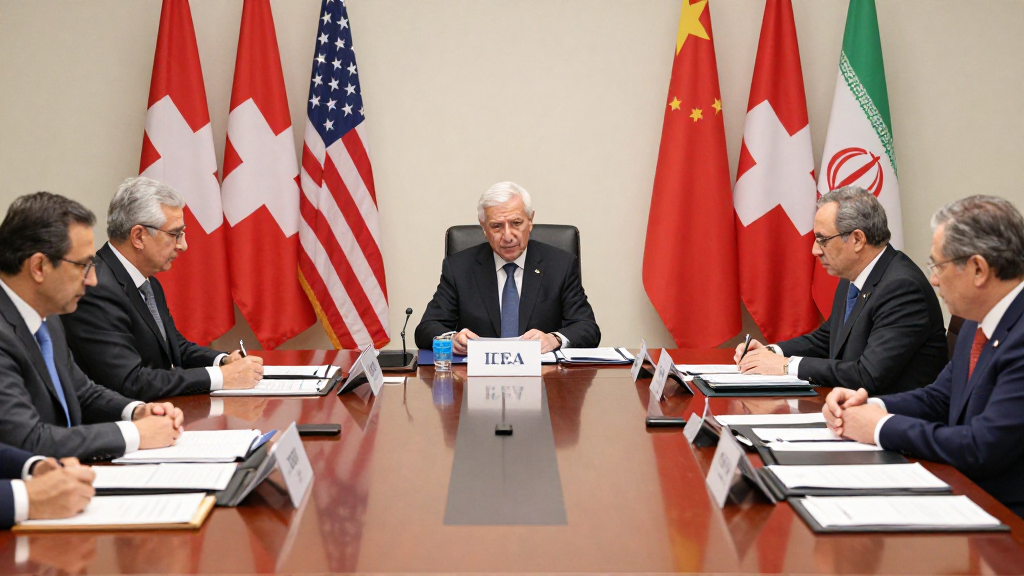
GENEVA — The United States and Iran entered into a new round of indirect nuclear negotiations in Geneva on Thursday, marking the first direct diplomatic engagement between the two adversaries since Washington launched airstrikes against Iranian nuclear facilities eight months ago. The talks, hosted by Switzerland and mediated by Oman, came as the two sides attempted to translate a fragile ceasefire framework signed in Doha last month into a more permanent nuclear accord.
Iran’s Foreign Minister Abbas Araghchi led the Iranian delegation, while the American team was headed by Special Envoy Steve Witkoff and Jared Kushner, the former senior adviser and son-in-law to President Donald Trump. The discussions, held at a lakeside villa outside Geneva, lasted roughly eight hours across two sessions, according to officials briefed on the talks.
Mediator Reports Significant Progress
Oman’s Foreign Minister Badr Albusaidi, who has played a central role in facilitating back-channel communications between Washington and Tehran since the conflict began, told reporters outside the venue that both sides had shown “openness to new and creative ideas” throughout the day. He said the two delegations had made “significant progress” but acknowledged that a comprehensive agreement remained elusive.
“There is a clearer path ahead, but the path is not without obstacles,” Albusaidi said. He said technical-level discussions would continue in Vienna next week under the auspices of the International Atomic Energy Agency, and that the two governments would consult with their respective capitals before deciding on a date for a further ministerial session.
Araghchi struck a similarly cautious tone upon leaving the venue. He told Iranian state television that “good progress” had been achieved, and that the two sides had agreed on a number of issues, though differences persisted on others. He said additional negotiations would take place in less than a week, without specifying a date or location.
There was no immediate official reaction from the Trump administration. The White House declined to comment beyond a brief statement saying the talks were “ongoing.”
IAEA Chief Joins Negotiations
Rafael Grossi, the director-general of the IAEA, participated in portions of Thursday’s talks, according to a statement from the nuclear watchdog agency. The inclusion of the IAEA signaled that both sides were moving toward discussing the specific monitoring and verification mechanisms that would underpin any nuclear agreement.
Under the ceasefire framework signed in Doha on June 17, Iran began destroying a portion of its enriched uranium stockpile at a facility near Isfahan, under IAEA supervision. Grossi described the initial phase of implementation as “satisfactory” in a report circulated among board members last week. Thursday’s talks appeared designed to build on that momentum and establish the contours of a longer-term arrangement.
According to Iranian state media, Tehran’s negotiating team insisted that Iran retains the right to peaceful nuclear energy and rejected American demands for a complete cessation of uranium enrichment on Iranian territory. The Iranian side also declined to transfer the estimated 400 kilograms of enriched uranium out of the country, a key American condition. However, officials familiar with the discussions said both sides had moved closer to a formula under which Iran would enrich at minimal levels under international monitoring for a defined period, in exchange for phased sanctions relief.
“We are not discussing the dismantling of our nuclear programme,” Araghchi told reporters in Tehran before departing for Geneva. “What we are discussing is the framework under which our programme operates, and the rights of the Iranian people to nuclear technology for peaceful purposes.”
Diplomatic Pressure and Military Build-Up
The Geneva talks unfolded against a backdrop of intense diplomatic and military pressure. The United States has assembled the largest concentration of military force in the Middle East since the 2003 invasion of Iraq, deploying two aircraft carrier strike groups, thousands of additional troops, and advanced fighter aircraft to bases across the region. Trump has repeatedly threatened to strike Iranian nuclear facilities if diplomacy fails, a warning that Iran has met with vows of forceful retaliation.
European allies, who were largely excluded from the initial ceasefire negotiations, have sought to reassert themselves in the broader diplomatic process. Germany, France, and Britain issued a joint statement Thursday welcoming the Geneva talks and urging both sides to “seize this window of opportunity” to reach a durable agreement. The three countries have maintained the sanctions architecture imposed on Iran since 2018, when Trump withdrew from the original Joint Comprehensive Plan of Action nuclear agreement.
The stakes of the negotiations extend well beyond the nuclear question. The ceasefire framework signed in Doha also addressed the reopening of the Strait of Hormuz, the world’s most critical oil shipping chokepoint, which Iran briefly closed during the height of the conflict earlier this year. Shipping analysts say the passage of tankers through the waterway remains constrained, and oil markets are closely watching whether a nuclear deal would lead to a full and sustained reopening.
What comes next will depend on how quickly the two governments can resolve the remaining gaps, analysts say. Technical discussions in Vienna are expected to focus on the specific terms of an enrichment cap, the timeline for sanctions removal, and the sequencing of reciprocal steps. A ministerial meeting could follow within two weeks, according to officials briefed on the schedule.