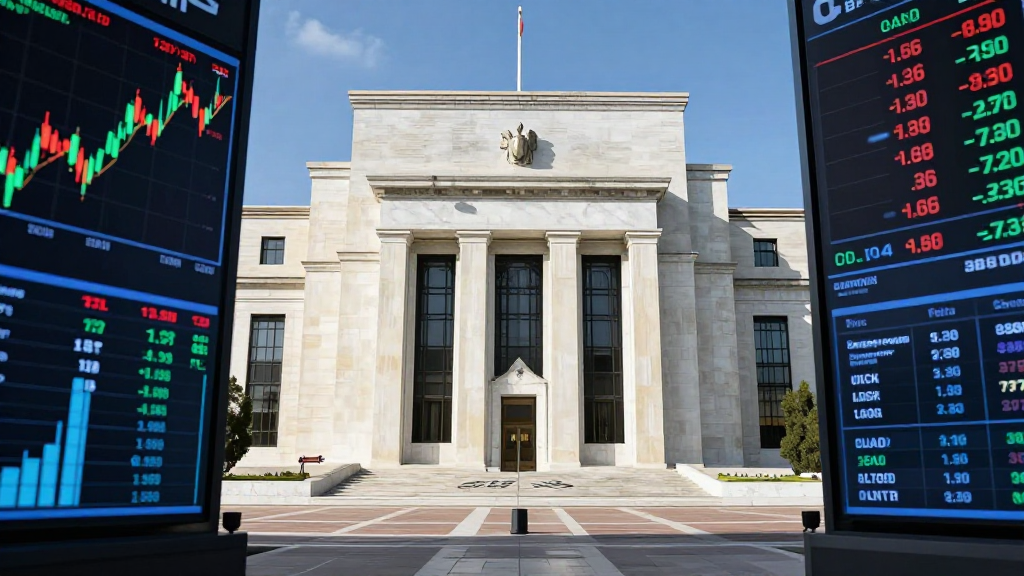
The Federal Reserve held its benchmark rate at 4.25-4.50 percent in a unanimous July decision, with Governor Kevin Warsh signaling the new leadership team is in no rush to cut. Markets now price the first cut no earlier than 2027.
Fed Keeps Rates Unchanged as Warsh Sets Hawkish Tone
The Federal Reserve held its benchmark interest rate steady at 4.25-4.50 percent at its July meeting, extending a pause that has now stretched for two consecutive gatherings as policymakers await clearer signals on where inflation and economic growth are heading. The unanimous decision to hold was widely anticipated by markets, with fed funds futures pricing in virtually no chance of a cut at this meeting, according to CME FedWatch data. Governor Michelle Bowman dissented in favor of a 25-basis-point increase, making her the first FOMC member to formally break ranks and call for tighter policy since the rate-hike cycle began in early 2022.
Her dissent signals that at least one voter on the committee believes the inflation battle is not yet won, and that maintaining current policy could allow price pressures to reaccelerate. The split vote underscores the growing divergence within the Fed as newer members appointed under the current administration push for a more aggressive stance, while longer-serving members advocate patience given signs that the economy is cooling.
Warsh Warns Inflation Risks Are Skewed to the Upside
Newly installed Fed Governor Kevin Warsh, attending his second FOMC gathering as a board member, delivered notably hawkish remarks following the decision. “The risks to achieving our price stability mandate appear tilted to the upside at present,” Warsh said in remarks released alongside the policy statement. “We are committed to returning inflation to our 2 percent target and will hold policy sufficiently restrictive for as long as necessary to accomplish that goal.”
Warsh, who served on the Fed board from 2011 to 2018 and returned to the institution this year, has long been regarded as one of the more inflation-averse voices in American monetary policy circles. His early public interventions since rejoining have set a tone distinct from his predecessor, emphasizing that the Fed cannot declare victory on inflation prematurely. Several analysts have interpreted his remarks as a signal that rate cuts remain distant on the calendar and that the central bank is prepared to tolerate slower growth if it means securing price stability.
PCE Inflation Holds Above Target as Labor Market Cools
The Fed’s preferred inflation gauge, the Personal Consumption Expenditures price index, rose 2.8 percent year-over-year in the most recent reading, more than a full percentage point above the central bank’s target. Core PCE, which strips out volatile food and energy components, held at 2.6 percent. Both readings represent stubborn persistence that complicates the case for easing anytime soon. The fact that core services inflation remains elevated at 3.4 percent is particularly concerning for policymakers, as this measure is most closely tied to domestic wage growth and therefore hardest to reduce without triggering a broader economic slowdown.
The labor market is showing signs of gradual softening that complicate the Fed’s calculus. The June jobs report showed payrolls adding 175,000 positions, above consensus expectations but marking a slowdown from the 220,000 average monthly gain recorded in the prior six months. The unemployment rate edged up to 4.3 percent, approaching the level that historically has prompted recession concerns among central bankers. Wage growth has moderated to 3.9 percent year-over-year, providing some comfort that inflationary pressures from the labor market are easing, but service-sector inflation remains stubbornly elevated in housing, healthcare, and financial services.
Markets Brace for Extended Pause as Rate-Cut Bets Pushed Out
Following the Fed statement and Warsh’s hawkish remarks, financial markets repriced the path of rate cuts for the remainder of the year. Traders have now pushed out expectations for the first full 25-basis-point cut to March 2027, down from a mid-2026 expectation just six weeks ago. The S&P 500 dipped 0.7 percent on the announcement before recovering, while two-year Treasury yields, which are most sensitive to near-term Fed expectations, rose four basis points to 4.58 percent.
“The Fed is signaling it will do whatever it takes to crush inflation, even at the cost of a meaningful slowdown,” said Priya Misra, portfolio strategist at JPMorgan Asset Management. “The days of the Fed rushing to cut rates are over. Warsh has made clear that the new guard is far less tolerant of above-target inflation than the previous regime.” The sharp repricing of rate expectations has put pressure on interest-rate-sensitive sectors, particularly real estate investment trusts and utilities, which fell 1.2 percent and 0.9 percent respectively in the session following the announcement.