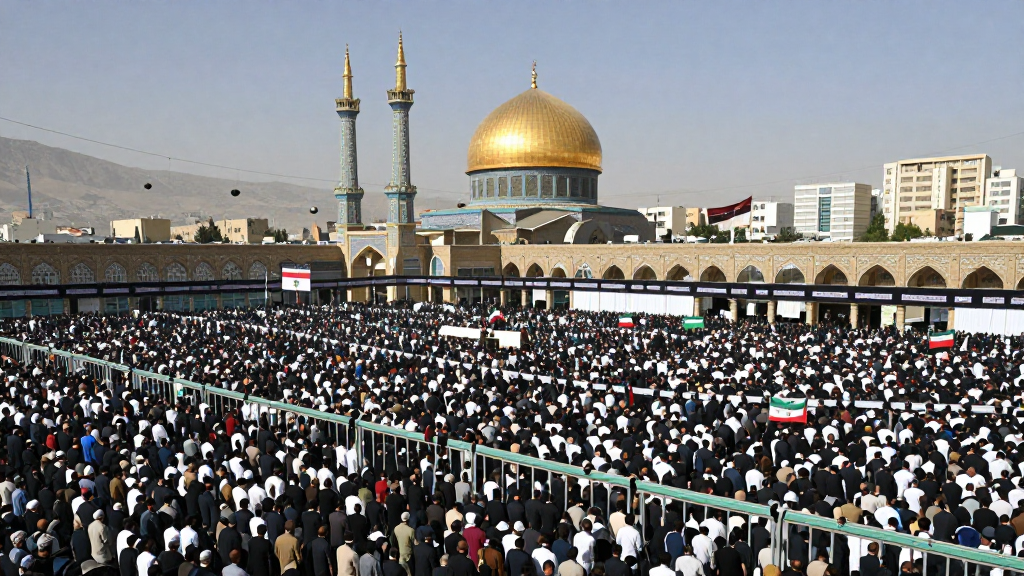
TEHRAN — Iran prepared on Thursday for what authorities described as one of the largest funerals in the Islamic Republic’s history, with more than 20 million mourners expected to gather across five cities in two countries to memorialize Supreme Leader Ali Khamenei, who was killed on February 28 at the outset of the US-Israeli war on Iran.
The weeklong funeral procession, stretching across Tehran and two holy sites in neighboring Iraq, comes at a delicate diplomatic moment. Iran’s Foreign Ministry spokesman, Esmaeil Baghaei, accused Washington on Thursday of having “constantly demonstrated its complete contempt for genuine peace and security in West Asia,” urging regional countries to draw “clear lessons” from the conflict.
The ceremony has been deliberately scheduled to overlap with the 250th American Independence Day on July 4, a choice analysts see as a pointed signal to Washington. Khamenei’s body is set to lie in state inside Tehran’s Imam Khomeini Mosalla, a massive mosque complex where firefighters have installed more than 6,000 overhead water sprinklers to protect crowds from the scorching July heat.
A Spectacle Designed to Send a Message
Four months after the supreme leader’s death in a coordinated US-Israeli strike that triggered a devastating regional war, Tehran is sparing no expense. Government employees, universities, labor unions, soldiers, aid workers, and religious mourning groups have been mobilized in what authorities call one of the largest logistical operations in the nation’s history. The capital’s international and domestic airports will shut during key procession days to manage the influx.
The scale of the ceremony, which spans three Iranian cities and two Iraqi pilgrimage sites, is intended as a defiant declaration of survival. “The assassination has made Khamenei far more powerful symbolically in death than he was in life,” Sina Toossi, a senior nonresident fellow at the Center of International Policy, told CNN. “Khamenei is now being framed as a martyred religious authority, akin to revered Shia saints who were martyred, whose worldview was vindicated by the manner of his death.”
The funeral also marks the anticipated public debut of Khamenei’s son and successor, Mojtaba Khamenei, who has remained in hiding since his father and other family members were killed. Banners depicting father and son together have appeared on fences outside the mosque complex, signaling continuity of the theocratic system even as the country reels from war damage and economic collapse.
Parliamentary Speaker Leads Negotiations Amid Mourning
Mohammad Bagher Ghalibaf, the powerful parliamentary speaker who is simultaneously leading Iran’s negotiations with the United States, called on the nation to turn the funeral into a display of strength. “We must rise and raise the cry for the nation’s blood to the world so that the world knows that the honorable and noble nation of Iran does not remain silent in the face of oppression,” Ghalibaf wrote in a message published by state media on Thursday. He called the funeral “an epic feat that will show the greatness of a nation’s spirit to the world.”
The juxtaposition of a funeral steeped in anti-American symbolism with ongoing peace negotiations has created a volatile diplomatic atmosphere. Qatar, which has served as a mediator in the conflict, cited what it called “positive progress” in the talks, though Iranian officials have used the days leading up to the funeral to issue increasingly stark warnings about US intentions.
Baghaei’s statement warned neighboring countries against aligning too closely with Washington, arguing that the US-Israeli military campaign had exposed the hollowness of American promises of security. The rhetoric reflects a hardening of Iran’s public posture even as back-channel discussions continue through intermediaries in Doha and Muscat.
Security Concerns Echo Past Tragedies
Iranian authorities are acutely aware of the risks associated with crowds of this magnitude. The Islamic Republic’s only comparable funerals were those of founder Ayatollah Ruhollah Khomeini in 1989 and Quds Force commander Qassem Soleimani in 2020. Both descended into deadly chaos. During Khomeini’s funeral, frenzied mourners tore at the coffin’s shrouds, forcing officials to remove the body by helicopter. Soleimani’s procession in Kerman was disrupted by a stampede that killed dozens.
To prevent a repeat, cooling systems have been installed across the mosque courtyard, and security forces have been deployed in force along the procession routes connecting Tehran to the Iraqi cities of Najaf and Karbala. Construction vehicles and cranes remained on site as of Thursday, with workers reinforcing viewing platforms and barricades.
Neighboring Iraq, where Shiite Muslims constitute a majority, is preparing for millions of mourners to cross the border for prayers at the holy shrines. Iraqi officials have coordinated with Tehran on border management and transportation, though the influx of pilgrims is expected to strain infrastructure in both countries.
What to Watch Next
The funeral’s first major event begins Saturday at 6 a.m. local time when Khamenei’s body is placed on an elevated stage at the Imam Khomeini Mosalla. Observers will be watching for Mojtaba Khamenei’s public appearance, which would represent the first time the new supreme leader addresses the nation since assuming power in the chaos following his father’s death.
Diplomatically, the coming days will test whether the peace track survives the anti-American theater of the proceedings. US negotiators have not publicly responded to Baghaei’s remarks, but officials familiar with the talks told Reuters that Washington views the funeral period as a necessary pause rather than a rupture. The next formal round of negotiations is expected after the mourning period concludes, with Qatar continuing to shuttle proposals between the two sides.
For Iran, the funeral is both a farewell to a leader who ruled for 37 years and a declaration that the system he built endures. Whether that message resonates with a population exhausted by war, sanctions, and repression remains an open question that no ceremony, however grand, can fully answer.