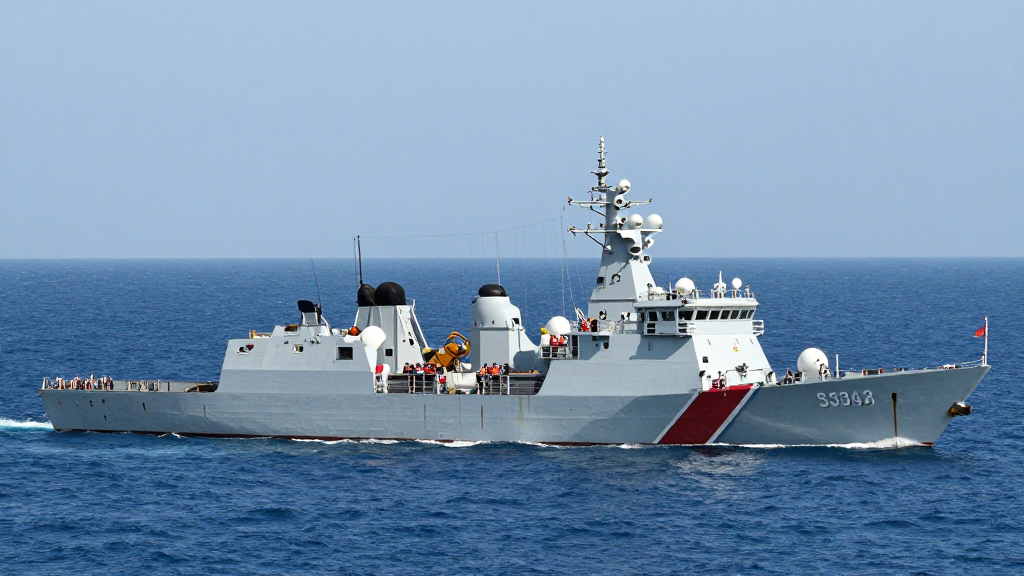
Coast Guard Ship-Days Near 2025 Full-Year Total in Six Months
China Coast Guard patrols at Scarborough Shoal reached 933 ship-days in the first half of 2026, nearly matching the entire full-year total of 1,099 recorded in 2025, according to new data released Thursday by the Asia Maritime Transparency Initiative at the Center for Strategic and International Studies. The figure represents a 73 percent increase over the same period last year and marks the highest concentration of Chinese law enforcement vessels ever recorded at a single feature in the South China Sea since AMTI began systematic automatic identification system tracking in 2019.
AMTI’s analysis shows China Coast Guard vessels averaged 156 ship-days per month in the first half of 2026, peaking at 216 in May alone. Multiple Chinese coast guard ships coordinated to maintain a perimeter patrol covering all approaches to Scarborough within a 30-nautical-mile radius, while a persistent detachment of six to eight Chinese maritime militia vessels maintained coverage closer to the shoal itself.
“The level of concerted Coast Guard presence at the shoal in 2026 is beyond any previously observed activity in the South China Sea,” the AMTI report said. “As Beijing doubles down on these familiar tactics, it is also employing new methods to enhance its physical presence.”
Philippine law enforcement patrols near Scarborough also increased, averaging 43 ship-days per month compared to 30 in the first half of 2025, though they remain heavily outnumbered by Chinese assets.
Floating Research Structure Triggers Diplomatic Protest
The surge in patrols has coincided with China’s deployment of multiple floating objects at the shoal, including buoys, a 352-meter floating barrier across the lagoon entrance that was later removed, and most recently a six-by-six-meter floating research platform discovered inside the lagoon on May 25. Philippine Defense Secretary Gilberto Teodoro Jr. said authorities were verifying whether the structure was fixed or floating, while military chief Gen. Romeo Brawner Jr. confirmed the military had monitored a suspected small structure.
Manila filed a diplomatic protest, and Chinese officials eventually described the platform as a “temporary research facility” collecting ecosystem data. The structure was removed on June 17, but other buoys and objects installed since October remain at the shoal.
“We’re not even sure if it’s a structure,” Teodoro told reporters in Manila. “Once in a while, they put a buoy or something there, or it may have drifted in from outside. It’s a shoal.”
The Philippine Coast Guard reported 112 days of interaction with Chinese vessels near Scarborough in the first half of 2026, averaging 19 days per month, with several encounters involving dangerous maneuvers and water cannon use.
Regional Drills and Carrier Movements Add Pressure
The Scarborough escalation is unfolding against the backdrop of overlapping military exercises across the Indo-Pacific. China’s newest aircraft carrier, the Fujian, transited the Taiwan Strait on June 22 for the first time since December, coinciding with Taiwan’s five-day Immediate Combat Readiness Exercise and the start of the U.S.-led Valiant Shield 2026 drills running across Guam, Japan, and the Mariana Islands.
China’s Liaoning carrier strike group also returned to Qingdao on June 22 after a 40-day deployment to the South China and Philippine Seas, during which it conducted joint exercises with amphibious assault ship CNS Anhui, the first publicly confirmed drills of their kind. The U.S. State Department separately condemned Chinese Coast Guard patrols off Taiwan’s east coast as “deeply destabilizing,” while Britain, France, and Germany issued a joint statement warning that Chinese activities threatened freedom of navigation.
Philippine President Ferdinand Marcos Jr. spoke by phone with U.S. Secretary of State Marco Rubio to discuss mutual concerns, including developments in the South China Sea. The Philippines and U.S. forces conducted a maritime cooperative activity near Scarborough from May 26 to 30, with a U.S. Coast Guard cutter joining for the first time. China stated it had carried out combat readiness patrols in response to what it called “rights violations and provocative acts,” a claim the Philippine military rejected.
Analysts at AMTI warned that China is pushing the boundaries of control at Scarborough without crossing traditional red lines of building permanent structures or conducting land reclamation, testing Manila’s response capacity and Washington’s commitment to allied maritime security in the Indo-Pacific.