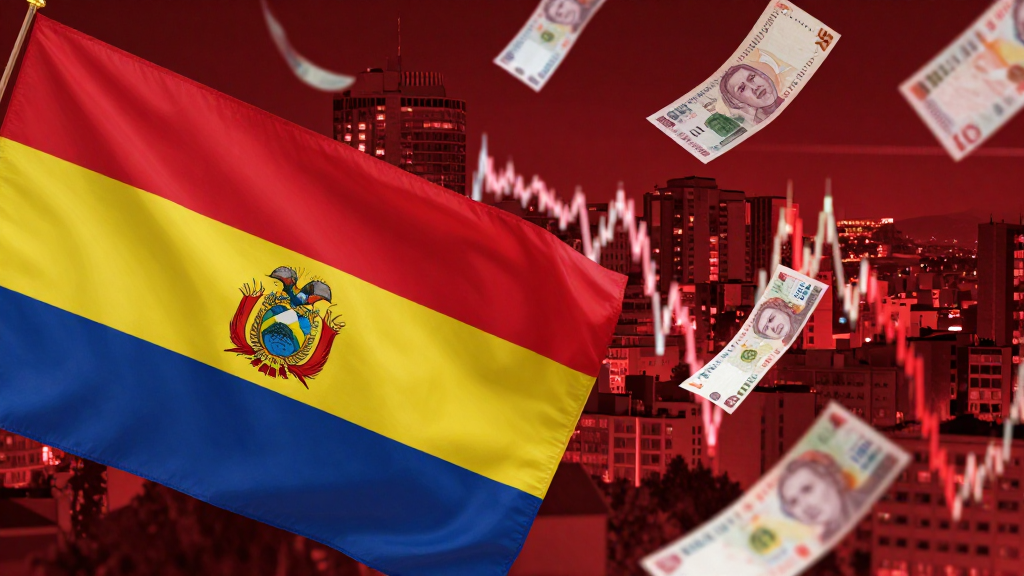
Bolivia has formally abandoned its 15-year fixed exchange rate to the US dollar, delivering one of the most consequential monetary policy shifts in the country’s modern history and sending the boliviano into a roughly 30 percent plunge against the greenback. The decree, issued on June 27, ended the long-held peg of 6.86 bolivianos per dollar and moved the country to a flexible exchange-rate system, with the central bank updating its official reference rate to approximately 9.73.
Economy Minister Jose Gabriel Espinoza announced the transition, framing it as an unavoidable correction after years of widening distortions between the official rate and the reality on the street. The decision follows months of escalating economic turmoil, a state of emergency declared by President Rodrigo Paz, and more than 50 days of protests that paralysed highways across the Andean nation.
How the Peg Collapsed Under Its Own Weight
The dollar peg, in place since 2011, was once a symbol of Bolivia’s commodity-driven prosperity. Foreign exchange reserves peaked at roughly $15 billion in 2014, the legacy of a natural gas and mining boom that filled government coffers. But as gas revenues declined and commodity prices cooled, those reserves drained to dangerously low levels, leaving the central bank unable to defend the peg.
A parallel currency market emerged almost inevitably. On the streets of La Paz, Cochabamba, and Santa Cruz, dollars traded at rates between 12.9 and 14.5 bolivianos, and at times approached 20 per dollar, more than double the official rate. Cryptocurrency adoption surged after the government lifted restrictions in 2024, with transaction volumes jumping 530 percent year-over-year as Bolivians turned to stablecoins like Tether for payments and savings.
The IMF Factor and a $2.5 Billion Question
The currency unification is inseparable from Bolivia’s parallel pursuit of an International Monetary Fund financing package estimated between $2.5 billion and $3.3 billion. The IMF had repeatedly signalled that greater exchange-rate flexibility was a precondition for broader support, giving La Paz a clear external incentive to formalise what the market had already priced in.
Economists have broadly endorsed the direction of the move, describing it as a necessary correction. But they caution that the new regime will only hold if Bolivia can rebuild its reserve buffer, attract capital inflows, and restore confidence. Without reserve rebuilding, a managed float can quickly become a disorderly one.
“The gap between old parallel market rates and the new official floating rate will need to close,” one regional currency analyst told investors, noting that traders who profited from the spread will see that arbitrage opportunity shrink, which is exactly the point of the policy change.
Ordinary Bolivians Brace for Higher Prices
The near-term cost for ordinary Bolivians is likely to be sharp. Higher import prices will ripple through fuel, food, and consumer goods, all of which will become more expensive in boliviano terms. That prospect is especially fraught in a country already battered by fuel shortages, the junk gasoline scandal that damaged vehicles and triggered transport strikes, and the broader political crisis that brought tens of thousands into the streets.
“What we are seeing is the cost of years of denial,” a La Paz-based economic researcher told local media. “The government chose to defend an unsustainable rate rather than confront the structural problems, and now ordinary people are paying the price.”
Labour Unions and Political Opposition Mobilise
Labour groups have mounted fierce protests against the government’s economic agenda, driven by fears that IMF financing will come attached to fiscal austerity conditions. The Bolivian Workers’ Center, the Unified syndical Confederation of Peasant Workers, and FEJUVE neighbourhood organisations have all mobilised against the reforms. Supporters of former President Evo Morales have joined the protests, turning an economic grievance into a broader political confrontation.
The crisis traces back to a familiar pattern for resource-dependent economies. Bolivia rode the commodities boom of the 2000s, building reserves that made the peg credible. When gas export revenues fell and the fiscal deficit widened, the government burned through reserves to maintain the illusion of stability rather than confronting the imbalance.
Regional Ripple Effects Across South America
For Bolivia’s neighbours, the episode is a cautionary signal. Managed pegs under reserve stress are slow-motion events until they suddenly are not, and the same vulnerabilities exist across parts of South America. Argentina’s currency travails, Venezuela’s hyperinflationary collapse, and Ecuador’s dollarisation debates all underscore how currency policy remains a defining fault line in regional stability.
Whether La Paz can navigate the transition without a deeper crisis will depend on the IMF negotiations, the pace of reserve recovery, and the government’s ability to hold together a fragile political consensus amid demands for change that show no sign of fading. The era of the official fiction is over.