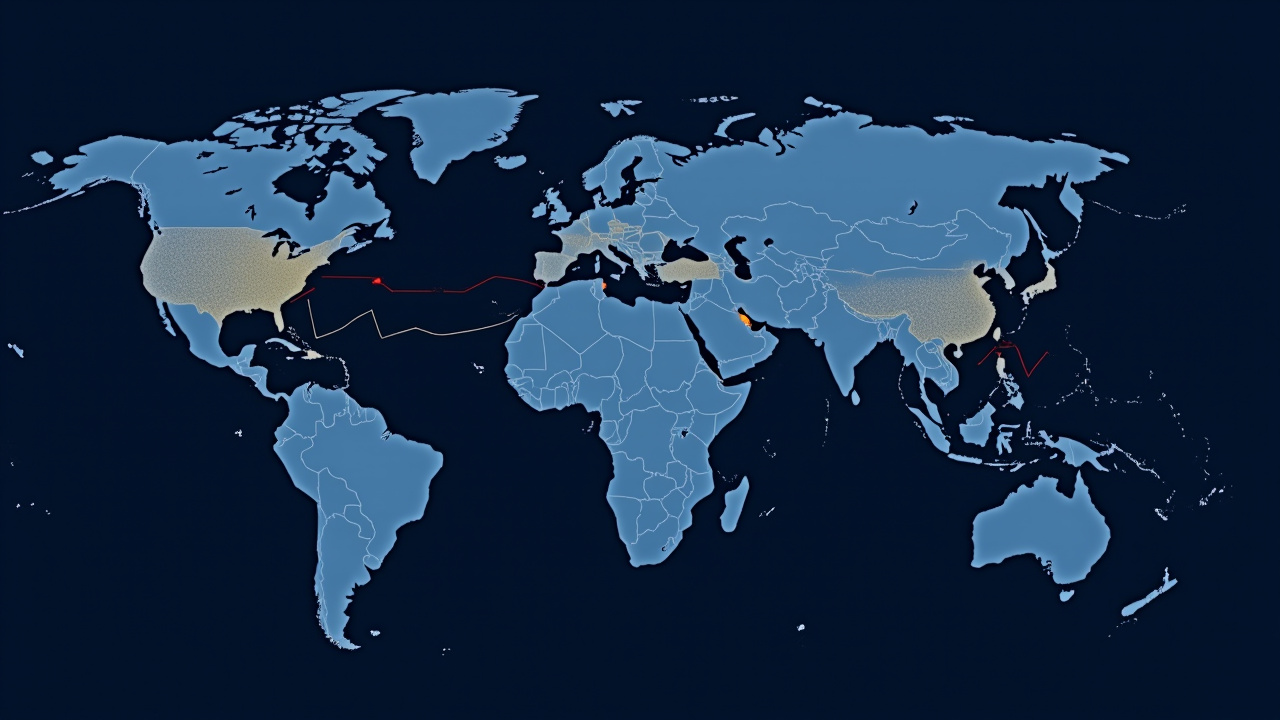
The architecture of global commerce, painstakingly constructed over seven decades by diplomats, economists, and multilateral institutions, is experiencing its most dramatic structural collapse since the interwar period. In the first four months of 2026, the world”’s major trading blocs have retreated into competing spheres of influence — and the aftershocks are reverberating from factory floors in Vietnam to commodity exchanges in São Paulo.
The numbers are stark. The World Trade Organization”’s latest monitoring report shows that global trade growth has slowed to 1.2% — less than half the pre-pandemic average and a sharp reversal from the 2.7% expansion recorded in 2024. More telling than the headline figure is the composition of trade flows: intra-bloc commerce within regional groupings has grown by 4.1%, while cross-bloc trade has contracted by 6.8%. We are not experiencing a trade slowdown. We are witnessing a managed fragmentation.
The Tariff War Enters Its Reckoning Phase
The U.S.-China trade relationship entered 2026 in a state of managed hostility. The tariff regime now covers nearly $680 billion in two-way trade, with American importers paying an average effective tariff of 24.3% on Chinese goods. Chinese retaliatory tariffs have raised the cost of American agricultural exports, semiconductors, and energy by comparable margins.
“What we are seeing is not trade war in the traditional sense. It is the deliberate construction of parallel economic ecosystems — each designed to be self-sufficient and resilient to the other”’s disruptions.” — Dr. Amara Nwosu, Director of Trade Policy, Peterson Institute for International Economics
American consumers have absorbed approximately $2,400 per household annually in higher prices, according to the Federal Reserve”’s consumer spending surveys — a quiet tax that has become a defining feature of the political economy of the current administration. Chinese manufacturers have made dramatic inroads in third-country markets, routing products through Vietnam, Malaysia, and Mexico in configurations that represent a sophisticated workaround of the letter if not the spirit of trade law.
The Emerging Market Squeeze
Nowhere is the stress more visible than in the emerging markets that once stood to gain from great-power competition. Vietnam, which attracted $36 billion in foreign direct investment in 2025 as manufacturers sought China+1 diversification, has found itself caught in a new bind. American customs authorities, deploying enhanced origin-tracing protocols powered by AI-assisted supply chain analysis, have invalidated dozens of tariff preferential certificates citing insufficient Vietnamese value-added transformation.
The International Monetary Fund”’s April 2026 World Economic Outlook places Vietnam”’s growth forecast at 4.8% for the year — down from 6.2% projected just six months ago. The revision reflects not a domestic demand crisis but the cascading effects of being caught between two incompatible regulatory regimes. Vietnamese factory owners describe a paradox: orders are plentiful, but the margin compression from tariff uncertainty makes many of them uneconomical to fulfill.
India”’s position has been similarly complicated. The Modi government”’s careful balancing act — deepening technology ties with Washington while maintaining robust trade relationships with Beijing — is under mounting pressure from both directions. The U.S. Inflation Reduction Act”’s local content requirements effectively exclude Indian solar panel manufacturers from American procurement. China, in turn, has used its dominance in rare earth processing to constrain India”’s ambitions in electric vehicle manufacturing.
Europe”’s Strategic Dilemma
The European Union, whose single market was itself a product of post-war trade integration logic, faces what European Commission President Maria Santos has called the trilemma of our generation: maintaining transatlantic solidarity with the United States, preserving access to Chinese markets, and protecting the integrity of the European economic model. Brussels has attempted to chart an independent course through the EU Global Gateway infrastructure initiative and the Critical Raw Materials Act — but these measures represent a fraction of the capital flows needed to structurally reorient European supply chains.
The European approach to de-risking — decoupling from China in critical technologies while maintaining commercial ties — requires investments that no member state budget can sustain independently. The EU Global Gateway is a good start, but it is chronically underfunded relative to the Belt and Road Initiative it was meant to counter. — Prof. Elena Bauer, European Institute of Public Administration
Germany, whose export-driven economic model depends more than any other major economy on open global trade routes, has been forced to undertake the most dramatic strategic pivot. The collapse of the Nord Stream gas infrastructure, the progressive decoupling from Chinese market access for its automotive sector, and the need to reorient toward American technology partnerships have converged to produce what the Ifo Institute describes as the most significant restructuring of the German economic model since reunification. Chancellor Friedrich Merz”’s government has committed €120 billion in industrial transition subsidies — a figure that represents nearly 3% of German GDP and has triggered fierce debate within the EU about competitive fairness.
The Dollar”’s Diminishing Dominion
Perhaps the most structurally significant development is the accelerating erosion of the dollar”’s role in global trade. For decades, the greenback”’s status as the world”’s reserve currency gave the United States a uniquely privileged position in the global financial system — the so-called exorbitant privilege that allowed Americans to borrow in their own currency and run persistent current account deficits without immediate market discipline. That privilege is now being actively contested.
The BRICS grouping — expanded in January 2026 to include Saudi Arabia, the UAE, and Nigeria — has formally committed to conducting a minimum of 30% of intra-bloc trade in local currencies, with a coordinated push to develop an alternative to the SWIFT messaging system for interbank transactions. China”’s Cross-Border Interbank Payment System (CIPS) now processes over $900 billion in annual transactions, up from $180 billion in 2022. While the dollar remains dominant in global financial markets — still accounting for roughly 55% of global FX reserves — the direction of travel is unmistakably toward multipolar currency arrangements.
We are not witnessing the end of dollar primacy in this decade. But we are witnessing the end of dollar exclusivity — and that is almost as consequential. Every country that opens a CNY account at its central bank, every bilateral trade agreement denominated in local currency, every new infrastructure bond issued in a currency other than dollars represents a small but irreversible chipping away of the system that has underwritten American economic power for eighty years. — Zanny Minton Beddoes, Editor-in-Chief, Foreign Policy
A Fragile Order at the Crossroads
The global trade order that will emerge from this period of fragmentation will not be the liberal internationalist system that prevailed from 1990 to 2018, nor will it be the clean bilateral spheres-of-influence model that some hawks in Washington and Beijing have advocated. It will be something messier, more incremental, and ultimately more unstable: a patchwork of regional arrangements, sector-specific accords, and strategic dependencies held together by mutual economic necessity rather than shared ideological commitment.
The cost of this transition — measured in fore gone trade, wasted capital, and the economic marginalization of the world’s poorest nations — will be borne disproportionately by those least able to absorb it. The developed world”’s ability to manage the transition will depend less on the elegance of their trade agreements than on the robustness of their domestic social contracts: whether the gains from whatever new arrangements emerge are widely shared or concentrated in the hands of those who already hold most of the cards.
For policymakers in 2026, the lesson of this turbulent year is clear: the question is not whether to engage with a more fragmented global economy, but how to do so in ways that build resilience without sacrificing the prosperity that open trade — however imperfectly and unevenly — has delivered. The multilateral system was built in the aftermath of a catastrophic war by leaders who understood that economic interdependence was not just an engine of growth but a guarantor of peace. Rebuilding that understanding, in a world of much greater complexity and much less trust, is the defining challenge of this generation of global economic governance.
David Foster is a Senior Analyst for Media Hook, specializing in geopolitical analysis, economic trends, and the forces reshaping the global order.