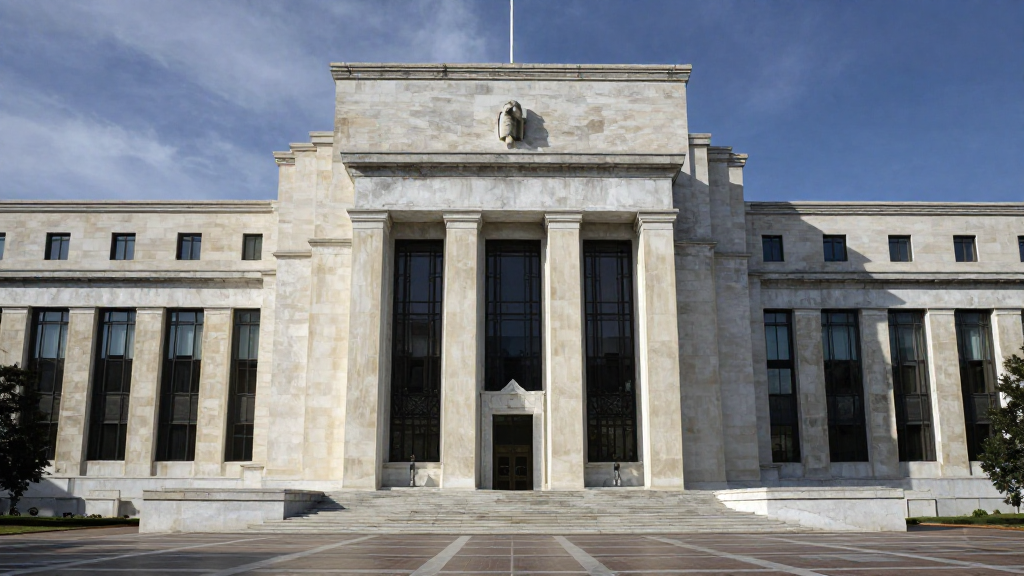
The Federal Reserve held interest rates steady at 3.5 percent to 3.75 percent on Wednesday, with the policy statement striking a notably more hawkish tone as officials signaled fewer rate cuts in 2026 than previously anticipated, marking Kevin Warsh’s first FOMC decision as chair.
Hawkish Dot Plot Signals Two Cuts at Most
The updated Summary of Economic Projections showed the median federal funds rate forecast settling at 3.63 percent by year-end 2026, implying only two quarter-point cuts from current levels. That marks a sharp downward revision from the three cuts penciled in at the March meeting and surprised markets that had priced in as many as four reductions. “The committee will deliver price stability,” the statement read, language that replaced the previous pledge to maintain the existing level of restriction. Fed futures traders immediately repriced rate-cut expectations, pushing back the anticipated first reduction to late 2026 or early 2027.
Inflation Remains the Central Concern
Consumer price inflation has proven stickier than Fed officials projected at the start of the year, running at 3.1 percent in the most recent reading and well above the committee’s comfort threshold. Supply shocks in energy and agricultural commodities, partly linked to continued disruptions in key shipping corridors, have kept price pressures elevated across a broad swath of consumer goods. “We are prepared to hold rates higher for longer if the data require it,” Warsh told reporters, underscoring the Fed’s resolve to avoid repeating the policy missteps of the 2020s when rates were kept too low for too long. Core personal consumption expenditures, the Fed’s preferred inflation gauge, held at 2.9 percent year-over-year in the latest report.
Growth Remains Solid but Divergence Widens
Despite the elevated rate environment, economic growth has held up better than many analysts expected. The FOMC statement acknowledged that “economic activity is expanding at a solid pace,” citing strong productivity growth and robust capital investment as offsetting factors. Job gains have continued to run ahead of the pace needed to absorb new workforce entrants, keeping the unemployment rate near 4.0 percent. However, regional manufacturing surveys have shown increasing contraction, and credit card delinquency rates have risen sharply among lower-income households, suggesting the higher-rate burden is spreading unevenly across the economy. Consumer confidence fell for the third consecutive month in June, according to the Conference Board index.
Market Reaction and Policy Outlook
Equity markets sold off modestly following the statement release, with the S&P 500 declining 1.2 percent before recovering to close 0.4 percent lower. The two-year Treasury yield, which is most sensitive to near-term Fed policy expectations, jumped 12 basis points to 4.87 percent, reflecting the repricing of the rate-cut path. The dollar index rose 0.6 percent against a basket of major currencies, putting additional pressure on emerging-market economies that have dollar-denominated debt. The next FOMC meeting is scheduled for late July, and traders will be watching incoming inflation and employment data for any signs that the hawkish pivot is gaining traction in slowing price growth.