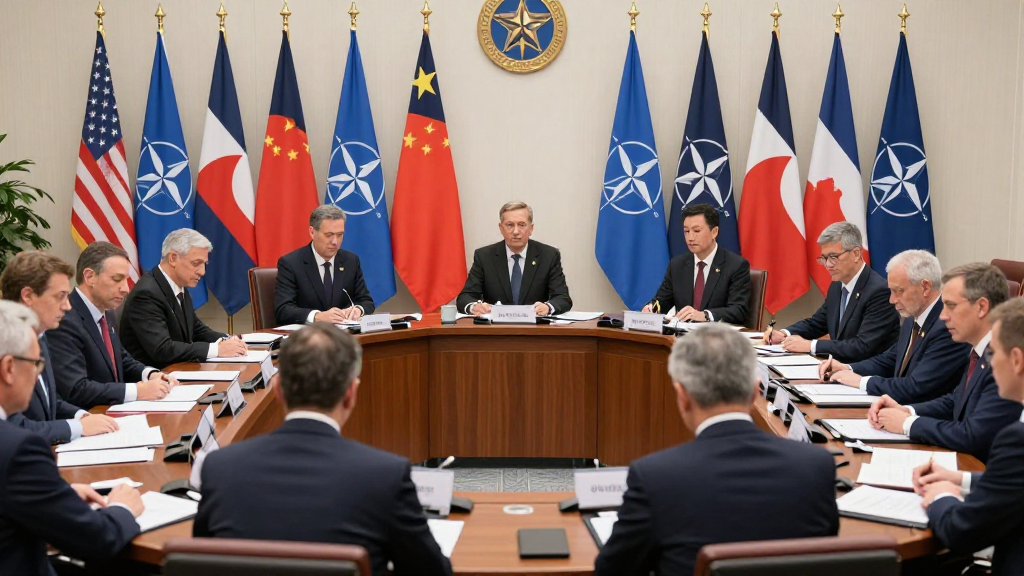
NATO allies are expected to pledge billions of dollars in new arms contracts and accelerated weapons production when leaders gather in Ankara next week, according to five NATO diplomats who spoke to POLITICO on condition of anonymity ahead of the formal announcement. The summit, set for July 7-8, will bring together alliance heads of state including President Donald Trump, who has repeatedly pressed European members to increase their defense spending and ramp up industrial output. Secretary-General Mark Rutte has made scaling up alliance-wide arms production the centrepiece of his agenda, officials said.
Beyond the arms procurement pledges, the summit is also expected to address NATO’s role in monitoring the Iranian conflict, an issue that has strained relations between Washington and several European capitals. The alliance has been asked to consider whether to deploy additional air defence assets to Gulf states, according to two NATO military officials who spoke to Reuters. No decision has been taken, the officials said, but the request is under active review at NATO’s military headquarters in Brussels. Several European governments have been reluctant to expand NATO’s geographic footprint beyond the Euro-Atlantic area, citing both legal constraints and the risk of entanglement in a conflict they view as a bilateral U.S. matter.
Arms Deals and Industrial Capacity at the Forefront
The diplomats described a draft declaration that includes new procurement commitments across several member states, though the precise figures remain under negotiation as of Wednesday. At least some of the deals are expected to be pre-agreed and repackaged for public announcement at the summit. Rutte has pushed to frame the gathering around defence industrial capacity, arguing that a concrete manufacturing agenda can unite members even as political differences persist over the U.S. campaign in Iran and how European allies should respond.
“The Secretary-General wants something tangible that all 32 members can rally behind,” one senior NATO diplomat told POLITICO. “A production pact plays to everyone’s interest and sidesteps the harder questions about troop deployments and Iran policy.” The challenge, officials acknowledge, is convincing European defence firms to shift from high-value, precision systems toward mass production of standard munitions — a structural shift that requires both investment and political will. Three separate procurement tracks are under discussion, covering artillery ammunition, air defence components and long-range strike capabilities, diplomats said.
Article 5 and Russia Still in the Text
Despite the friction over Iran, the draft communique is expected to reaffirm the alliance’s Article 5 mutual defence clause and once again describe Russia as a long-term threat to Euro-Atlantic security, according to two diplomats briefed on the negotiations. The joint statement will be deliberately short — a deliberate choice, one official said, to avoid language that could provoke objections from any of the 32 member governments ahead of the final signing ceremony. Country heads will sign off on the text in Ankara before the summit closes on July 8.
The timing of the gathering coincides with heightened concern in several Eastern European capitals about Russia’s military posture following the conclusion of major winter operations. NATO’s eastern flank members, including Poland and the Baltic states, have pressed for stronger language on forward deterrence, but diplomats said those demands were likely to be addressed in a separate military posture document rather than the political declaration. “The eastern members want to see more, and they are right to push,” a second senior NATO official said. “But there is only so much the 32 can agree on in a single text.”
Iran Question Exposes Transatlantic Divide
One of the most contentious issues under discussion is whether the summit declaration should make any reference to the U.S. war in Iran, diplomats said. Trump has criticised European allies for declining to participate in military operations against Tehran, and administration officials have signalled they expect NATO members to demonstrate solidarity even outside the alliance’s traditional Euro-Atlantic theatre. European governments, many of which have maintained diplomatic channels with Iran and oppose further escalation, are resisting language that would appear to endorse Washington’s campaign, according to three officials familiar with the negotiations.
The internal debate reflects a deeper tension over the future scope of NATO’s mandate. Since returning to office, Trump has insisted that alliance commitments must extend to supporting U.S. operations globally, a position that puts him at odds with European partners who view the Iran question as outside NATO’s founding purpose. NATO ambassadors are continuing to hammer out the declaration’s precise wording, and the text could change before leaders formally endorse it in Ankara.
The Ankara summit marks the third major NATO gathering of 2026 and comes against a backdrop of mounting pressure from Washington for the alliance to demonstrate both strategic relevance and financial commitment. Trump has repeatedly suggested that NATO members who fall short of the two-percent GDP defence spending target should face consequences, though administration officials have not specified what form those consequences might take. Alliance diplomats expect the summit communique to include language reaffirming the two-percent commitment, but differ on whether it will include new enforcement mechanisms.
Secretary-General Rutte has sought to frame the summit around practical outcomes rather than political disputes. His office released a statement this week describing the Ankara gathering as an opportunity to accelerate delivery on commitments already made — language that critics say sidesteps the harder question of whether NATO members are actually meeting their pledges. Defence spending data from NATO’s own reporting shows that 23 of the 32 member states are expected to meet or exceed the two-percent target in 2026, up from 18 in 2024, but the distribution remains uneven, with Germany, Spain and Italy still below the threshold.