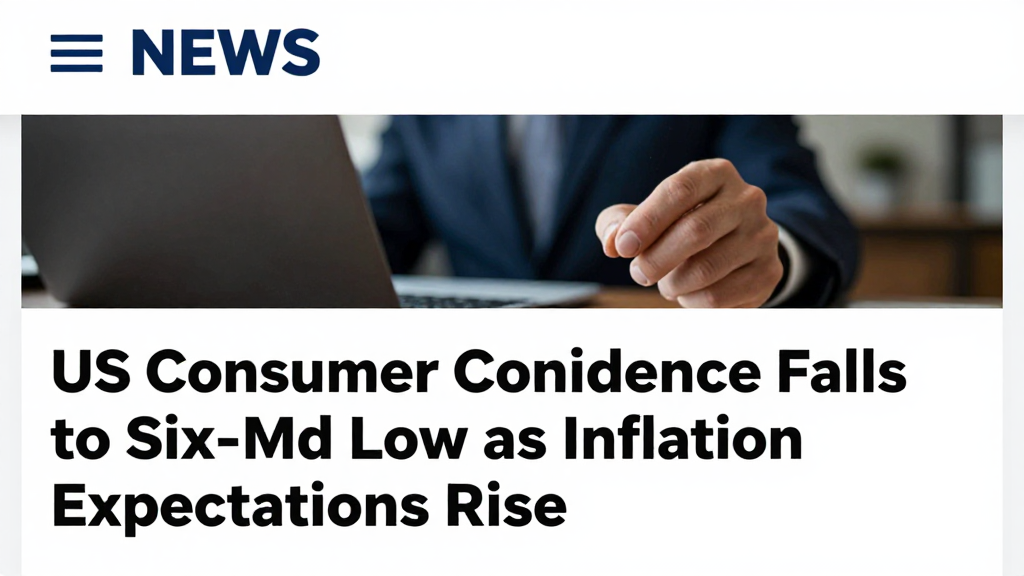
US Consumer Confidence Falls to Six-Month Low as Inflation Expectations Rise
Confidence Slides as Households Feel the Squeeze
American consumer confidence retreated to its lowest level in six months in June 2026, according to the Conference Board, as persistently elevated inflation continued to erode household purchasing power and dimmed expectations for the broader economy. The benchmark Consumer Confidence Index fell to 103.8 from a revised 106.4 in May, missing economist forecasts of a more modest decline to 105.2. The diffusion index measuring present economic conditions dropped three full points to 130.2, while the expectations index fell to 85.6 from 89.1, slipping further into territory that has historically signaled recession risk. The data underscored the growing tension between still-resilient spending patterns and mounting financial strain among lower- and middle-income households. Families are stretching paychecks further than they did a year ago, and the cumulative effect of three years of elevated prices is starting to show in discretionary spending, said Lori Donovan, a senior economist at Bank of America Institute. When consumers pull back on big-ticket purchases, the feedback loops into hiring and investment decisions within months.
Inflation Expectations Tick Higher at the Pump and Grocery Store
TheConference Board survey also revealed a worrying shift in inflation expectations: the mean rate at which consumers anticipate price increases over the next 12 months rose to 5.3 percent, up from 5.0 percent the prior month the highest reading since April 2025. The surge was driven predominantly by rising gasoline prices and food costs, categories that disproportionately affect lower-income households that spend a larger share of their income on essentials. Energy prices have climbed steadily since the OPEC+ production meeting in early June, with retail gasoline averages nudging past 3.40 per gallon nationally. Consumers also reported a slight increase in the share who described current job availability as hard to get, a signal that labour market tightness is gradually easing. The combination of softer job prospects and higher anticipated costs creates a psychological pinch that tends to precede sustained spending cutbacks. Federal Reserve policymakers have been closely tracking these survey-based inflation expectations, viewing them as leading indicators that can become self-fulfilling if households begin negotiating wages around higher price assumptions.
Spending Patterns Signal a Cautious Consumer Under Pressure
Separate data from the Commerce Department showed that core personal consumption expenditures the Fed is preferred gauge of inflation, excluding food and energy held steady at 2.8 percent year-over-year in May, remaining well above the central bank is 2.0 percent target. Consumer spending, which accounts for roughly two-thirds of U.S. economic activity, rose just 0.1 percent in real terms month-over-month after a downwardly revised 0.3 percent gain in April. The personal saving rate inched up to 4.9 percent, suggesting households are choosing to retain rather than spend incremental income gains. The housing market added to the cautious tone: new home sales fell 2.3 percent in May compared with the prior month, while existing home sales slipped for the third consecutive month as mortgage rates hovering near 6.8 percent kept many prospective buyers on the sidelines. The consumer is not collapsing, but the buffer built during the post-pandemic spending surge is being steadily depleted, noted Marcus Tran, chief U.S. economist at Oxford Economics. Growth in the second half of 2026 will depend heavily on whether the labour market can maintain its current pace and whether energy prices stabilize.
Fed Faces a Delicate Balancing Act on Rates
The confluence of softer growth, sticky inflation, and deteriorating confidence complicates the Federal Reserve is path toward monetary easing. Markets had priced in two quarter-point rate cuts by year-end as recently as early June, but that expectation has narrowed to a single cut following the hotter-than-expected consumer price index report for May and the string of mixed labour market readings. Fed Chair Jerome Powell, in congressional testimony last week, emphasized that the central bank needed greater confidence that inflation was converging to target before lowering borrowing costs. The latest ISM manufacturing survey, showing a contraction in factory activity for the third straight month, added to concerns that elevated interest rates are beginning to weigh on business investment and hiring in rate-sensitive sectors. The Fed is trapped between a rock and a hard place, said Elena Vasquez, chief investment officer at Pacific Rim Asset Management. Cut too soon and you risk re-igniting inflation expectations. Wait too long and you risk tipping a consumer-led slowdown into a broader recession.