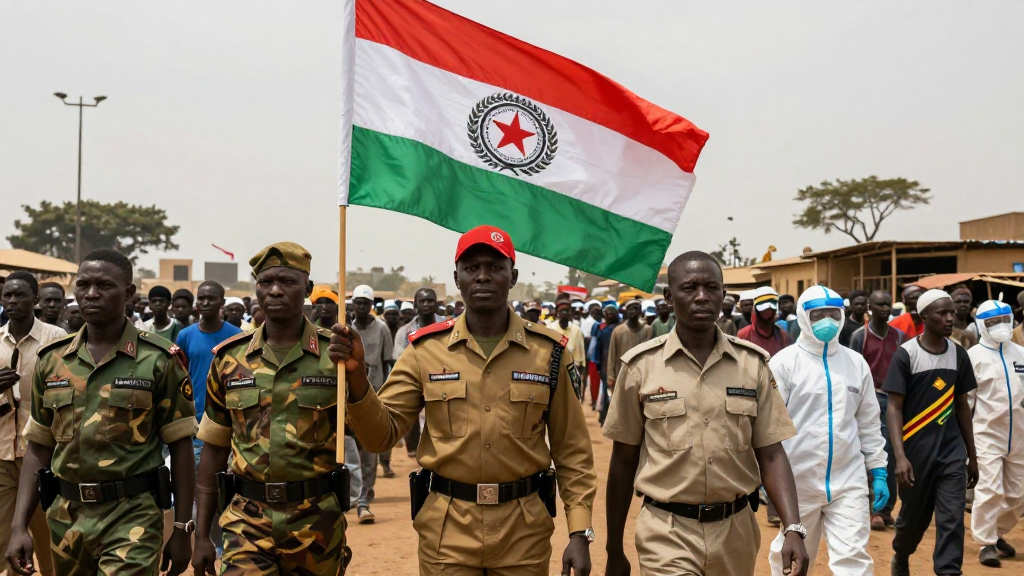
Dakar, Senegal — Three of Africa’s most crisis-hit nations have taken a historic step away from international justice, formalizing their withdrawal from the International Criminal Court while simultaneously deepening their reliance on military rule and paramilitary forces accused of atrocities. Burkina Faso, Mali, and Niger deposited their notifications to leave the Rome Statute — the treaty that established the ICC — between June 18 and June 24, 2026, with the court confirming the move on July 2. The withdrawals take effect in June 2027, but rights groups say the damage to victims seeking accountability is already irreversible.
The three Sahel nations, all led by military governments that seized power through coups between 2020 and 2023, announced their intention to quit the ICC in September 2025, denouncing it as a tool of neocolonial repression. Rights monitors have documented serious abuses by both state forces and Islamist insurgent groups across the region, with large swaths of territory now outside government control.
West Africa: Sahel Trio Quits the ICC, Siding with Impunity Over Justice
The ICC confirmed on July 2 that Burkina Faso, Mali, and Niger had submitted formal withdrawal letters, triggering a one-year process to exit the world’s permanent war crimes tribunal. The court’s governing body warned in a statement that the decision risked “weakening global efforts to end impunity and undermining the pursuit of justice.”
The three countries are among the world’s most conflict-affected, with Islamist insurgencies linked to al-Qaeda and the Islamic State group having seized vast rural territory and killed thousands of soldiers, civilians, and aid workers since 2015. Rights groups have accused both militants and government forces of possible war crimes and crimes against humanity. The ICC has had Mali’s situation under investigation since 2013 — a probe that remains active even after the withdrawal takes effect.
Marceau Sivieude, Amnesty International’s regional director for West and Central Africa, said the move threatened to deny thousands of victims the possibility of truth, justice and reparations. “Withdrawing from the ICC amounts to a headlong retreat by these governments from their international law and justice obligations,” Sivieude said. “It will also further imperil civilian lives and further enshrine impunity for crimes under international law.”
North Africa: Sudan RSF Accused of Crimes Against Humanity in El Fasher
In Sudan, a new Amnesty International report released in early July accused the Rapid Support Forces of committing crimes against humanity in El Fasher, the capital of North Darfur, describing the findings as “a stain on the conscience of humanity.” The report detailed systematic killings, sexual violence, and deliberate starvation of civilians trapped in the city since fighting between the RSF and the Sudanese Armed Forces erupted in April 2023. The conflict has killed more than 1,500 people and displaced millions, with UN agencies warning that famine conditions are spreading across the country.
East Africa: Kenya’s Gen Z Returns to the Streets as Uganda Silences the Press
In East Africa, Kenya is experiencing a revival of the youth-led protests that shook Nairobi and Mombasa in mid-2025. According to Al Jazeera, thousands of young Kenyans — many organizing through social media platforms — returned to the streets beginning June 25, marking the one-year anniversary of the first mass demonstrations against the Finance Bill. Police deployed water cannon and tear gas in response, and several protest leaders were arrested. Amnesty Kenya separately released a report accusing the government of weaponizing digital surveillance tools against demonstrators.
Across the border in Uganda, authorities banned the Nation Media Group — one of East Africa’s largest independent broadcasters — from operating, according to witnesses and news reports. The shutdown followed the network’s coverage of opposition figure Kizza Besigye’s treason trial, which has drawn international criticism. Reporters Without Borders called it “an escalation of the systematic silencing of independent journalism under the Museveni government.”
Southern Africa: South Africa Defuses a Crisis But Underlying Tensions Remain
In South Africa, President Cyril Ramaphosa credited diplomacy with largely preventing violence on June 30, the day an anti-migrant movement had called for foreigners to leave the country. At least 42 people were killed in xenophobic violence in the preceding weeks, and more than 1,000 were displaced in Johannesburg’s inner city alone, according to Business Day and CAJ News Africa. Ramaphosa deployed 2,500 soldiers to hotspots but said the deeper drivers — unemployment, economic stagnation, and service delivery failures — required structural solutions, not security responses.
The Southern African Development Community held emergency talks and issued a warning that the violence threatened regional integration and the free-movement protocols of the African Continental Free Trade Area. Several neighboring countries summoned South Africa’s ambassadors to demand explanations.
Central Africa: Ebola Cross-Border Concerns Mount as CAR Holds Contested Elections
Central Africa’s most pressing concern is the ongoing Ebola outbreak in the Democratic Republic of Congo, which has now spread to Uganda for a second time in two years, according to the World Health Organization. The Africa Centres for Disease Control and Prevention activated its continental emergency mechanism and dispatched teams to the DRC-Uganda border. Meanwhile, the Central African Republic held legislative elections that opposition parties said were neither free nor fair, with armed groups disrupting voting in nearly a third of constituencies, according to observers.
The convergence of justice retreats in the Sahel, atrocities in Sudan, press censorship in Uganda, protest resurgence in Kenya, xenophobic violence in South Africa, and health emergencies across Central Africa is testing the African Union’s capacity to respond coherently. With three of its member states formally abandoning the ICC, the continent’s accountability architecture faces its most severe stress test in a generation.