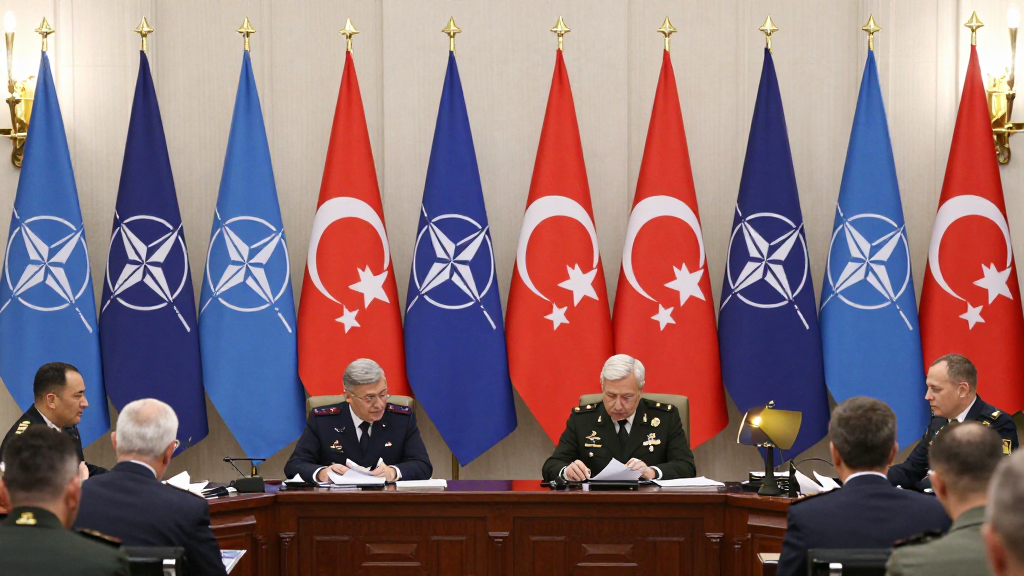
ANKARA, Turkey — NATO leaders wrapped a two-day summit in Ankara on Wednesday with a sweeping package of defense commitments that analysus described as the most consequential alliance decisions in years, as allied governments moved to accelerate military production, deepen industrial integration and sustain long-term support for Ukraine amid an escalating security crisis across Europe and the Middle East.
Heads of state and government from the 32-member alliance issued a joint declaration reaffirming their ironclad commitment to collective defense under Article 5 of the North Atlantic Treaty, while endorsing approximately 70 billion euros in support for Ukraine for 2026 alone — a figure that senior NATO officials said reflected a shared assessment that Ukrainian security remains inseparable from Euro-Atlantic stability.
Article 5 Reaffirmed as Foundation of Alliance
The declaration, signed by all 32 leaders present, reinforced the principle that an armed attack against any single member constitutes an attack against the entire alliance. Secretary General Mark Rutte described the reaffirmation as a direct response to what he called an era of accelerating strategic competition and persistent instability along NATO’s eastern and southern flanks.
The political declaration was accompanied by concrete operational commitments. Allied governments endorsed a new round of enhanced forward-presence deployments along NATO’s eastern border with Russia, including additional battlegroups in Poland, the Baltic states and Romania. NATO military authorities said the reinforcements would bring total allied troop levels in the region to their highest since the Cold War.
Ukraine Support Package and Defense Industrial Acceleration
Beyond the political declaration, the summit produced the largest single financial commitment to Ukraine since Russia’s full-scale invasion began. The 70 billion euro package includes military equipment, training programs, ammunition deliveries and investment in Ukraine’s own defense industrial base — a component that senior officials said would help Ukraine sustain operations without indefinitely depending on direct allied transfers.
Simultaneously, allied leaders endorsed new joint procurement initiatives worth more than $50 billion to expand NATO’s collective industrial capacity. The spending is intended to address chronic shortfalls in ammunition stockpiles, replace equipment donated to Ukraine and ensure that allied defense production can meet the demands of a prolonged security competition.
Speaking at a press conference following the closing session, NATO Secretary General Rutte said the summit had demonstrated that the alliance was moving at the speed of reality rather than waiting for consensus to develop. The decisions made here are not aspirational. They are funded, they are timetabled, and they will be implemented, he said.
Black Sea Security and Middle East Dimensions
The summit expanded NATO’s strategic aperture beyond Europe. Turkey, Romania and Bulgaria agreed to deepen coordination on protecting critical maritime infrastructure in the Black Sea, including ports, subsea energy facilities and undersea communications cables. The three nations signed a memorandum of understanding committing to joint monitoring and rapid-response protocols against conventional, hybrid and cyber threats targeting strategic infrastructure.
Allies also addressed the deteriorating situation in the Middle East. NATO leaders declared that Iran must never acquire a nuclear weapon and called for the preservation of freedom of navigation through the Strait of Hormuz — a waterway through which roughly one-fifth of the world’s oil tanker traffic passes. The statement reflected growing concern among European allies that escalating tensions between the United States and Iran could disrupt global energy markets beyond any immediate regional fallout.
President Recep Tayyip Erdogan of Turkey used the summit to press for deeper defense-industrial cooperation across the alliance, calling for the removal of national restrictions that limit intra-NATO arms sales and urging greater integration of Turkey’s substantial defense manufacturing base into Europe’s emerging security architecture. Turkey hosts NATO’s second-largest armed forces and has developed significant indigenous capabilities in missiles, drones and aerospace systems.
Drone Warfare and the Changing Nature of Conflict
Recognizing that uncrewed systems have fundamentally altered the economics and tactics of modern warfare, NATO leaders endorsed the expansion of the alliance’s Drone Edge initiative — a program designed to accelerate joint investment in autonomous platforms, swarming technologies and counter-drone capabilities. Officials said the initiative would guide billions of dollars in coordinated research and procurement over the next five years.
Military mobility and logistics formed the final pillar of the summit’s substantive output. NATO announced plans to modernize strategic fuel storage and pipeline infrastructure serving its eastern flank, recognizing that resilient logistics have become as central to deterrence as weapons systems themselves. Allied defense ministers were tasked with presenting detailed implementation plans at a councim meeting scheduled for September.
The Ankara summit was notable for the absence of significant public friction among leaders, a contrast to previous gatherings where disputes over burden-sharing, defense spending targets and relations with Russia produced visible discord. Analysts at the Center for Strategic and International Studies said the relative cohesion reflected a shared recognition that the strategic environment had shifted in ways that made previous points of contention secondary to immediate security imperatives.