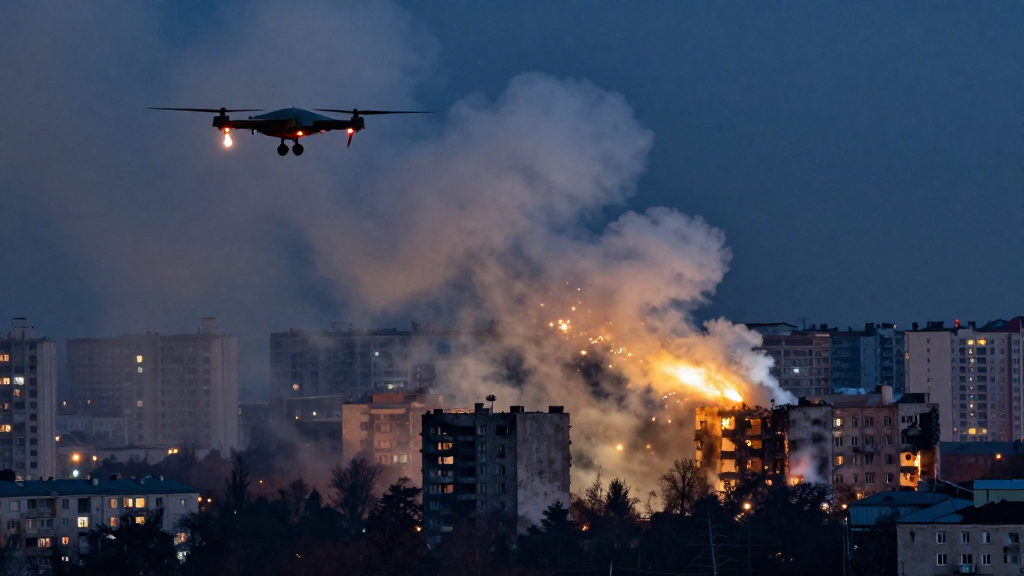
Negotiations aimed at ending the grinding war in Ukraine collapsed Wednesday after Russia launched a fresh wave of drone and missile strikes on Kyiv and three other Ukrainian cities, killing at least 12 civilians and wounding more than 60, according to Ukrainian emergency services.
Strikes Hit Hours After Diplomatic Signals
The assault began shortly after midnight local time, with air defense units intercepting dozens of Iranian-designed Shahed drones over the capital and the surrounding region. Ukraine’s Air Force Command said its units shot down 38 of 52 drones launched from occupied Crimea and Russia’s southern border regions. The remainder struck infrastructure targets in the Kyiv, Sumy, Poltava, and Dnipropetrovsk oblasts.
At least three residential buildings in the Sviatoshyn and Podil districts of Kyiv were damaged. Emergency workers pulled bodies from the rubble of a five-story apartment block in the Darnytsia district throughout the morning. The State Emergency Service said 12 people were confirmed dead and 63 injured. A further four people were reported missing.
Ceasefire Talks End Without Agreement
The strikes came less than 48 hours after Ukrainian President Volodymyr Zelenskyy said negotiations on a potential ceasefire had reached an “extremely difficult” phase. Russian officials denied any formal talks were underway, describing recent diplomatic contacts as “preliminary consultations.” A statement from the Kremlin press service said Russia had “no intention of halting its military operations while Ukraine and its Western sponsors refuse to acknowledge the new territorial realities.”
Mediators from Turkey and Saudi Arabia, who had hosted separate rounds of indirect talks in recent weeks, issued a joint statement expressing “deep concern” at the escalation. “The parties have retreated from previously agreed parameters. We call on both sides to exercise maximum restraint and return to dialogue,” the statement read.
Western Allies React With Condemnation
Western governments swiftly condemned the strikes. U.S. Secretary of State Antony Blinken called the attacks “a deliberate obstruction of peace efforts” and said Washington was consulting with allies on a coordinated response. The White House said no new sanctions packages were imminent but that existing pressure on Russia’s energy and financial sectors would be intensified.
“Russia chose bombs over negotiation tonight. The world has seen this pattern before,” Blinken told reporters at the State Department. Britain’s Foreign Secretary said the strikes represented “the most significant breach of diplomatic good faith since the Minsk process.”
What Happens Next
Ukraine’s parliament voted Wednesday to extend martial law for a further 90 days. The General Staff of the Armed Forces of Ukraine ordered full mobilization of reserve units in five front-line oblasts. Russia’s Defense Ministry, in its daily briefing, said the strikes were “retaliatory measures against military infrastructure sites that were used to plan cross-border incursions into Russian territory.”
Diplomatic sources in Ankara and Riyadh told journalists that a new round of indirect talks could be arranged within two weeks if both sides demonstrate a willingness to halt offensive operations. Whether Russia’s leadership is prepared to accept any binding ceasefire terms remains deeply unclear, according to analysts who track the conflict closely.