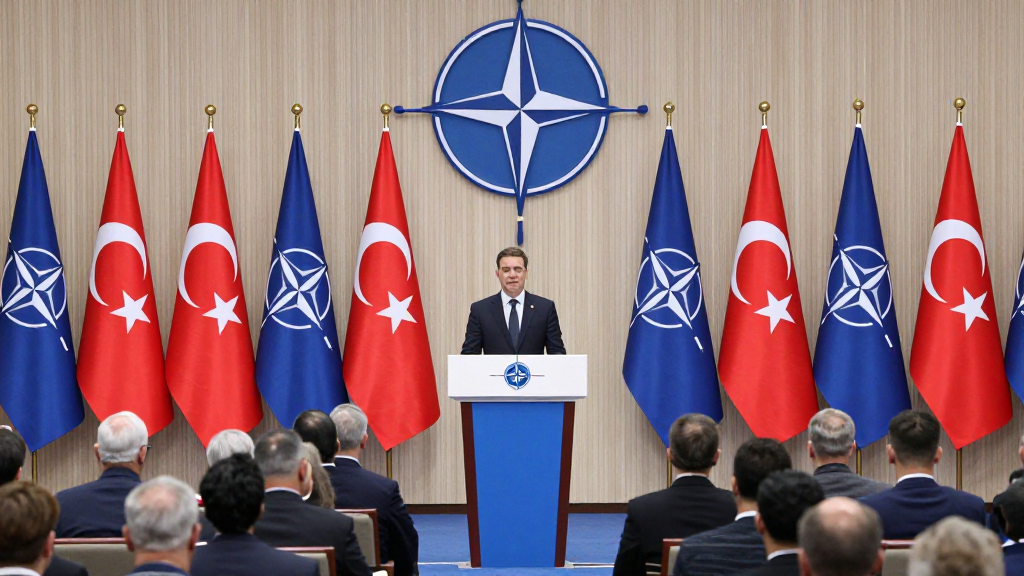
ANKARA, Turkey — World leaders from the 32-member NATO alliance gathered in this Turkish capital on Tuesday for a summit that underscored both the alliance’s renewed ambitions and the persistent strains within the trans-Atlantic partnership, as the United States pressed European members to shoulder a greater share of the continent’s collective defense.
The two-day conference, hosted at a convention center overlooking the city, marked the first time the alliance has convened under the presidency of U.S. President Donald Trump in his second term. NATO Secretary General Mark Rutte framed the gathering as a turning point for the bloc, describing it as the opening chapter of a trans-Atlantic “defense industrial revolution.” “This summit will be the beginning of a trans-Atlantic defense industrial revolution,” Rutte told reporters at a pre-summit briefing last month at the Atlantic Council. “Our allies understand that the security of Europe can no longer be treated as separate from the security of North America.”
Five Percent Pledge Meets Resistance
At Trump’s urging, NATO allies agreed last year to raise their respective defense spending to at least 5 percent of gross domestic product by 2035 — a landmark commitment that would represent roughly a doubling of current European defense budgets. The 2 percent target that NATO members had pledged since 2014 was widely viewed as insufficient by Washington even before the Russia-Ukraine conflict escalated in 2022. The new 5 percent benchmark signals a fundamental shift in how the alliance calculates burden-sharing. According to figures compiled by NATO’s own secretariat, only Poland currently meets the 5 percent threshold. Germany, France, and Britain — the alliance’s three largest European economies — remain well below that mark, though each has announced multi-year plans to increase defense allocations.
European defense ministers acknowledged that meeting the 5 percent target would require difficult trade-offs in domestic spending priorities. “The 5 percent commitment is a political signal as much as a budgetary one,” said one senior European diplomat who spoke on condition of anonymity to discuss internal deliberations. “The real test will be whether governments can sustain these spending increases through election cycles and economic downturns.”
Alliance Cohesion Under Scrutiny
Despite the fanfare surrounding the summit, fissures within the alliance were difficult to conceal. The Pew Research Center released a survey on Monday showing that more than 70 percent of people in Poland, Sweden, Germany, and Hungary hold a favorable view of NATO. Yet approval rates have declined in France, Italy, and notably the United States — where the White House has grown increasingly vocal in its criticism of allies it accuses of free-riding on American security guarantees. “The United States spends more money on NATO than any other country, by far, to protect them, without getting any benefit from so doing,” Trump wrote on Truth Social last week. The post, which drew swift condemnation from European leaders, underscored the transactional tone that has come to define Washington’s approach to the alliance under the current administration.
The summit agenda also reflected deeper divisions over how to address ongoing conflicts in Europe’s neighborhood. Russia’s continued war against Ukraine dominated bilateral meetings on the summit’s sidelines. Ukrainian President Volodymyr Zelensky attended the opening session, urging NATO members to move beyond weapons deliveries and political statements toward a clear pathway toward membership. NATO officials said the alliance would use the summit to announce an expanded training mission and a new tranche of military equipment for Kyiv, though membership discussions remained shelved for the time being.
Strategic Reckoning for the Alliance
NATO analysts said the Ankara summit represented the most consequential gathering of alliance leaders since the 2022 Madrid summit, when Finland and Sweden were invited to join following Russia’s invasion of Ukraine. “What we are witnessing is not simply a budget adjustment,” said Dr. Hannah Beech, a senior fellow at the Royal United Services Institute in London. “It is a fundamental renegotiation of what collective defense means in the twenty-first century. The 5 percent figure is a floor, not a ceiling, and allies know it.”
The summit concluded on Wednesday with the adoption of a joint declaration reaffirming the 5 percent pledge and outlining a new framework for joint weapons procurement. Alliance members also endorsed a revised strategic concept that identifies cyber threats, climate change, and gray-zone aggression as core security challenges alongside conventional military threats. Secretary General Rutte struck a cautiously optimistic note at the closing press conference, saying that NATO had demonstrated its ability to adapt to changing circumstances. “NATO has always been at its best when it has been forced to confront hard truths,” Rutte said. “This summit has done exactly that.”