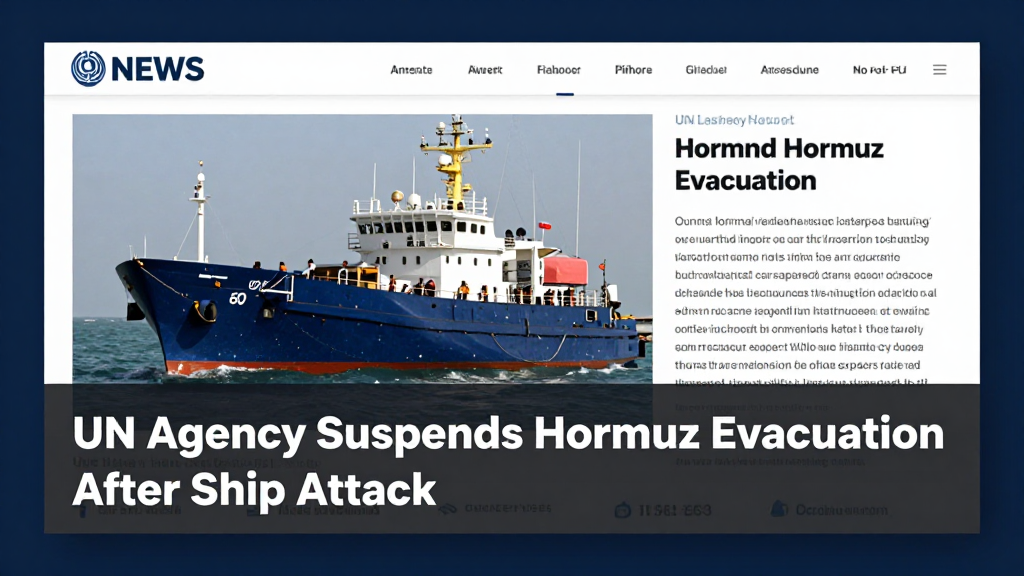
The United Nations International Maritime Organization paused its evacuation effort for stranded vessels and seafarers in the Strait of Hormuz on Thursday after a cargo ship was attacked in the Gulf of Oman, casting fresh doubt on efforts to reopen one of the world’s most critical energy chokepoints. The incident came just days after the IMO began moving approximately 11,000 mariners off roughly 600 ships that had been trapped since the US-Israel war on Iran began on February 28.
The Singapore-flagged container ship Ever Lovely reported a suspected attack on its starboard side by a projectile 14 kilometers southeast of Oman’s port of Dahit, the United Kingdom Maritime Trade Operations agency said. The vessel was not part of the UN evacuation framework. A maritime security source told Reuters that a drone was the likely culprit, though responsibility remained unconfirmed.
IMO Secretary-General Arsenio Dominguez ordered an immediate suspension of the evacuation plan. “I have decided to temporarily pause the implementation of the evacuation plan in order to reconfirm that the necessary safety guarantees continue to be in place for the ships on our evacuation list and all those in the region,” he said in a statement. The IMO had spent days coordinating with both Iranian authorities and a Western-led maritime coalition to secure the two approved transit corridors — one through Iranian waters and one through Omani waters with American oversight.
Iran’s IRGC Intervenes as Tensions Mount
Hours before the attack on the Ever Lovely, Iran’s Islamic Revolutionary Guard Corps ordered two Panama-flagged vessels to change course, according to British maritime security firm Ambrey. The IRGC action underscored the fragility of the arrangement that had allowed limited commercial traffic to resume under the shadow of the ongoing conflict.
Following the incident, Iran’s Persian Gulf Strait Authority warned that vessels transiting outside its designated routes would no longer be covered by guarantees of safe passage. “Consequences arising from passage through unauthorized routes shall be the responsibility of the owner, operator, and vessel commander,” the PGSA said in a statement posted to social media.
MarineTraffic, the ship-tracking firm, recorded 70 verified crossings on Wednesday and 31 on Tuesday — far below the pre-war average of approximately 120 vessels per day. The numbers indicated that even before Thursday’s attack, ship operators were moving with extreme caution through the waterway that carries roughly one-fifth of the world’s oil and a significant portion of global liquefied natural gas shipments.
Diplomatic Fallout and the US-Iran Memorandum
The evacuation suspension arrived against the backdrop of a tentative diplomatic opening. The United States and Iran signed a memorandum of understanding in Switzerland last week, committing both sides to work toward ending the war that began with Israeli strikes on Iranian territory on February 28. As part of that understanding, Iran had eased its blockade of Hormuz enough to allow the IMO’s cautious evacuation pilot to begin.
France and the United Kingdom are leading an international maritime coalition to help reopen the waterway, with Denmark announcing it would join the mission. Oman, whose waters provide one of the two approved transit corridors, warned that the current environment creates an elevated risk of collision and demanded a gradual, controlled approach to any resumed movement.
The attack on the Ever Lovely threatens to undercut confidence in the entire diplomatic architecture built around the MOU. Iran insists it has the right to control transit through waters it considers sovereign, while the United States and its allies maintain that Hormuz is an international waterway subject to customary navigation law. That legal fault line has defined decades of tension over the strait and remains unresolved.
What Comes Next
IMO chief Dominguez said his agency was working to verify whether the safety conditions that enabled the evacuation plan to start still hold. The pause was described as temporary, but the incident has rattled insurers, shipowners, and the navies backing the coalition corridor. Shipping industry officials said the pause could extend for days or longer depending on what the investigation into the Ever Lovely attack concludes.
Around 11,000 seafarers remain aboard the trapped vessels, many of them in increasingly difficult conditions after nearly four months without the ability to rotate crew or receive adequate supplies. The International Transport Workers’ Federation called on all parties to prioritize the safety of mariners caught in the standoff, warning that the human cost of the standoff continues to mount even as diplomats negotiate at the political level.
The next diplomatic checkpoint is expected in Geneva, where US and Iranian officials are scheduled to continue talks on implementing the MOU’s provisions. How they handle the Ever Lovely aftermath — and whether Iran restrains the IRGC from further interference — will be an early test of whether the agreement can survive its first serious shock.